

should occur at temperatures close to the solvent freezing temperature. This discrepancy may partially be attributed to the nonequilibrium effects during freezing
[91]. The concentrated unfrozen polymer solutions at low temperatures have high
viscosities that may slow down the equilibration of solvent and the growth of
solvent crystals to an extent that stops freezing. Moreover, the initial
non-isothermal reaction period may also be responsible for the observed deviation
from theory. We have to mention that T prep is the temperature of the thermostated
bath in which the gelation reactions are carried out. Since the polymerization
initiator (or crosslinker) should be added into the monomer (or polymer) solution
before freezing of the reaction system, the polymerization and crosslinking reactions proceed non-isothermally from the moment of initiator addition to the
moment when the temperature of the reaction system reaches T prep . Therefore,
the time needed for bulk freezing of the reaction system strongly depends on
T prep . For example, aqueous reaction mixtures containing AMPS and BAAm at
T prep ¼ À22
C became frozen within 4–5 min, whereas those at À5
C required
more than 1 h for freezing [36]. Compared to these freezing times, the gelation time
recorded using the falling-ball technique was 5 min at 0
C [36]. Thus, gelation and
gel growth reactions at T prep ¼ À5
C mainly proceed before the onset of bulk
freezing of the system, whereas the reactions at À22
C occur in the unfrozen
microzones. Therefore, variation in the cooling rate depending on T prep may also be
responsible for the appearance of porous structures at temperatures much below the
bulk freezing point of the reaction system. This also suggests that isothermal
gelation could provide formation of cryogels at a temperature close to the freezing
point of the solvent.
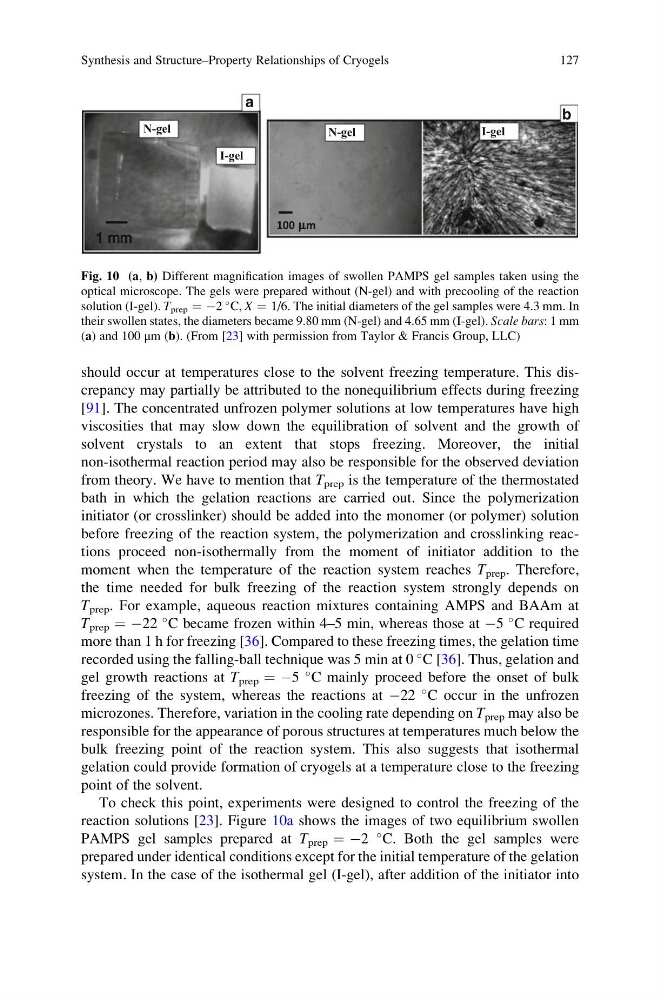
To check this point, experiments were designed to control the freezing of the
reaction solutions [23]. Figure 10a shows the images of two equilibrium swollen
PAMPS gel samples prepared at T prep ¼ À2
C. Both the gel samples were
prepared under identical conditions except for the initial temperature of the gelation
system. In the case of the isothermal gel (I-gel), after addition of the initiator into
a
b
N-gel
N-gel
I-gel
I-gel
1 1 mm
100 μm
Fig. 10 (a, b) Different magnification images of swollen PAMPS gel samples taken using the
optical microscope. The gels were prepared without (N-gel) and with precooling of the reaction
solution (I-gel). T prep ¼ À2
C, X ¼ 1/6. The initial diameters of the gel samples were 4.3 mm. In
their swollen states, the diameters became 9.80 mm (N-gel) and 4.65 mm (I-gel). Scale bars: 1 mm
(a) and 100 μm (b). (From [23] with permission from Taylor & Francis Group, LLC)
Synthesis and Structure–Property Relationships of Cryogels
127
[91]. The concentrated unfrozen polymer solutions at low temperatures have high
viscosities that may slow down the equilibration of solvent and the growth of
solvent crystals to an extent that stops freezing. Moreover, the initial
non-isothermal reaction period may also be responsible for the observed deviation
from theory. We have to mention that T prep is the temperature of the thermostated
bath in which the gelation reactions are carried out. Since the polymerization
initiator (or crosslinker) should be added into the monomer (or polymer) solution
before freezing of the reaction system, the polymerization and crosslinking reactions proceed non-isothermally from the moment of initiator addition to the
moment when the temperature of the reaction system reaches T prep . Therefore,
the time needed for bulk freezing of the reaction system strongly depends on
T prep . For example, aqueous reaction mixtures containing AMPS and BAAm at
T prep ¼ À22
C became frozen within 4–5 min, whereas those at À5
C required
more than 1 h for freezing [36]. Compared to these freezing times, the gelation time
recorded using the falling-ball technique was 5 min at 0
C [36]. Thus, gelation and
gel growth reactions at T prep ¼ À5
C mainly proceed before the onset of bulk
freezing of the system, whereas the reactions at À22
C occur in the unfrozen
microzones. Therefore, variation in the cooling rate depending on T prep may also be
responsible for the appearance of porous structures at temperatures much below the
bulk freezing point of the reaction system. This also suggests that isothermal
gelation could provide formation of cryogels at a temperature close to the freezing
point of the solvent.
To check this point, experiments were designed to control the freezing of the
reaction solutions [23]. Figure 10a shows the images of two equilibrium swollen
PAMPS gel samples prepared at T prep ¼ À2
C. Both the gel samples were
prepared under identical conditions except for the initial temperature of the gelation
system. In the case of the isothermal gel (I-gel), after addition of the initiator into
a
b
N-gel
N-gel
I-gel
I-gel
1 1 mm
100 μm
Fig. 10 (a, b) Different magnification images of swollen PAMPS gel samples taken using the
optical microscope. The gels were prepared without (N-gel) and with precooling of the reaction
solution (I-gel). T prep ¼ À2
C, X ¼ 1/6. The initial diameters of the gel samples were 4.3 mm. In
their swollen states, the diameters became 9.80 mm (N-gel) and 4.65 mm (I-gel). Scale bars: 1 mm
(a) and 100 μm (b). (From [23] with permission from Taylor & Francis Group, LLC)
Synthesis and Structure–Property Relationships of Cryogels
127