

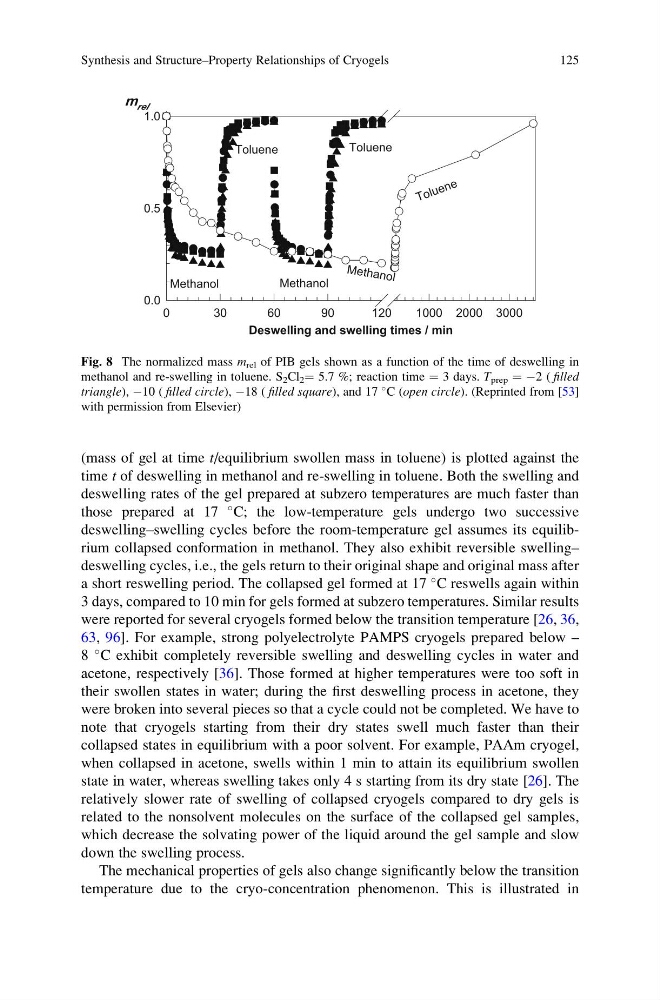
(mass of gel at time t/equilibrium swollen mass in toluene) is plotted against the
time t of deswelling in methanol and re-swelling in toluene. Both the swelling and
deswelling rates of the gel prepared at subzero temperatures are much faster than
those prepared at 17
C; the low-temperature gels undergo two successive
deswelling–swelling cycles before the room-temperature gel assumes its equilibrium collapsed conformation in methanol. They also exhibit reversible swelling–
deswelling cycles, i.e., the gels return to their original shape and original mass after
a short reswelling period. The collapsed gel formed at 17
C reswells again within
3 days, compared to 10 min for gels formed at subzero temperatures. Similar results
were reported for several cryogels formed below the transition temperature [26, 36,
63, 96]. For example, strong polyelectrolyte PAMPS cryogels prepared below –
8
C exhibit completely reversible swelling and deswelling cycles in water and
acetone, respectively [36]. Those formed at higher temperatures were too soft in
their swollen states in water; during the first deswelling process in acetone, they
were broken into several pieces so that a cycle could not be completed. We have to
note that cryogels starting from their dry states swell much faster than their
collapsed states in equilibrium with a poor solvent. For example, PAAm cryogel,
when collapsed in acetone, swells within 1 min to attain its equilibrium swollen
state in water, whereas swelling takes only 4 s starting from its dry state [26]. The
relatively slower rate of swelling of collapsed cryogels compared to dry gels is
related to the nonsolvent molecules on the surface of the collapsed gel samples,
which decrease the solvating power of the liquid around the gel sample and slow
down the swelling process.
The mechanical properties of gels also change significantly below the transition
temperature due to the cryo-concentration phenomenon. This is illustrated in
Deswelling and swelling times / min
0
30
60
90
120
1000 2000 3000
m rel
0.0
0.5
1.0
Methanol
Toluene
Methanol
Toluene
M et ha no l
T o lu e n e
Fig. 8 The normalized mass m rel of PIB gels shown as a function of the time of deswelling in
methanol and re-swelling in toluene. S 2 Cl 2 ¼ 5.7 %; reaction time ¼ 3 days. T prep ¼ À2 ( filled
triangle), À10 ( filled circle), À18 ( filled square), and 17
C (open circle). (Reprinted from [53]
with permission from Elsevier)
Synthesis and Structure–Property Relationships of Cryogels
125
time t of deswelling in methanol and re-swelling in toluene. Both the swelling and
deswelling rates of the gel prepared at subzero temperatures are much faster than
those prepared at 17
C; the low-temperature gels undergo two successive
deswelling–swelling cycles before the room-temperature gel assumes its equilibrium collapsed conformation in methanol. They also exhibit reversible swelling–
deswelling cycles, i.e., the gels return to their original shape and original mass after
a short reswelling period. The collapsed gel formed at 17
C reswells again within
3 days, compared to 10 min for gels formed at subzero temperatures. Similar results
were reported for several cryogels formed below the transition temperature [26, 36,
63, 96]. For example, strong polyelectrolyte PAMPS cryogels prepared below –
8
C exhibit completely reversible swelling and deswelling cycles in water and
acetone, respectively [36]. Those formed at higher temperatures were too soft in
their swollen states in water; during the first deswelling process in acetone, they
were broken into several pieces so that a cycle could not be completed. We have to
note that cryogels starting from their dry states swell much faster than their
collapsed states in equilibrium with a poor solvent. For example, PAAm cryogel,
when collapsed in acetone, swells within 1 min to attain its equilibrium swollen
state in water, whereas swelling takes only 4 s starting from its dry state [26]. The
relatively slower rate of swelling of collapsed cryogels compared to dry gels is
related to the nonsolvent molecules on the surface of the collapsed gel samples,
which decrease the solvating power of the liquid around the gel sample and slow
down the swelling process.
The mechanical properties of gels also change significantly below the transition
temperature due to the cryo-concentration phenomenon. This is illustrated in
Deswelling and swelling times / min
0
30
60
90
120
1000 2000 3000
m rel
0.0
0.5
1.0
Methanol
Toluene
Methanol
Toluene
M et ha no l
T o lu e n e
Fig. 8 The normalized mass m rel of PIB gels shown as a function of the time of deswelling in
methanol and re-swelling in toluene. S 2 Cl 2 ¼ 5.7 %; reaction time ¼ 3 days. T prep ¼ À2 ( filled
triangle), À10 ( filled circle), À18 ( filled square), and 17
C (open circle). (Reprinted from [53]
with permission from Elsevier)
Synthesis and Structure–Property Relationships of Cryogels
125