

where D and D dry are the gel diameters in equilibrium swollen and dry states,
respectively, and m is the weight of equilibrium swollen gel. During the cryogel
swelling process, the pores inside the cryogel network are rapidly filled with the
solvent; at the same time, the network region making up the pore walls of the
cryogel takes up solvent from the environment by diffusion process. Therefore, the
swelling of cryogels is governed by two separate processes: (1) solvation (swelling)
of the pore walls and (2) filling of the pores by the solvent.
The equilibrium weight swelling ratio q w includes the amount of solvent taken
up by both of these processes. By contrast, if we assume isotropic swelling (i.e., the
volume of the pores remains constant upon swelling), the volume swelling ratio q v
of cryogels is caused by solvation of the pore walls, i.e., by the first process. Thus,
q v only includes the amount of solvent taken up by the gel portion of the cryogel
network. Accordingly, the higher the difference between q w and q v , the higher is the
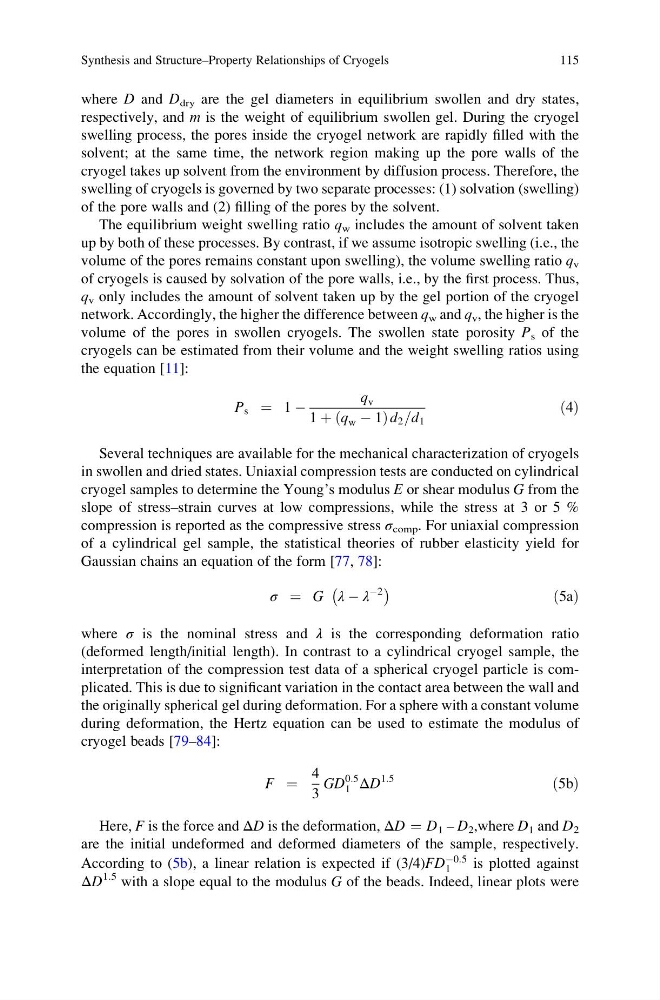
volume of the pores in swollen cryogels. The swollen state porosity P s of the
cryogels can be estimated from their volume and the weight swelling ratios using
the equation [11]:
P s ¼ 1 À
q v
1 þ q w À 1
ð
Þd 2 =d 1
ð4Þ
Several techniques are available for the mechanical characterization of cryogels
in swollen and dried states. Uniaxial compression tests are conducted on cylindrical
cryogel samples to determine the Young’s modulus E or shear modulus G from the
slope of stress–strain curves at low compressions, while the stress at 3 or 5 %
compression is reported as the compressive stress σ comp . For uniaxial compression
of a cylindrical gel sample, the statistical theories of rubber elasticity yield for
Gaussian chains an equation of the form [77, 78]:
σ ¼ G λ À λ
À2
À
Á
ð5aÞ
where σ is the nominal stress and λ is the corresponding deformation ratio
(deformed length/initial length). In contrast to a cylindrical cryogel sample, the
interpretation of the compression test data of a spherical cryogel particle is complicated. This is due to significant variation in the contact area between the wall and
the originally spherical gel during deformation. For a sphere with a constant volume
during deformation, the Hertz equation can be used to estimate the modulus of
cryogel beads [79–84]:
F ¼
4
3
GD
0:5
1 ΔD
1:5
ð5bÞ
Here, F is the force and ΔD is the deformation, ΔD ¼ D 1 – D 2 ,where D 1 and D 2
are the initial undeformed and deformed diameters of the sample, respectively.
According to (5b), a linear relation is expected if (3/4)FD
À0:5
1
is plotted against
ΔD
1.5 with a slope equal to the modulus G of the beads. Indeed, linear plots were
Synthesis and Structure–Property Relationships of Cryogels
115
respectively, and m is the weight of equilibrium swollen gel. During the cryogel
swelling process, the pores inside the cryogel network are rapidly filled with the
solvent; at the same time, the network region making up the pore walls of the
cryogel takes up solvent from the environment by diffusion process. Therefore, the
swelling of cryogels is governed by two separate processes: (1) solvation (swelling)
of the pore walls and (2) filling of the pores by the solvent.
The equilibrium weight swelling ratio q w includes the amount of solvent taken
up by both of these processes. By contrast, if we assume isotropic swelling (i.e., the
volume of the pores remains constant upon swelling), the volume swelling ratio q v
of cryogels is caused by solvation of the pore walls, i.e., by the first process. Thus,
q v only includes the amount of solvent taken up by the gel portion of the cryogel
network. Accordingly, the higher the difference between q w and q v , the higher is the
volume of the pores in swollen cryogels. The swollen state porosity P s of the
cryogels can be estimated from their volume and the weight swelling ratios using
the equation [11]:
P s ¼ 1 À
q v
1 þ q w À 1
ð
Þd 2 =d 1
ð4Þ
Several techniques are available for the mechanical characterization of cryogels
in swollen and dried states. Uniaxial compression tests are conducted on cylindrical
cryogel samples to determine the Young’s modulus E or shear modulus G from the
slope of stress–strain curves at low compressions, while the stress at 3 or 5 %
compression is reported as the compressive stress σ comp . For uniaxial compression
of a cylindrical gel sample, the statistical theories of rubber elasticity yield for
Gaussian chains an equation of the form [77, 78]:
σ ¼ G λ À λ
À2
À
Á
ð5aÞ
where σ is the nominal stress and λ is the corresponding deformation ratio
(deformed length/initial length). In contrast to a cylindrical cryogel sample, the
interpretation of the compression test data of a spherical cryogel particle is complicated. This is due to significant variation in the contact area between the wall and
the originally spherical gel during deformation. For a sphere with a constant volume
during deformation, the Hertz equation can be used to estimate the modulus of
cryogel beads [79–84]:
F ¼
4
3
GD
0:5
1 ΔD
1:5
ð5bÞ
Here, F is the force and ΔD is the deformation, ΔD ¼ D 1 – D 2 ,where D 1 and D 2
are the initial undeformed and deformed diameters of the sample, respectively.
According to (5b), a linear relation is expected if (3/4)FD
À0:5
1
is plotted against
ΔD
1.5 with a slope equal to the modulus G of the beads. Indeed, linear plots were
Synthesis and Structure–Property Relationships of Cryogels
115