

Although techniques such as optical microscopy, environmental scanning electron
microscopy (ESEM), and confocal laser scanning microscopy (CLSM) can be used
for the morphological characterization of cryogels in their swollen states, they do
not lead to sufficient resolution to reveal the fine structure of cryogels. Due to the
compressibility of gels under high pressure, other techniques such as mercury
intrusion porosimetry and gas adsorption/desorption are not suitable for porestructure characterization and can only be applied to dry materials. SEM is a
suitable technique for characterizing the fine structure of cryogels; however, it
also requires drying of the gel samples, which might result in structural changes.
Nevertheless, it is assumed that freeze-drying and the sample preparation do not
result in alteration of the pore structures due to the formation of dense pore walls
during cryo-concentration. Therefore, SEM has been generally used to visualize the
morphology and calculate the average pore size of cryogels. Moreover, the flowthrough characteristics of cryogels in the form of blocks or beads can also be used to
estimate their pore sizes and morphologies. More details about other characterization techniques used for cryogels can be found in recent reviews by Gun’ko and
Savina [75, 76].
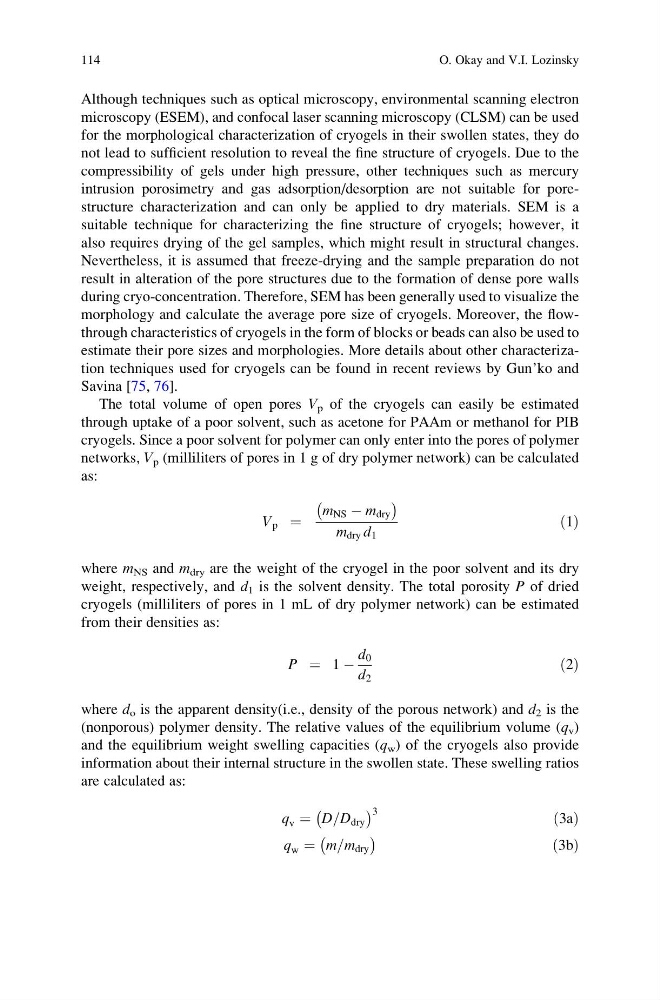
The total volume of open pores V p of the cryogels can easily be estimated
through uptake of a poor solvent, such as acetone for PAAm or methanol for PIB
cryogels. Since a poor solvent for polymer can only enter into the pores of polymer
networks, V p (milliliters of pores in 1 g of dry polymer network) can be calculated
as:
V p ¼
m NS À m dry
À
Á
m dry d 1
ð1Þ
where m NS and m dry are the weight of the cryogel in the poor solvent and its dry
weight, respectively, and d 1 is the solvent density. The total porosity P of dried
cryogels (milliliters of pores in 1 mL of dry polymer network) can be estimated
from their densities as:
P ¼ 1 À
d 0
d 2
ð2Þ
where d o is the apparent density(i.e., density of the porous network) and d 2 is the
(nonporous) polymer density. The relative values of the equilibrium volume (q v )
and the equilibrium weight swelling capacities (q w ) of the cryogels also provide
information about their internal structure in the swollen state. These swelling ratios
are calculated as:
q v ¼ D=D dry
À
Á 3
ð3aÞ
q w ¼ m=m dry
À
Á
ð3bÞ
114
O. Okay and V.I. Lozinsky
microscopy (ESEM), and confocal laser scanning microscopy (CLSM) can be used
for the morphological characterization of cryogels in their swollen states, they do
not lead to sufficient resolution to reveal the fine structure of cryogels. Due to the
compressibility of gels under high pressure, other techniques such as mercury
intrusion porosimetry and gas adsorption/desorption are not suitable for porestructure characterization and can only be applied to dry materials. SEM is a
suitable technique for characterizing the fine structure of cryogels; however, it
also requires drying of the gel samples, which might result in structural changes.
Nevertheless, it is assumed that freeze-drying and the sample preparation do not
result in alteration of the pore structures due to the formation of dense pore walls
during cryo-concentration. Therefore, SEM has been generally used to visualize the
morphology and calculate the average pore size of cryogels. Moreover, the flowthrough characteristics of cryogels in the form of blocks or beads can also be used to
estimate their pore sizes and morphologies. More details about other characterization techniques used for cryogels can be found in recent reviews by Gun’ko and
Savina [75, 76].
The total volume of open pores V p of the cryogels can easily be estimated
through uptake of a poor solvent, such as acetone for PAAm or methanol for PIB
cryogels. Since a poor solvent for polymer can only enter into the pores of polymer
networks, V p (milliliters of pores in 1 g of dry polymer network) can be calculated
as:
V p ¼
m NS À m dry
À
Á
m dry d 1
ð1Þ
where m NS and m dry are the weight of the cryogel in the poor solvent and its dry
weight, respectively, and d 1 is the solvent density. The total porosity P of dried
cryogels (milliliters of pores in 1 mL of dry polymer network) can be estimated
from their densities as:
P ¼ 1 À
d 0
d 2
ð2Þ
where d o is the apparent density(i.e., density of the porous network) and d 2 is the
(nonporous) polymer density. The relative values of the equilibrium volume (q v )
and the equilibrium weight swelling capacities (q w ) of the cryogels also provide
information about their internal structure in the swollen state. These swelling ratios
are calculated as:
q v ¼ D=D dry
À
Á 3
ð3aÞ
q w ¼ m=m dry
À
Á
ð3bÞ
114
O. Okay and V.I. Lozinsky