

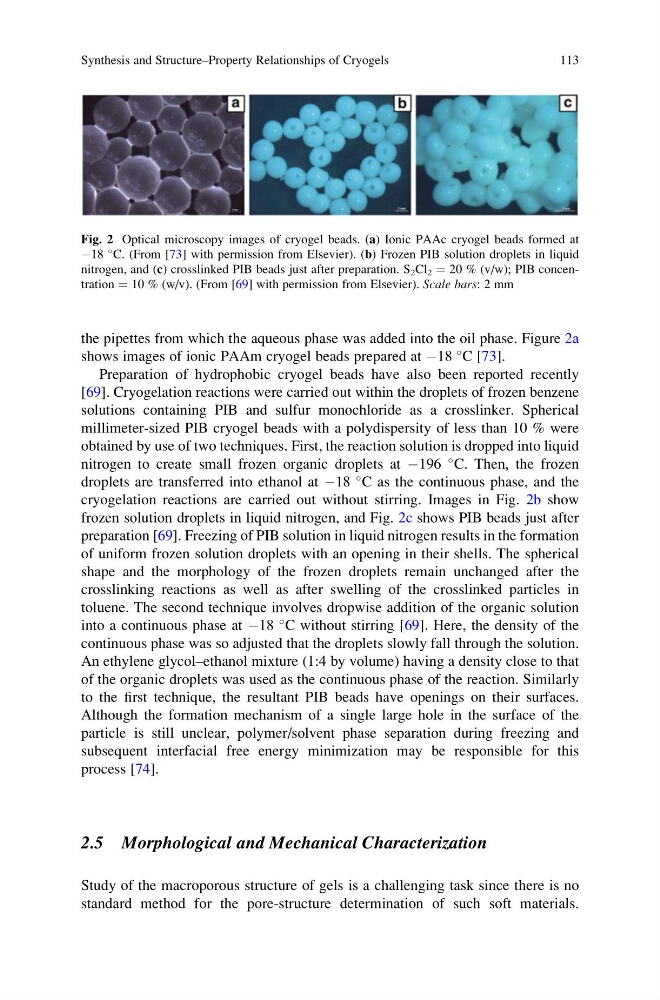
the pipettes from which the aqueous phase was added into the oil phase. Figure 2a
shows images of ionic PAAm cryogel beads prepared at À18
C [73].
Preparation of hydrophobic cryogel beads have also been reported recently
[69]. Cryogelation reactions were carried out within the droplets of frozen benzene
solutions containing PIB and sulfur monochloride as a crosslinker. Spherical
millimeter-sized PIB cryogel beads with a polydispersity of less than 10 % were
obtained by use of two techniques. First, the reaction solution is dropped into liquid
nitrogen to create small frozen organic droplets at À196
C. Then, the frozen
droplets are transferred into ethanol at À18
C as the continuous phase, and the
cryogelation reactions are carried out without stirring. Images in Fig. 2b show
frozen solution droplets in liquid nitrogen, and Fig. 2c shows PIB beads just after
preparation [69]. Freezing of PIB solution in liquid nitrogen results in the formation
of uniform frozen solution droplets with an opening in their shells. The spherical
shape and the morphology of the frozen droplets remain unchanged after the
crosslinking reactions as well as after swelling of the crosslinked particles in
toluene. The second technique involves dropwise addition of the organic solution
into a continuous phase at À18
C without stirring [69]. Here, the density of the
continuous phase was so adjusted that the droplets slowly fall through the solution.
An ethylene glycol–ethanol mixture (1:4 by volume) having a density close to that
of the organic droplets was used as the continuous phase of the reaction. Similarly
to the first technique, the resultant PIB beads have openings on their surfaces.
Although the formation mechanism of a single large hole in the surface of the
particle is still unclear, polymer/solvent phase separation during freezing and
subsequent interfacial free energy minimization may be responsible for this
process [74].
2.5 Morphological and Mechanical Characterization
Study of the macroporous structure of gels is a challenging task since there is no
standard method for the pore-structure determination of such soft materials.
Fig. 2 Optical microscopy images of cryogel beads. (a) Ionic PAAc cryogel beads formed at
À18
C. (From [73] with permission from Elsevier). (b) Frozen PIB solution droplets in liquid
nitrogen, and (c) crosslinked PIB beads just after preparation. S 2 Cl 2 ¼ 20 % (v/w); PIB concentration ¼ 10 % (w/v). (From [69] with permission from Elsevier). Scale bars: 2 mm
Synthesis and Structure–Property Relationships of Cryogels
113
shows images of ionic PAAm cryogel beads prepared at À18
C [73].
Preparation of hydrophobic cryogel beads have also been reported recently
[69]. Cryogelation reactions were carried out within the droplets of frozen benzene
solutions containing PIB and sulfur monochloride as a crosslinker. Spherical
millimeter-sized PIB cryogel beads with a polydispersity of less than 10 % were
obtained by use of two techniques. First, the reaction solution is dropped into liquid
nitrogen to create small frozen organic droplets at À196
C. Then, the frozen
droplets are transferred into ethanol at À18
C as the continuous phase, and the
cryogelation reactions are carried out without stirring. Images in Fig. 2b show
frozen solution droplets in liquid nitrogen, and Fig. 2c shows PIB beads just after
preparation [69]. Freezing of PIB solution in liquid nitrogen results in the formation
of uniform frozen solution droplets with an opening in their shells. The spherical
shape and the morphology of the frozen droplets remain unchanged after the
crosslinking reactions as well as after swelling of the crosslinked particles in
toluene. The second technique involves dropwise addition of the organic solution
into a continuous phase at À18
C without stirring [69]. Here, the density of the
continuous phase was so adjusted that the droplets slowly fall through the solution.
An ethylene glycol–ethanol mixture (1:4 by volume) having a density close to that
of the organic droplets was used as the continuous phase of the reaction. Similarly
to the first technique, the resultant PIB beads have openings on their surfaces.
Although the formation mechanism of a single large hole in the surface of the
particle is still unclear, polymer/solvent phase separation during freezing and
subsequent interfacial free energy minimization may be responsible for this
process [74].
2.5 Morphological and Mechanical Characterization
Study of the macroporous structure of gels is a challenging task since there is no
standard method for the pore-structure determination of such soft materials.
Fig. 2 Optical microscopy images of cryogel beads. (a) Ionic PAAc cryogel beads formed at
À18
C. (From [73] with permission from Elsevier). (b) Frozen PIB solution droplets in liquid
nitrogen, and (c) crosslinked PIB beads just after preparation. S 2 Cl 2 ¼ 20 % (v/w); PIB concentration ¼ 10 % (w/v). (From [69] with permission from Elsevier). Scale bars: 2 mm
Synthesis and Structure–Property Relationships of Cryogels
113