

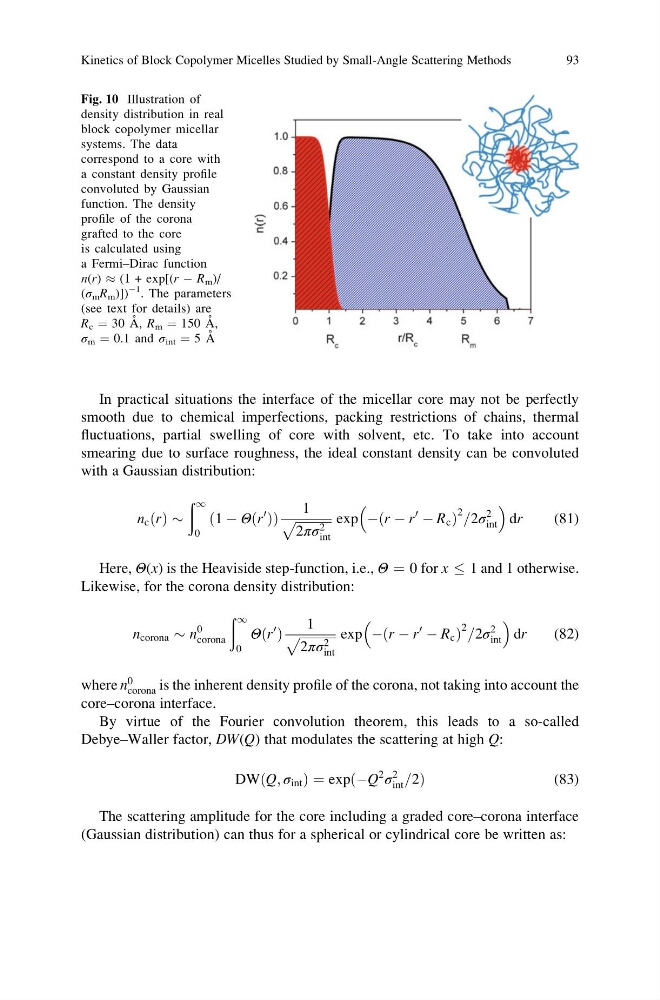
In practical situations the interface of the micellar core may not be perfectly
smooth due to chemical imperfections, packing restrictions of chains, thermal
fluctuations, partial swelling of core with solvent, etc. To take into account
smearing due to surface roughness, the ideal constant density can be convoluted
with a Gaussian distribution:
n c ðrÞ $
ð 1
0
1 À Θðr
0
Þ
ð
Þ
1
ffiffiffiffiffiffiffiffiffiffiffi ffi
2πσ 2
int
p
exp Àðr À r
0
À R c Þ
2 =2σ
2
int
dr
(81)
Here, Θ(x) is the Heaviside step-function, i.e., Θ ¼ 0 for x 1 and 1 otherwise.
Likewise, for the corona density distribution:
n corona $ n
0
corona
ð 1
0
Θðr
0
Þ
1
ffiffiffiffiffiffiffiffiffiffiffi ffi
2πσ 2
int
p
exp Àðr À r
0
À R c Þ
2 =2σ
2
int
dr
(82)
where n
0
corona is the inherent density profile of the corona, not taking into account the
core–corona interface.
By virtue of the Fourier convolution theorem, this leads to a so-called
Debye–Waller factor, DW(Q) that modulates the scattering at high Q:
DWðQ; σ int Þ ¼ expðÀQ
2
σ
2
int =2Þ
(83)
The scattering amplitude for the core including a graded core–corona interface
(Gaussian distribution) can thus for a spherical or cylindrical core be written as:
Fig. 10 Illustration of
density distribution in real
block copolymer micellar
systems. The data
correspond to a core with
a constant density profile
convoluted by Gaussian
function. The density
profile of the corona
grafted to the core
is calculated using
a Fermi–Dirac function
n(r) % (1 + exp[(r À R m )/
(σ m R m )])
À1 . The parameters
(see text for details) are
R c ¼ 30 A ˚ , R m ¼ 150 A ˚ ,
σ m ¼ 0.1 and σ int ¼ 5 A ˚
Kinetics of Block Copolymer Micelles Studied by Small-Angle Scattering Methods
93
smooth due to chemical imperfections, packing restrictions of chains, thermal
fluctuations, partial swelling of core with solvent, etc. To take into account
smearing due to surface roughness, the ideal constant density can be convoluted
with a Gaussian distribution:
n c ðrÞ $
ð 1
0
1 À Θðr
0
Þ
ð
Þ
1
ffiffiffiffiffiffiffiffiffiffiffi ffi
2πσ 2
int
p
exp Àðr À r
0
À R c Þ
2 =2σ
2
int
dr
(81)
Here, Θ(x) is the Heaviside step-function, i.e., Θ ¼ 0 for x 1 and 1 otherwise.
Likewise, for the corona density distribution:
n corona $ n
0
corona
ð 1
0
Θðr
0
Þ
1
ffiffiffiffiffiffiffiffiffiffiffi ffi
2πσ 2
int
p
exp Àðr À r
0
À R c Þ
2 =2σ
2
int
dr
(82)
where n
0
corona is the inherent density profile of the corona, not taking into account the
core–corona interface.
By virtue of the Fourier convolution theorem, this leads to a so-called
Debye–Waller factor, DW(Q) that modulates the scattering at high Q:
DWðQ; σ int Þ ¼ expðÀQ
2
σ
2
int =2Þ
(83)
The scattering amplitude for the core including a graded core–corona interface
(Gaussian distribution) can thus for a spherical or cylindrical core be written as:
Fig. 10 Illustration of
density distribution in real
block copolymer micellar
systems. The data
correspond to a core with
a constant density profile
convoluted by Gaussian
function. The density
profile of the corona
grafted to the core
is calculated using
a Fermi–Dirac function
n(r) % (1 + exp[(r À R m )/
(σ m R m )])
À1 . The parameters
(see text for details) are
R c ¼ 30 A ˚ , R m ¼ 150 A ˚ ,
σ m ¼ 0.1 and σ int ¼ 5 A ˚
Kinetics of Block Copolymer Micelles Studied by Small-Angle Scattering Methods
93