

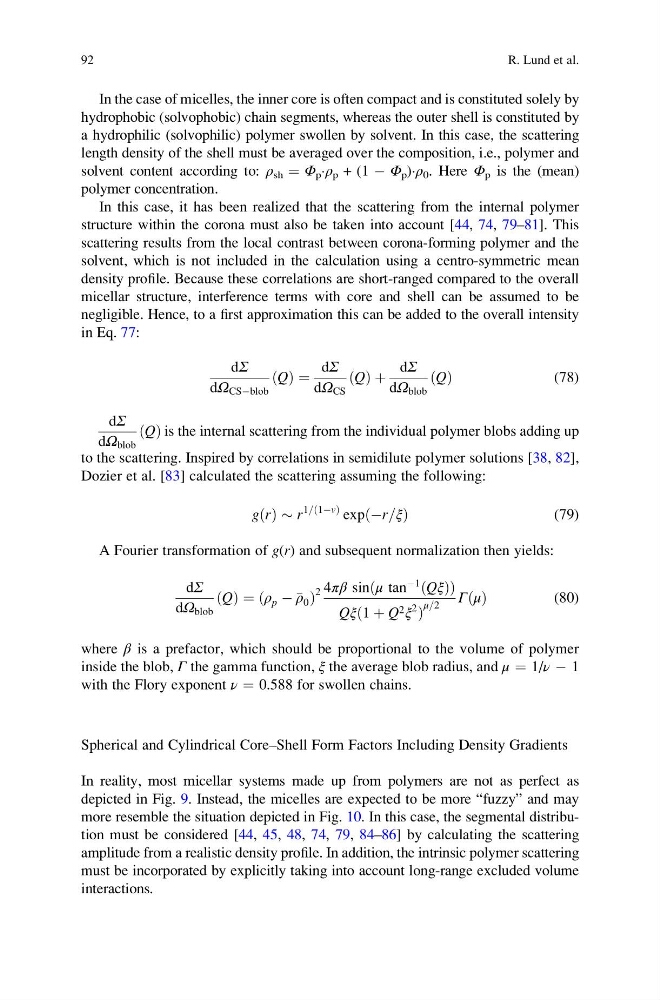
In the case of micelles, the inner core is often compact and is constituted solely by
hydrophobic (solvophobic) chain segments, whereas the outer shell is constituted by
a hydrophilic (solvophilic) polymer swollen by solvent. In this case, the scattering
length density of the shell must be averaged over the composition, i.e., polymer and
solvent content according to: ρ sh ¼ Φ p Áρ p + (1 À Φ p )Áρ 0 . Here Φ p is the (mean)
polymer concentration.
In this case, it has been realized that the scattering from the internal polymer
structure within the corona must also be taken into account [44, 74, 79–81]. This
scattering results from the local contrast between corona-forming polymer and the
solvent, which is not included in the calculation using a centro-symmetric mean
density profile. Because these correlations are short-ranged compared to the overall
micellar structure, interference terms with core and shell can be assumed to be
negligible. Hence, to a first approximation this can be added to the overall intensity
in Eq. 77:
dΣ
dΩ CSÀblob
ðQÞ ¼
dΣ
dΩ CS
ðQÞ þ
dΣ
dΩ blob
ðQÞ
(78)
dΣ
dΩ blob
ðQÞ is the internal scattering from the individual polymer blobs adding up
to the scattering. Inspired by correlations in semidilute polymer solutions [38, 82],
Dozier et al. [83] calculated the scattering assuming the following:
gðrÞ $ r
1=ð1ÀvÞ expðÀr=ξÞ
(79)
A Fourier transformation of g(r) and subsequent normalization then yields:
dΣ
dΩ blob
ðQÞ ¼ ðρ p À ρ 0 Þ
2 4πβ sin μ tan
À1
ðQξÞ
ð
Þ
Qξð1 þ Q 2 ξ
2
Þ
μ=2
ΓðμÞ
(80)
where β is a prefactor, which should be proportional to the volume of polymer
inside the blob, Γ the gamma function, ξ the average blob radius, and μ ¼ 1/ν À 1
with the Flory exponent ν ¼ 0.588 for swollen chains.
Spherical and Cylindrical Core–Shell Form Factors Including Density Gradients
In reality, most micellar systems made up from polymers are not as perfect as
depicted in Fig. 9. Instead, the micelles are expected to be more “fuzzy” and may
more resemble the situation depicted in Fig. 10. In this case, the segmental distribution must be considered [44, 45, 48, 74, 79, 84–86] by calculating the scattering
amplitude from a realistic density profile. In addition, the intrinsic polymer scattering
must be incorporated by explicitly taking into account long-range excluded volume
interactions.
92
R. Lund et al.
hydrophobic (solvophobic) chain segments, whereas the outer shell is constituted by
a hydrophilic (solvophilic) polymer swollen by solvent. In this case, the scattering
length density of the shell must be averaged over the composition, i.e., polymer and
solvent content according to: ρ sh ¼ Φ p Áρ p + (1 À Φ p )Áρ 0 . Here Φ p is the (mean)
polymer concentration.
In this case, it has been realized that the scattering from the internal polymer
structure within the corona must also be taken into account [44, 74, 79–81]. This
scattering results from the local contrast between corona-forming polymer and the
solvent, which is not included in the calculation using a centro-symmetric mean
density profile. Because these correlations are short-ranged compared to the overall
micellar structure, interference terms with core and shell can be assumed to be
negligible. Hence, to a first approximation this can be added to the overall intensity
in Eq. 77:
dΣ
dΩ CSÀblob
ðQÞ ¼
dΣ
dΩ CS
ðQÞ þ
dΣ
dΩ blob
ðQÞ
(78)
dΣ
dΩ blob
ðQÞ is the internal scattering from the individual polymer blobs adding up
to the scattering. Inspired by correlations in semidilute polymer solutions [38, 82],
Dozier et al. [83] calculated the scattering assuming the following:
gðrÞ $ r
1=ð1ÀvÞ expðÀr=ξÞ
(79)
A Fourier transformation of g(r) and subsequent normalization then yields:
dΣ
dΩ blob
ðQÞ ¼ ðρ p À ρ 0 Þ
2 4πβ sin μ tan
À1
ðQξÞ
ð
Þ
Qξð1 þ Q 2 ξ
2
Þ
μ=2
ΓðμÞ
(80)
where β is a prefactor, which should be proportional to the volume of polymer
inside the blob, Γ the gamma function, ξ the average blob radius, and μ ¼ 1/ν À 1
with the Flory exponent ν ¼ 0.588 for swollen chains.
Spherical and Cylindrical Core–Shell Form Factors Including Density Gradients
In reality, most micellar systems made up from polymers are not as perfect as
depicted in Fig. 9. Instead, the micelles are expected to be more “fuzzy” and may
more resemble the situation depicted in Fig. 10. In this case, the segmental distribution must be considered [44, 45, 48, 74, 79, 84–86] by calculating the scattering
amplitude from a realistic density profile. In addition, the intrinsic polymer scattering
must be incorporated by explicitly taking into account long-range excluded volume
interactions.
92
R. Lund et al.