

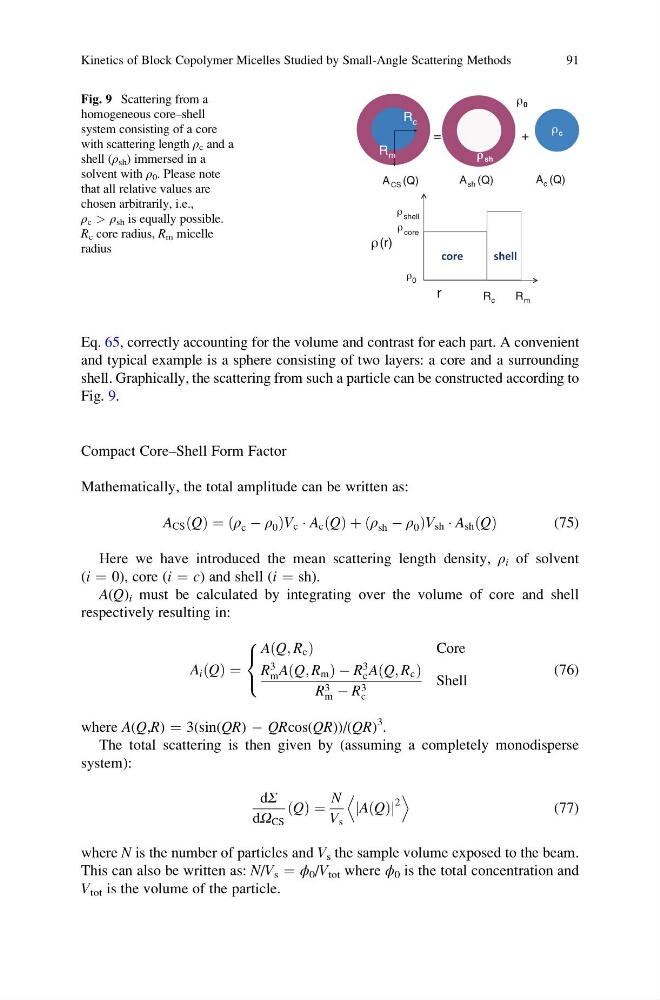
Eq. 65, correctly accounting for the volume and contrast for each part. A convenient
and typical example is a sphere consisting of two layers: a core and a surrounding
shell. Graphically, the scattering from such a particle can be constructed according to
Fig. 9.
Compact Core–Shell Form Factor
Mathematically, the total amplitude can be written as:
A CS ðQÞ ¼ ðρ c À ρ 0 ÞV c Á A c ðQÞ þ ðρ sh À ρ 0 ÞV sh Á A sh ðQÞ
(75)
Here we have introduced the mean scattering length density, ρ i of solvent
(i ¼ 0), core (i ¼ c) and shell (i ¼ sh).
A(Q) i must be calculated by integrating over the volume of core and shell
respectively resulting in:
A i ðQÞ ¼
AðQ; R c Þ
Core
R
3
m AðQ; R m Þ À R
3
c AðQ; R c Þ
R 3
m À R 3
c
Shell
8
<
:
(76)
where A(Q,R) ¼ 3(sin(QR) À QRcos(QR))/(QR)
3 .
The total scattering is then given by (assuming a completely monodisperse
system):
dΣ
dΩ CS
ðQÞ ¼
N
V s
AðQÞ
j
j
2
D
E
(77)
where N is the number of particles and V s the sample volume exposed to the beam.
This can also be written as: N/V s ¼ ϕ 0 /V tot where ϕ 0 is the total concentration and
V tot is the volume of the particle.
=
+
A CS (Q)
A sh (Q)
A c (Q)
R c
R m
sh
c
0
(r)
core
0
shell
R m
r
R c
Fig. 9 Scattering from a
homogeneous core–shell
system consisting of a core
with scattering length ρ c and a
shell (ρ sh ) immersed in a
solvent with ρ 0 . Please note
that all relative values are
chosen arbitrarily, i.e.,
ρ c > ρ sh is equally possible.
R c core radius, R m micelle
radius
Kinetics of Block Copolymer Micelles Studied by Small-Angle Scattering Methods
91
and typical example is a sphere consisting of two layers: a core and a surrounding
shell. Graphically, the scattering from such a particle can be constructed according to
Fig. 9.
Compact Core–Shell Form Factor
Mathematically, the total amplitude can be written as:
A CS ðQÞ ¼ ðρ c À ρ 0 ÞV c Á A c ðQÞ þ ðρ sh À ρ 0 ÞV sh Á A sh ðQÞ
(75)
Here we have introduced the mean scattering length density, ρ i of solvent
(i ¼ 0), core (i ¼ c) and shell (i ¼ sh).
A(Q) i must be calculated by integrating over the volume of core and shell
respectively resulting in:
A i ðQÞ ¼
AðQ; R c Þ
Core
R
3
m AðQ; R m Þ À R
3
c AðQ; R c Þ
R 3
m À R 3
c
Shell
8
<
:
(76)
where A(Q,R) ¼ 3(sin(QR) À QRcos(QR))/(QR)
3 .
The total scattering is then given by (assuming a completely monodisperse
system):
dΣ
dΩ CS
ðQÞ ¼
N
V s
AðQÞ
j
j
2
D
E
(77)
where N is the number of particles and V s the sample volume exposed to the beam.
This can also be written as: N/V s ¼ ϕ 0 /V tot where ϕ 0 is the total concentration and
V tot is the volume of the particle.
=
+
A CS (Q)
A sh (Q)
A c (Q)
R c
R m
sh
c
0
(r)
core
0
shell
R m
r
R c
Fig. 9 Scattering from a
homogeneous core–shell
system consisting of a core
with scattering length ρ c and a
shell (ρ sh ) immersed in a
solvent with ρ 0 . Please note
that all relative values are
chosen arbitrarily, i.e.,
ρ c > ρ sh is equally possible.
R c core radius, R m micelle
radius
Kinetics of Block Copolymer Micelles Studied by Small-Angle Scattering Methods
91