

3.1.5 Effect of Experimental Resolution
In practical situations, the scattering intensity is effectively “smeared” in Q because
of the intrinsic finite beam divergence, distributed (neutron) wave lengths, finite size
of detector pixels and so on. These issues are more important for SANS and laboratory SAXS equipments that use rather large apertures and/or are characterized by a
significant wave length spread (for SANS, Δλ/λ is typically 10–20%). This leads to a
distribution of Q at each observed scattering angle that have to be incorporated when
experimental results are compared with theoretical models.
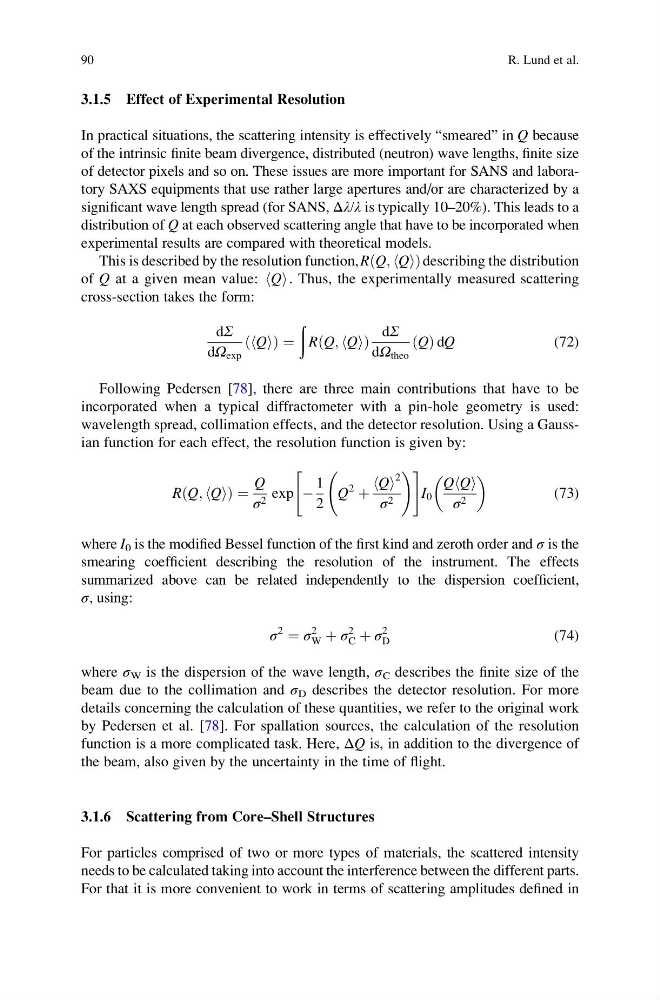
This is described by the resolution function, RðQ; hQiÞ describing the distribution
of Q at a given mean value: hQi. Thus, the experimentally measured scattering
cross-section takes the form:
dΣ
dΩ exp
Q
h i
ð Þ ¼
ð
R Q; Q
h i
ð
Þ
dΣ
dΩ theo
ðQÞ dQ
(72)
Following Pedersen [78], there are three main contributions that have to be
incorporated when a typical diffractometer with a pin-hole geometry is used:
wavelength spread, collimation effects, and the detector resolution. Using a Gaussian function for each effect, the resolution function is given by:
R Q; Q
h i
ð
Þ¼
Q
σ 2 exp À
1
2
Q
2
þ
Q
h i
2
σ 2
!
"
#
I 0
Q Q
h i
σ 2
(73)
where I 0 is the modified Bessel function of the first kind and zeroth order and σ is the
smearing coefficient describing the resolution of the instrument. The effects
summarized above can be related independently to the dispersion coefficient,
σ, using:
σ
2
¼ σ
2
W þ σ
2
C þ σ
2
D
(74)
where σ W is the dispersion of the wave length, σ C describes the finite size of the
beam due to the collimation and σ D describes the detector resolution. For more
details concerning the calculation of these quantities, we refer to the original work
by Pedersen et al. [78]. For spallation sources, the calculation of the resolution
function is a more complicated task. Here, ΔQ is, in addition to the divergence of
the beam, also given by the uncertainty in the time of flight.
3.1.6 Scattering from Core–Shell Structures
For particles comprised of two or more types of materials, the scattered intensity
needs to be calculated taking into account the interference between the different parts.
For that it is more convenient to work in terms of scattering amplitudes defined in
90
R. Lund et al.
In practical situations, the scattering intensity is effectively “smeared” in Q because
of the intrinsic finite beam divergence, distributed (neutron) wave lengths, finite size
of detector pixels and so on. These issues are more important for SANS and laboratory SAXS equipments that use rather large apertures and/or are characterized by a
significant wave length spread (for SANS, Δλ/λ is typically 10–20%). This leads to a
distribution of Q at each observed scattering angle that have to be incorporated when
experimental results are compared with theoretical models.
This is described by the resolution function, RðQ; hQiÞ describing the distribution
of Q at a given mean value: hQi. Thus, the experimentally measured scattering
cross-section takes the form:
dΣ
dΩ exp
Q
h i
ð Þ ¼
ð
R Q; Q
h i
ð
Þ
dΣ
dΩ theo
ðQÞ dQ
(72)
Following Pedersen [78], there are three main contributions that have to be
incorporated when a typical diffractometer with a pin-hole geometry is used:
wavelength spread, collimation effects, and the detector resolution. Using a Gaussian function for each effect, the resolution function is given by:
R Q; Q
h i
ð
Þ¼
Q
σ 2 exp À
1
2
Q
2
þ
Q
h i
2
σ 2
!
"
#
I 0
Q Q
h i
σ 2
(73)
where I 0 is the modified Bessel function of the first kind and zeroth order and σ is the
smearing coefficient describing the resolution of the instrument. The effects
summarized above can be related independently to the dispersion coefficient,
σ, using:
σ
2
¼ σ
2
W þ σ
2
C þ σ
2
D
(74)
where σ W is the dispersion of the wave length, σ C describes the finite size of the
beam due to the collimation and σ D describes the detector resolution. For more
details concerning the calculation of these quantities, we refer to the original work
by Pedersen et al. [78]. For spallation sources, the calculation of the resolution
function is a more complicated task. Here, ΔQ is, in addition to the divergence of
the beam, also given by the uncertainty in the time of flight.
3.1.6 Scattering from Core–Shell Structures
For particles comprised of two or more types of materials, the scattered intensity
needs to be calculated taking into account the interference between the different parts.
For that it is more convenient to work in terms of scattering amplitudes defined in
90
R. Lund et al.