

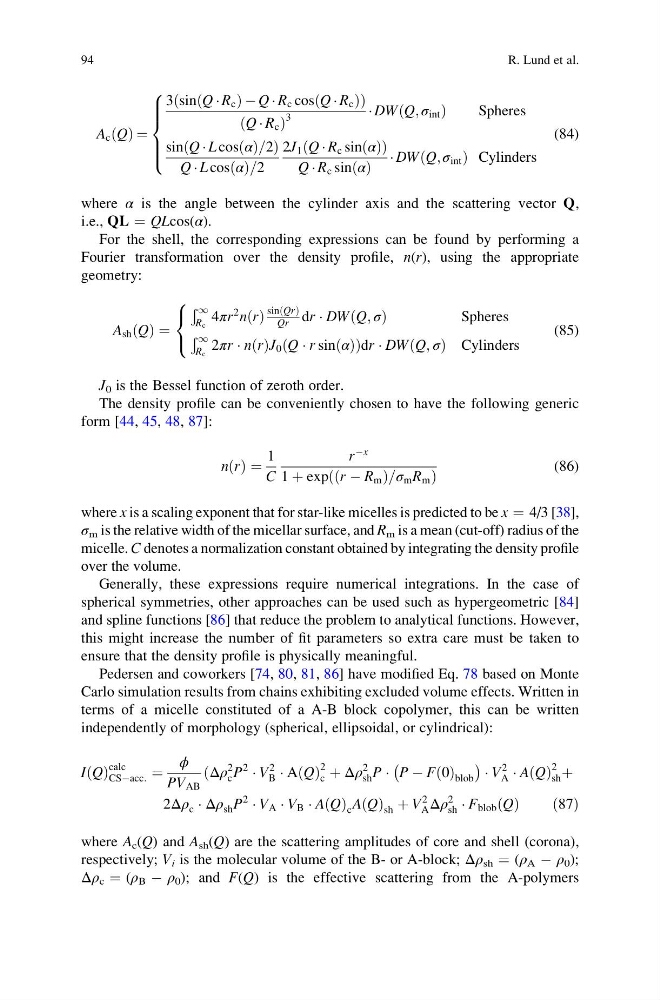
A c ðQÞ ¼
3 sinðQ Á R c Þ À Q Á R c cosðQ Á R c Þ
ð
Þ
ðQ Á R c Þ
3
Á DWðQ; σ int Þ
Spheres
sin Q Á L cosðαÞ=2
ð
Þ
Q Á L cosðαÞ=2
2J 1 Q Á R c sinðαÞ
ð
Þ
Q Á R c sinðαÞ
Á DWðQ; σ int Þ Cylinders
8
> > > <
> > > :
(84)
where α is the angle between the cylinder axis and the scattering vector Q,
i.e., QL ¼ QLcos(α).
For the shell, the corresponding expressions can be found by performing a
Fourier transformation over the density profile, n(r), using the appropriate
geometry:
A sh ðQÞ ¼
Ð 1
R c
4πr
2 nðrÞ
sinðQrÞ
Qr dr Á DWðQ; σÞ
Spheres
Ð 1
R c
2πr Á nðrÞJ 0 Q Á r sinðαÞ
ð
Þ dr Á DWðQ; σÞ Cylinders
8
<
:
(85)
J 0 is the Bessel function of zeroth order.
The density profile can be conveniently chosen to have the following generic
form [44, 45, 48, 87]:
nðrÞ ¼
1
C
r
Àx
1 þ exp ðr À R m Þ=σ m R m
ð
Þ
(86)
where x is a scaling exponent that for star-like micelles is predicted to be x ¼ 4/3 [38],
σ m is the relative width of the micellar surface, and R m is a mean (cut-off) radius of the
micelle. C denotes a normalization constant obtained by integrating the density profile
over the volume.
Generally, these expressions require numerical integrations. In the case of
spherical symmetries, other approaches can be used such as hypergeometric [84]
and spline functions [86] that reduce the problem to analytical functions. However,
this might increase the number of fit parameters so extra care must be taken to
ensure that the density profile is physically meaningful.
Pedersen and coworkers [74, 80, 81, 86] have modified Eq. 78 based on Monte
Carlo simulation results from chains exhibiting excluded volume effects. Written in
terms of a micelle constituted of a A-B block copolymer, this can be written
independently of morphology (spherical, ellipsoidal, or cylindrical):
IðQÞ
calc
CSÀacc: ¼
ϕ
PV AB
ðΔρ
2
c P
2
Á V
2
B Á AðQÞ
2
c þ Δρ
2
sh P Á P À Fð0Þ blob
À
Á Á V
2
A Á AðQÞ
2
sh þ
2Δρ c Á Δρ sh P
2
Á V A Á V B Á AðQÞ c AðQÞ sh þ V
2
A Δρ
2
sh Á F blob ðQÞ
ð87Þ
where A c (Q) and A sh (Q) are the scattering amplitudes of core and shell (corona),
respectively; V i is the molecular volume of the B- or A-block; Δρ sh ¼ (ρ A À ρ 0 );
Δρ c ¼ (ρ B À ρ 0 ); and F(Q) is the effective scattering from the A-polymers
94
R. Lund et al.
3 sinðQ Á R c Þ À Q Á R c cosðQ Á R c Þ
ð
Þ
ðQ Á R c Þ
3
Á DWðQ; σ int Þ
Spheres
sin Q Á L cosðαÞ=2
ð
Þ
Q Á L cosðαÞ=2
2J 1 Q Á R c sinðαÞ
ð
Þ
Q Á R c sinðαÞ
Á DWðQ; σ int Þ Cylinders
8
> > > <
> > > :
(84)
where α is the angle between the cylinder axis and the scattering vector Q,
i.e., QL ¼ QLcos(α).
For the shell, the corresponding expressions can be found by performing a
Fourier transformation over the density profile, n(r), using the appropriate
geometry:
A sh ðQÞ ¼
Ð 1
R c
4πr
2 nðrÞ
sinðQrÞ
Qr dr Á DWðQ; σÞ
Spheres
Ð 1
R c
2πr Á nðrÞJ 0 Q Á r sinðαÞ
ð
Þ dr Á DWðQ; σÞ Cylinders
8
<
:
(85)
J 0 is the Bessel function of zeroth order.
The density profile can be conveniently chosen to have the following generic
form [44, 45, 48, 87]:
nðrÞ ¼
1
C
r
Àx
1 þ exp ðr À R m Þ=σ m R m
ð
Þ
(86)
where x is a scaling exponent that for star-like micelles is predicted to be x ¼ 4/3 [38],
σ m is the relative width of the micellar surface, and R m is a mean (cut-off) radius of the
micelle. C denotes a normalization constant obtained by integrating the density profile
over the volume.
Generally, these expressions require numerical integrations. In the case of
spherical symmetries, other approaches can be used such as hypergeometric [84]
and spline functions [86] that reduce the problem to analytical functions. However,
this might increase the number of fit parameters so extra care must be taken to
ensure that the density profile is physically meaningful.
Pedersen and coworkers [74, 80, 81, 86] have modified Eq. 78 based on Monte
Carlo simulation results from chains exhibiting excluded volume effects. Written in
terms of a micelle constituted of a A-B block copolymer, this can be written
independently of morphology (spherical, ellipsoidal, or cylindrical):
IðQÞ
calc
CSÀacc: ¼
ϕ
PV AB
ðΔρ
2
c P
2
Á V
2
B Á AðQÞ
2
c þ Δρ
2
sh P Á P À Fð0Þ blob
À
Á Á V
2
A Á AðQÞ
2
sh þ
2Δρ c Á Δρ sh P
2
Á V A Á V B Á AðQÞ c AðQÞ sh þ V
2
A Δρ
2
sh Á F blob ðQÞ
ð87Þ
where A c (Q) and A sh (Q) are the scattering amplitudes of core and shell (corona),
respectively; V i is the molecular volume of the B- or A-block; Δρ sh ¼ (ρ A À ρ 0 );
Δρ c ¼ (ρ B À ρ 0 ); and F(Q) is the effective scattering from the A-polymers
94
R. Lund et al.