

constituting the corona (“blob scattering”). ϕ 0 is the volume fraction of block
copolymer.
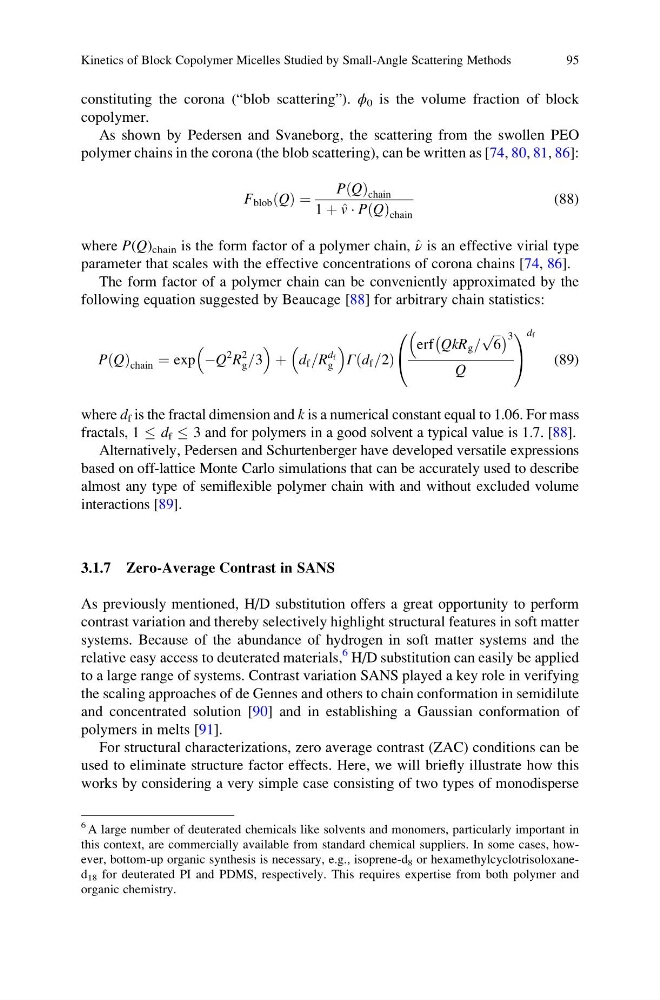
As shown by Pedersen and Svaneborg, the scattering from the swollen PEO
polymer chains in the corona (the blob scattering), can be written as [74, 80, 81, 86]:
F blob ðQÞ ¼
PðQÞ chain
1 þ ^
v Á PðQÞ chain
(88)
where P(Q) chain is the form factor of a polymer chain, ^ ν is an effective virial type
parameter that scales with the effective concentrations of corona chains [74, 86].
The form factor of a polymer chain can be conveniently approximated by the
following equation suggested by Beaucage [88] for arbitrary chain statistics:
PðQÞ chain ¼ exp ÀQ
2 R
2
g =3
þ d f =R
d f
g
Γðd f =2Þ
erf QkR g =
ffiffi ffi
6
p
À
Á 3
Q
0
@
1
A
d f
(89)
where d f is the fractal dimension and k is a numerical constant equal to 1.06. For mass
fractals, 1 d f 3 and for polymers in a good solvent a typical value is 1.7. [88].
Alternatively, Pedersen and Schurtenberger have developed versatile expressions
based on off-lattice Monte Carlo simulations that can be accurately used to describe
almost any type of semiflexible polymer chain with and without excluded volume
interactions [89].
3.1.7 Zero-Average Contrast in SANS
As previously mentioned, H/D substitution offers a great opportunity to perform
contrast variation and thereby selectively highlight structural features in soft matter
systems. Because of the abundance of hydrogen in soft matter systems and the
relative easy access to deuterated materials,
6 H/D substitution can easily be applied
to a large range of systems. Contrast variation SANS played a key role in verifying
the scaling approaches of de Gennes and others to chain conformation in semidilute
and concentrated solution [90] and in establishing a Gaussian conformation of
polymers in melts [91].
For structural characterizations, zero average contrast (ZAC) conditions can be
used to eliminate structure factor effects. Here, we will briefly illustrate how this
works by considering a very simple case consisting of two types of monodisperse
6 A large number of deuterated chemicals like solvents and monomers, particularly important in
this context, are commercially available from standard chemical suppliers. In some cases, however, bottom-up organic synthesis is necessary, e.g., isoprene-d 8 or hexamethylcyclotrisoloxaned 18 for deuterated PI and PDMS, respectively. This requires expertise from both polymer and
organic chemistry.
Kinetics of Block Copolymer Micelles Studied by Small-Angle Scattering Methods
95
copolymer.
As shown by Pedersen and Svaneborg, the scattering from the swollen PEO
polymer chains in the corona (the blob scattering), can be written as [74, 80, 81, 86]:
F blob ðQÞ ¼
PðQÞ chain
1 þ ^
v Á PðQÞ chain
(88)
where P(Q) chain is the form factor of a polymer chain, ^ ν is an effective virial type
parameter that scales with the effective concentrations of corona chains [74, 86].
The form factor of a polymer chain can be conveniently approximated by the
following equation suggested by Beaucage [88] for arbitrary chain statistics:
PðQÞ chain ¼ exp ÀQ
2 R
2
g =3
þ d f =R
d f
g
Γðd f =2Þ
erf QkR g =
ffiffi ffi
6
p
À
Á 3
Q
0
@
1
A
d f
(89)
where d f is the fractal dimension and k is a numerical constant equal to 1.06. For mass
fractals, 1 d f 3 and for polymers in a good solvent a typical value is 1.7. [88].
Alternatively, Pedersen and Schurtenberger have developed versatile expressions
based on off-lattice Monte Carlo simulations that can be accurately used to describe
almost any type of semiflexible polymer chain with and without excluded volume
interactions [89].
3.1.7 Zero-Average Contrast in SANS
As previously mentioned, H/D substitution offers a great opportunity to perform
contrast variation and thereby selectively highlight structural features in soft matter
systems. Because of the abundance of hydrogen in soft matter systems and the
relative easy access to deuterated materials,
6 H/D substitution can easily be applied
to a large range of systems. Contrast variation SANS played a key role in verifying
the scaling approaches of de Gennes and others to chain conformation in semidilute
and concentrated solution [90] and in establishing a Gaussian conformation of
polymers in melts [91].
For structural characterizations, zero average contrast (ZAC) conditions can be
used to eliminate structure factor effects. Here, we will briefly illustrate how this
works by considering a very simple case consisting of two types of monodisperse
6 A large number of deuterated chemicals like solvents and monomers, particularly important in
this context, are commercially available from standard chemical suppliers. In some cases, however, bottom-up organic synthesis is necessary, e.g., isoprene-d 8 or hexamethylcyclotrisoloxaned 18 for deuterated PI and PDMS, respectively. This requires expertise from both polymer and
organic chemistry.
Kinetics of Block Copolymer Micelles Studied by Small-Angle Scattering Methods
95