

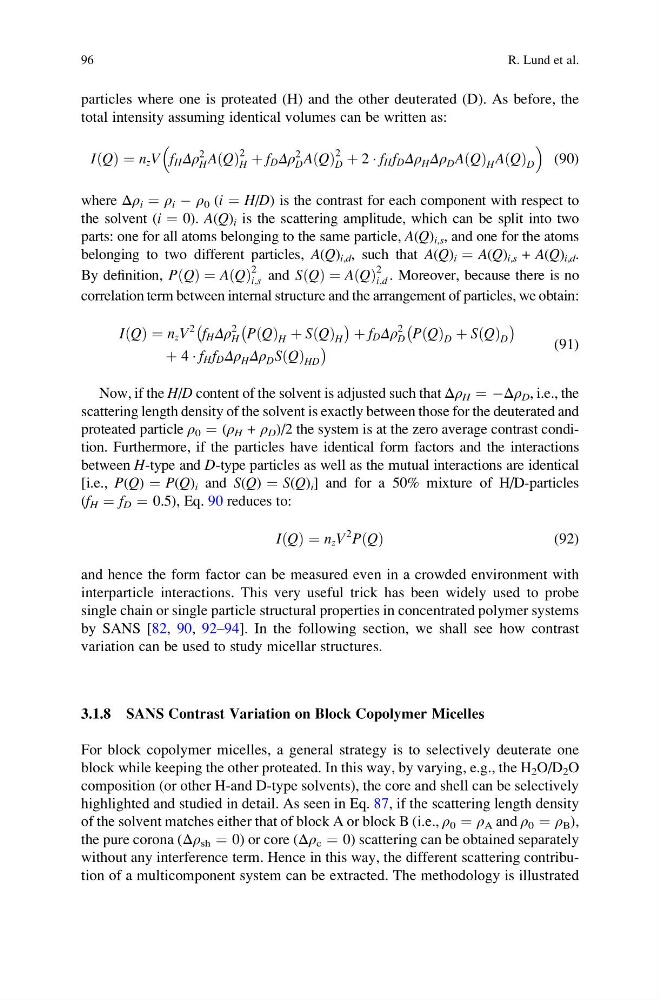
particles where one is proteated (H) and the other deuterated (D). As before, the
total intensity assuming identical volumes can be written as:
IðQÞ ¼ n z V f H Δρ
2
H AðQÞ
2
H þ f D Δρ
2
D AðQÞ
2
D þ 2 Á f H f D Δρ H Δρ D AðQÞ H AðQÞ D
(90)
where Δρ i ¼ ρ i À ρ 0 (i ¼ H/D) is the contrast for each component with respect to
the solvent (i ¼ 0). A(Q) i is the scattering amplitude, which can be split into two
parts: one for all atoms belonging to the same particle, A(Q) i,s , and one for the atoms
belonging to two different particles, A(Q) i,d , such that A(Q) i ¼ A(Q) i,s + A(Q) i,d .
By definition, PðQÞ ¼ AðQÞ
2
i;s and SðQÞ ¼ AðQÞ
2
i;d . Moreover, because there is no
correlation term between internal structure and the arrangement of particles, we obtain:
IðQÞ ¼ n z V
2 f H Δρ
2
H PðQÞ H þ SðQÞ H
À
Á þ f D Δρ
2
D PðQÞ D þ SðQÞ D
À
Á
À
þ 4 Á f H f D Δρ H Δρ D SðQÞ HD
Á
(91)
Now, if the H/D content of the solvent is adjusted such that Δρ H ¼ ÀΔρ D , i.e., the
scattering length density of the solvent is exactly between those for the deuterated and
proteated particle ρ 0 ¼ (ρ H + ρ D )/2 the system is at the zero average contrast condition. Furthermore, if the particles have identical form factors and the interactions
between H-type and D-type particles as well as the mutual interactions are identical
[i.e., P(Q) ¼ P(Q) i and S(Q) ¼ S(Q) i ] and for a 50% mixture of H/D-particles
(f H ¼ f D ¼ 0.5), Eq. 90 reduces to:
IðQÞ ¼ n z V
2 PðQÞ
(92)
and hence the form factor can be measured even in a crowded environment with
interparticle interactions. This very useful trick has been widely used to probe
single chain or single particle structural properties in concentrated polymer systems
by SANS [82, 90, 92–94]. In the following section, we shall see how contrast
variation can be used to study micellar structures.
3.1.8 SANS Contrast Variation on Block Copolymer Micelles
For block copolymer micelles, a general strategy is to selectively deuterate one
block while keeping the other proteated. In this way, by varying, e.g., the H 2 O/D 2 O
composition (or other H-and D-type solvents), the core and shell can be selectively
highlighted and studied in detail. As seen in Eq. 87, if the scattering length density
of the solvent matches either that of block A or block B (i.e., ρ 0 ¼ ρ A and ρ 0 ¼ ρ B ),
the pure corona (Δρ sh ¼ 0) or core (Δρ c ¼ 0) scattering can be obtained separately
without any interference term. Hence in this way, the different scattering contribution of a multicomponent system can be extracted. The methodology is illustrated
96
R. Lund et al.
total intensity assuming identical volumes can be written as:
IðQÞ ¼ n z V f H Δρ
2
H AðQÞ
2
H þ f D Δρ
2
D AðQÞ
2
D þ 2 Á f H f D Δρ H Δρ D AðQÞ H AðQÞ D
(90)
where Δρ i ¼ ρ i À ρ 0 (i ¼ H/D) is the contrast for each component with respect to
the solvent (i ¼ 0). A(Q) i is the scattering amplitude, which can be split into two
parts: one for all atoms belonging to the same particle, A(Q) i,s , and one for the atoms
belonging to two different particles, A(Q) i,d , such that A(Q) i ¼ A(Q) i,s + A(Q) i,d .
By definition, PðQÞ ¼ AðQÞ
2
i;s and SðQÞ ¼ AðQÞ
2
i;d . Moreover, because there is no
correlation term between internal structure and the arrangement of particles, we obtain:
IðQÞ ¼ n z V
2 f H Δρ
2
H PðQÞ H þ SðQÞ H
À
Á þ f D Δρ
2
D PðQÞ D þ SðQÞ D
À
Á
À
þ 4 Á f H f D Δρ H Δρ D SðQÞ HD
Á
(91)
Now, if the H/D content of the solvent is adjusted such that Δρ H ¼ ÀΔρ D , i.e., the
scattering length density of the solvent is exactly between those for the deuterated and
proteated particle ρ 0 ¼ (ρ H + ρ D )/2 the system is at the zero average contrast condition. Furthermore, if the particles have identical form factors and the interactions
between H-type and D-type particles as well as the mutual interactions are identical
[i.e., P(Q) ¼ P(Q) i and S(Q) ¼ S(Q) i ] and for a 50% mixture of H/D-particles
(f H ¼ f D ¼ 0.5), Eq. 90 reduces to:
IðQÞ ¼ n z V
2 PðQÞ
(92)
and hence the form factor can be measured even in a crowded environment with
interparticle interactions. This very useful trick has been widely used to probe
single chain or single particle structural properties in concentrated polymer systems
by SANS [82, 90, 92–94]. In the following section, we shall see how contrast
variation can be used to study micellar structures.
3.1.8 SANS Contrast Variation on Block Copolymer Micelles
For block copolymer micelles, a general strategy is to selectively deuterate one
block while keeping the other proteated. In this way, by varying, e.g., the H 2 O/D 2 O
composition (or other H-and D-type solvents), the core and shell can be selectively
highlighted and studied in detail. As seen in Eq. 87, if the scattering length density
of the solvent matches either that of block A or block B (i.e., ρ 0 ¼ ρ A and ρ 0 ¼ ρ B ),
the pure corona (Δρ sh ¼ 0) or core (Δρ c ¼ 0) scattering can be obtained separately
without any interference term. Hence in this way, the different scattering contribution of a multicomponent system can be extracted. The methodology is illustrated
96
R. Lund et al.