

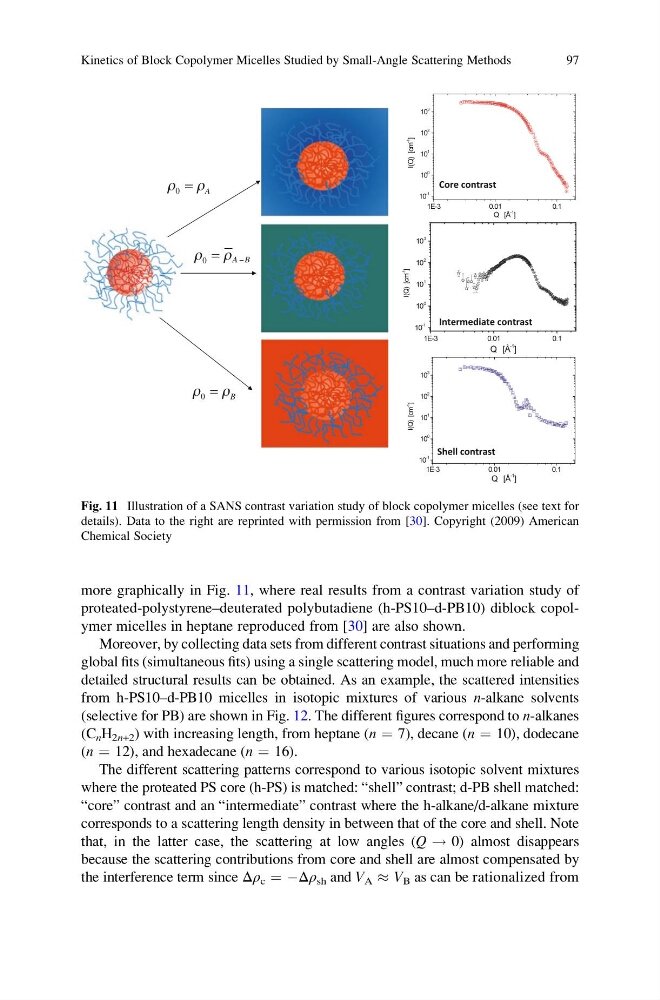
more graphically in Fig. 11, where real results from a contrast variation study of
proteated-polystyrene–deuterated polybutadiene (h-PS10–d-PB10) diblock copolymer micelles in heptane reproduced from [30] are also shown.
Moreover, by collecting data sets from different contrast situations and performing
global fits (simultaneous fits) using a single scattering model, much more reliable and
detailed structural results can be obtained. As an example, the scattered intensities
from h-PS10–d-PB10 micelles in isotopic mixtures of various n-alkane solvents
(selective for PB) are shown in Fig. 12. The different figures correspond to n-alkanes
(C n H 2n+2 ) with increasing length, from heptane (n ¼ 7), decane (n ¼ 10), dodecane
(n ¼ 12), and hexadecane (n ¼ 16).
The different scattering patterns correspond to various isotopic solvent mixtures
where the proteated PS core (h-PS) is matched: “shell” contrast; d-PB shell matched:
“core” contrast and an “intermediate” contrast where the h-alkane/d-alkane mixture
corresponds to a scattering length density in between that of the core and shell. Note
that, in the latter case, the scattering at low angles (Q ! 0) almost disappears
because the scattering contributions from core and shell are almost compensated by
the interference term since Δρ c ¼ ÀΔρ sh and V A % V B as can be rationalized from
0 = A
0 = A B
0 = B
Fig. 11 Illustration of a SANS contrast variation study of block copolymer micelles (see text for
details). Data to the right are reprinted with permission from [30]. Copyright (2009) American
Chemical Society
Kinetics of Block Copolymer Micelles Studied by Small-Angle Scattering Methods
97
proteated-polystyrene–deuterated polybutadiene (h-PS10–d-PB10) diblock copolymer micelles in heptane reproduced from [30] are also shown.
Moreover, by collecting data sets from different contrast situations and performing
global fits (simultaneous fits) using a single scattering model, much more reliable and
detailed structural results can be obtained. As an example, the scattered intensities
from h-PS10–d-PB10 micelles in isotopic mixtures of various n-alkane solvents
(selective for PB) are shown in Fig. 12. The different figures correspond to n-alkanes
(C n H 2n+2 ) with increasing length, from heptane (n ¼ 7), decane (n ¼ 10), dodecane
(n ¼ 12), and hexadecane (n ¼ 16).
The different scattering patterns correspond to various isotopic solvent mixtures
where the proteated PS core (h-PS) is matched: “shell” contrast; d-PB shell matched:
“core” contrast and an “intermediate” contrast where the h-alkane/d-alkane mixture
corresponds to a scattering length density in between that of the core and shell. Note
that, in the latter case, the scattering at low angles (Q ! 0) almost disappears
because the scattering contributions from core and shell are almost compensated by
the interference term since Δρ c ¼ ÀΔρ sh and V A % V B as can be rationalized from
0 = A
0 = A B
0 = B
Fig. 11 Illustration of a SANS contrast variation study of block copolymer micelles (see text for
details). Data to the right are reprinted with permission from [30]. Copyright (2009) American
Chemical Society
Kinetics of Block Copolymer Micelles Studied by Small-Angle Scattering Methods
97