

PðQÞ¼
2 expðÀyÞÀ1þy
ð
Þ
y 2
;y¼ðQR g Þ
2
IdealChainðDebyeÞ
A s ðQ;RÞ
ð
Þ
2 ; A s ðQ;RÞ¼
3 sinðQRÞÀQRcosðQRÞ
ð
Þ
ðQRÞ
3
Sphere
R
3
2 A s ðQ;R 2 ÞÀR
3
1 A s ðQ;R 1 Þ
R
3
2
ÀR
3
1
2
Shell=Vesicle
ð π=2
0
sin QÁLcosðαÞ=2
ð
Þ
QÁLcosðαÞ=2
2J 1 QÁRsinðαÞ
ð
Þ
QÁRsinðαÞ
2
sinðαÞdα Cylinder
8
> > > > > > > > > <
> > > > > > > > > :
(68)
where α is the angle between the cylinder axis and the scattering vector, Q of a
cylinder with length, L.
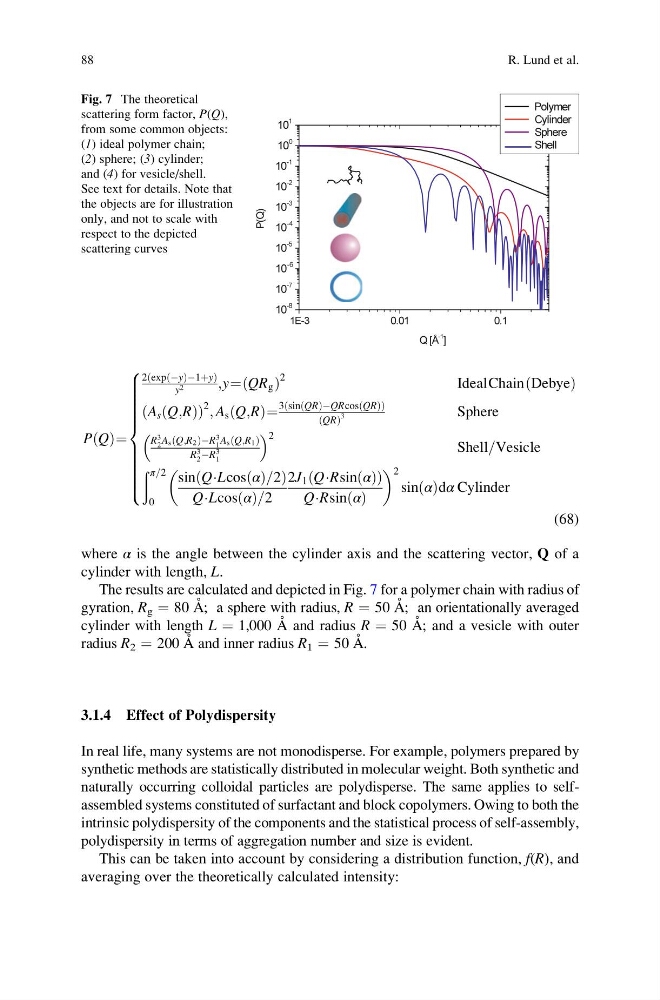
The results are calculated and depicted in Fig. 7 for a polymer chain with radius of
gyration, R g ¼ 80 A ˚ ; a sphere with radius, R ¼ 50 A ˚ ; an orientationally averaged
cylinder with length L ¼ 1,000 A ˚ and radius R ¼ 50 A ˚ ; and a vesicle with outer
radius R 2 ¼ 200 A ˚ and inner radius R 1 ¼ 50 A ˚ .
3.1.4 Effect of Polydispersity
In real life, many systems are not monodisperse. For example, polymers prepared by
synthetic methods are statistically distributed in molecular weight. Both synthetic and
naturally occurring colloidal particles are polydisperse. The same applies to selfassembled systems constituted of surfactant and block copolymers. Owing to both the
intrinsic polydispersity of the components and the statistical process of self-assembly,
polydispersity in terms of aggregation number and size is evident.
This can be taken into account by considering a distribution function, f(R), and
averaging over the theoretically calculated intensity:
Fig. 7 The theoretical
scattering form factor, P(Q),
from some common objects:
(1) ideal polymer chain;
(2) sphere; (3) cylinder;
and (4) for vesicle/shell.
See text for details. Note that
the objects are for illustration
only, and not to scale with
respect to the depicted
scattering curves
88
R. Lund et al.
2 expðÀyÞÀ1þy
ð
Þ
y 2
;y¼ðQR g Þ
2
IdealChainðDebyeÞ
A s ðQ;RÞ
ð
Þ
2 ; A s ðQ;RÞ¼
3 sinðQRÞÀQRcosðQRÞ
ð
Þ
ðQRÞ
3
Sphere
R
3
2 A s ðQ;R 2 ÞÀR
3
1 A s ðQ;R 1 Þ
R
3
2
ÀR
3
1
2
Shell=Vesicle
ð π=2
0
sin QÁLcosðαÞ=2
ð
Þ
QÁLcosðαÞ=2
2J 1 QÁRsinðαÞ
ð
Þ
QÁRsinðαÞ
2
sinðαÞdα Cylinder
8
> > > > > > > > > <
> > > > > > > > > :
(68)
where α is the angle between the cylinder axis and the scattering vector, Q of a
cylinder with length, L.
The results are calculated and depicted in Fig. 7 for a polymer chain with radius of
gyration, R g ¼ 80 A ˚ ; a sphere with radius, R ¼ 50 A ˚ ; an orientationally averaged
cylinder with length L ¼ 1,000 A ˚ and radius R ¼ 50 A ˚ ; and a vesicle with outer
radius R 2 ¼ 200 A ˚ and inner radius R 1 ¼ 50 A ˚ .
3.1.4 Effect of Polydispersity
In real life, many systems are not monodisperse. For example, polymers prepared by
synthetic methods are statistically distributed in molecular weight. Both synthetic and
naturally occurring colloidal particles are polydisperse. The same applies to selfassembled systems constituted of surfactant and block copolymers. Owing to both the
intrinsic polydispersity of the components and the statistical process of self-assembly,
polydispersity in terms of aggregation number and size is evident.
This can be taken into account by considering a distribution function, f(R), and
averaging over the theoretically calculated intensity:
Fig. 7 The theoretical
scattering form factor, P(Q),
from some common objects:
(1) ideal polymer chain;
(2) sphere; (3) cylinder;
and (4) for vesicle/shell.
See text for details. Note that
the objects are for illustration
only, and not to scale with
respect to the depicted
scattering curves
88
R. Lund et al.