

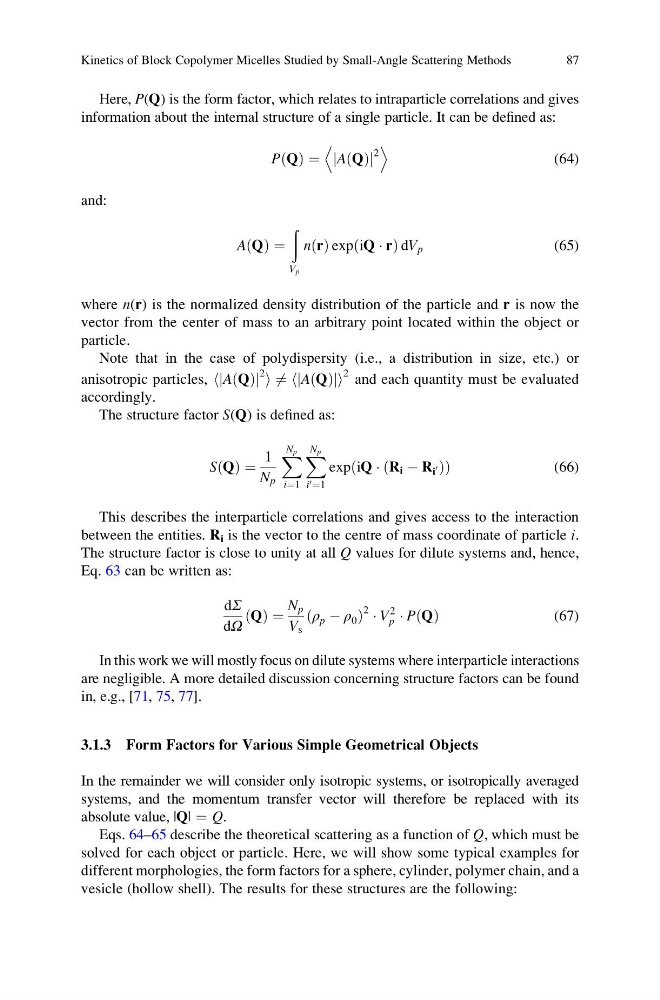
Here, P(Q) is the form factor, which relates to intraparticle correlations and gives
information about the internal structure of a single particle. It can be defined as:
PðQÞ ¼ AðQÞ
j
j
2
D
E
(64)
and:
AðQÞ ¼
ð
V p
nðrÞ expðiQ Á rÞ dV p
(65)
where n(r) is the normalized density distribution of the particle and r is now the
vector from the center of mass to an arbitrary point located within the object or
particle.
Note that in the case of polydispersity (i.e., a distribution in size, etc.) or
anisotropic particles, hjA Q
ð Þj
2 i 6 ¼ hjA Q
ð Þji
2 and each quantity must be evaluated
accordingly.
The structure factor S(Q) is defined as:
SðQÞ ¼
1
N p
X N p
i¼1
X N p
i 0 ¼1
exp iQ Á ðR i À R i
0 Þ
ð
Þ
(66)
This describes the interparticle correlations and gives access to the interaction
between the entities. R i is the vector to the centre of mass coordinate of particle i.
The structure factor is close to unity at all Q values for dilute systems and, hence,
Eq. 63 can be written as:
dΣ
dΩ
ðQÞ ¼
N p
V s
ðρ p À ρ 0 Þ
2 Á V
2
p Á PðQÞ
(67)
In this work we will mostly focus on dilute systems where interparticle interactions
are negligible. A more detailed discussion concerning structure factors can be found
in, e.g., [71, 75, 77].
3.1.3 Form Factors for Various Simple Geometrical Objects
In the remainder we will consider only isotropic systems, or isotropically averaged
systems, and the momentum transfer vector will therefore be replaced with its
absolute value, |Q| ¼ Q.
Eqs. 64–65 describe the theoretical scattering as a function of Q, which must be
solved for each object or particle. Here, we will show some typical examples for
different morphologies, the form factors for a sphere, cylinder, polymer chain, and a
vesicle (hollow shell). The results for these structures are the following:
Kinetics of Block Copolymer Micelles Studied by Small-Angle Scattering Methods
87
information about the internal structure of a single particle. It can be defined as:
PðQÞ ¼ AðQÞ
j
j
2
D
E
(64)
and:
AðQÞ ¼
ð
V p
nðrÞ expðiQ Á rÞ dV p
(65)
where n(r) is the normalized density distribution of the particle and r is now the
vector from the center of mass to an arbitrary point located within the object or
particle.
Note that in the case of polydispersity (i.e., a distribution in size, etc.) or
anisotropic particles, hjA Q
ð Þj
2 i 6 ¼ hjA Q
ð Þji
2 and each quantity must be evaluated
accordingly.
The structure factor S(Q) is defined as:
SðQÞ ¼
1
N p
X N p
i¼1
X N p
i 0 ¼1
exp iQ Á ðR i À R i
0 Þ
ð
Þ
(66)
This describes the interparticle correlations and gives access to the interaction
between the entities. R i is the vector to the centre of mass coordinate of particle i.
The structure factor is close to unity at all Q values for dilute systems and, hence,
Eq. 63 can be written as:
dΣ
dΩ
ðQÞ ¼
N p
V s
ðρ p À ρ 0 Þ
2 Á V
2
p Á PðQÞ
(67)
In this work we will mostly focus on dilute systems where interparticle interactions
are negligible. A more detailed discussion concerning structure factors can be found
in, e.g., [71, 75, 77].
3.1.3 Form Factors for Various Simple Geometrical Objects
In the remainder we will consider only isotropic systems, or isotropically averaged
systems, and the momentum transfer vector will therefore be replaced with its
absolute value, |Q| ¼ Q.
Eqs. 64–65 describe the theoretical scattering as a function of Q, which must be
solved for each object or particle. Here, we will show some typical examples for
different morphologies, the form factors for a sphere, cylinder, polymer chain, and a
vesicle (hollow shell). The results for these structures are the following:
Kinetics of Block Copolymer Micelles Studied by Small-Angle Scattering Methods
87