

where V s is the scattering volume.
In case there is a distribution in the scattering lengths for neutrons, e.g., because
of a natural distribution of isotopes and spin states, the mean values and their spread
must be considered. In this way Eq. 60 can be rewritten as:
dΣ
dΩ
ðQÞ ¼
1
V s
hbi
2
X N
i;j¼1
hj expðiQ Á r i Þj
2 i þ
N
V s
ðhb
2
i À hbi
2 Þ
(61)
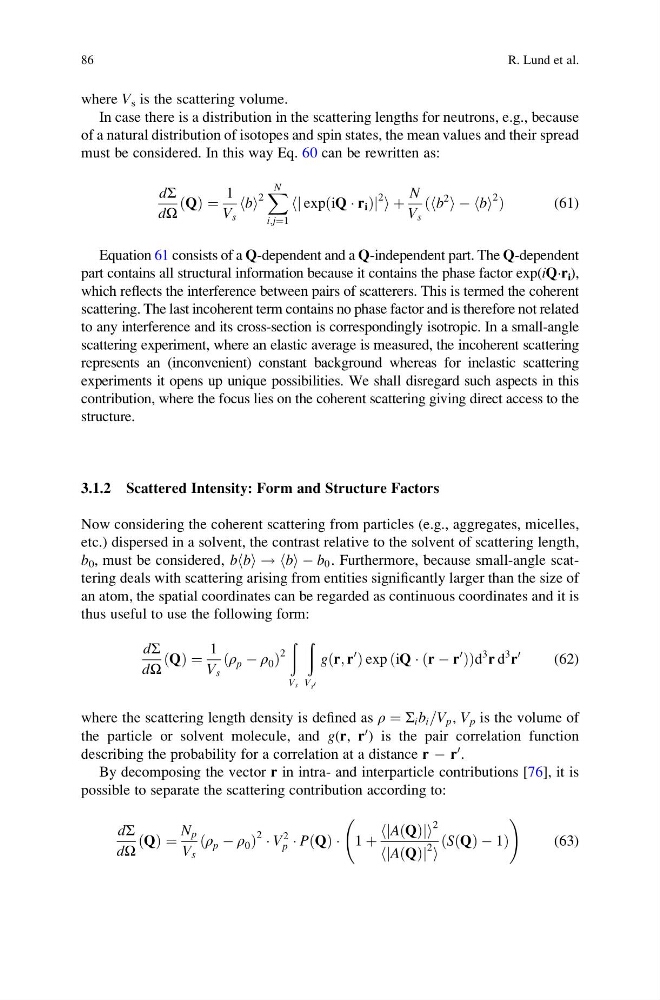
Equation 61 consists of a Q-dependent and a Q-independent part. The Q-dependent
part contains all structural information because it contains the phase factor exp(iQÁr i ),
which reflects the interference between pairs of scatterers. This is termed the coherent
scattering. The last incoherent term contains no phase factor and is therefore not related
to any interference and its cross-section is correspondingly isotropic. In a small-angle
scattering experiment, where an elastic average is measured, the incoherent scattering
represents an (inconvenient) constant background whereas for inelastic scattering
experiments it opens up unique possibilities. We shall disregard such aspects in this
contribution, where the focus lies on the coherent scattering giving direct access to the
structure.
3.1.2 Scattered Intensity: Form and Structure Factors
Now considering the coherent scattering from particles (e.g., aggregates, micelles,
etc.) dispersed in a solvent, the contrast relative to the solvent of scattering length,
b 0 , must be considered, bhbi ! hbi À b 0 . Furthermore, because small-angle scattering deals with scattering arising from entities significantly larger than the size of
an atom, the spatial coordinates can be regarded as continuous coordinates and it is
thus useful to use the following form:
dΣ
dΩ
ðQÞ ¼
1
V s
ðρ p À ρ 0 Þ
2
ð
V s
ð
V s 0
gðr; r
0
Þ exp ðiQ Á ðr À r
0
ÞÞd
3 r d
3 r
0
(62)
where the scattering length density is defined as ρ ¼ Σ i b i =V p , V p is the volume of
the particle or solvent molecule, and g(r, r
0 ) is the pair correlation function
describing the probability for a correlation at a distance r À r
0 .
By decomposing the vector r in intra- and interparticle contributions [76], it is
possible to separate the scattering contribution according to:
dΣ
dΩ
ðQÞ ¼
N p
V s
ðρ p À ρ 0 Þ
2 Á V
2
p Á PðQÞ Á 1 þ
hjAðQÞji
2
hjAðQÞj
2 i
ðSðQÞ À 1Þ
!
(63)
86
R. Lund et al.
In case there is a distribution in the scattering lengths for neutrons, e.g., because
of a natural distribution of isotopes and spin states, the mean values and their spread
must be considered. In this way Eq. 60 can be rewritten as:
dΣ
dΩ
ðQÞ ¼
1
V s
hbi
2
X N
i;j¼1
hj expðiQ Á r i Þj
2 i þ
N
V s
ðhb
2
i À hbi
2 Þ
(61)
Equation 61 consists of a Q-dependent and a Q-independent part. The Q-dependent
part contains all structural information because it contains the phase factor exp(iQÁr i ),
which reflects the interference between pairs of scatterers. This is termed the coherent
scattering. The last incoherent term contains no phase factor and is therefore not related
to any interference and its cross-section is correspondingly isotropic. In a small-angle
scattering experiment, where an elastic average is measured, the incoherent scattering
represents an (inconvenient) constant background whereas for inelastic scattering
experiments it opens up unique possibilities. We shall disregard such aspects in this
contribution, where the focus lies on the coherent scattering giving direct access to the
structure.
3.1.2 Scattered Intensity: Form and Structure Factors
Now considering the coherent scattering from particles (e.g., aggregates, micelles,
etc.) dispersed in a solvent, the contrast relative to the solvent of scattering length,
b 0 , must be considered, bhbi ! hbi À b 0 . Furthermore, because small-angle scattering deals with scattering arising from entities significantly larger than the size of
an atom, the spatial coordinates can be regarded as continuous coordinates and it is
thus useful to use the following form:
dΣ
dΩ
ðQÞ ¼
1
V s
ðρ p À ρ 0 Þ
2
ð
V s
ð
V s 0
gðr; r
0
Þ exp ðiQ Á ðr À r
0
ÞÞd
3 r d
3 r
0
(62)
where the scattering length density is defined as ρ ¼ Σ i b i =V p , V p is the volume of
the particle or solvent molecule, and g(r, r
0 ) is the pair correlation function
describing the probability for a correlation at a distance r À r
0 .
By decomposing the vector r in intra- and interparticle contributions [76], it is
possible to separate the scattering contribution according to:
dΣ
dΩ
ðQÞ ¼
N p
V s
ðρ p À ρ 0 Þ
2 Á V
2
p Á PðQÞ Á 1 þ
hjAðQÞji
2
hjAðQÞj
2 i
ðSðQÞ À 1Þ
!
(63)
86
R. Lund et al.