

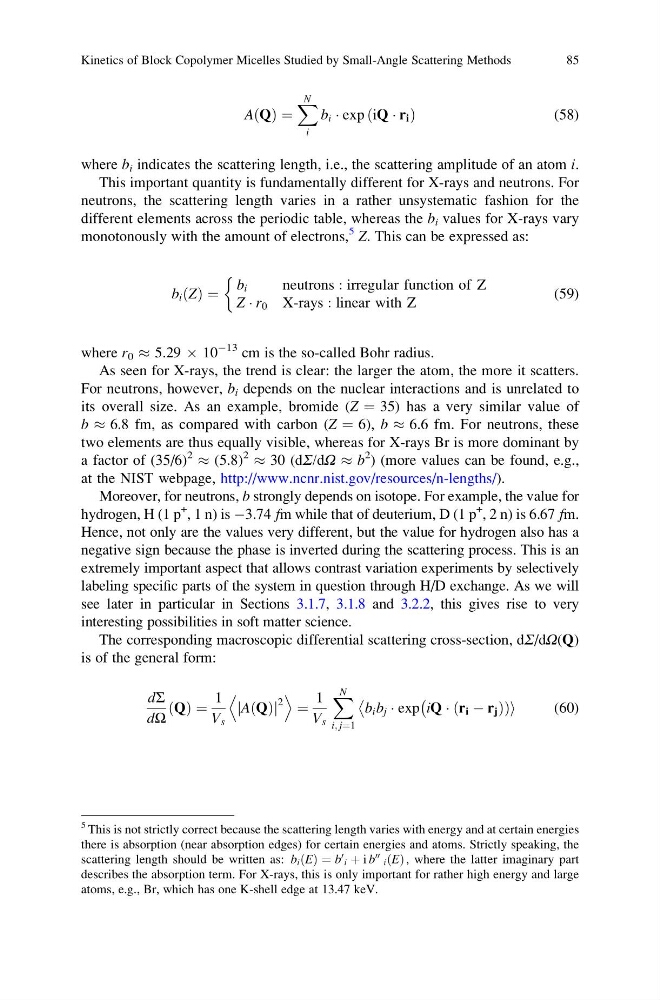
AðQÞ ¼
X N
i
b i Á exp ðiQ Á r i Þ
(58)
where b i indicates the scattering length, i.e., the scattering amplitude of an atom i.
This important quantity is fundamentally different for X-rays and neutrons. For
neutrons, the scattering length varies in a rather unsystematic fashion for the
different elements across the periodic table, whereas the b i values for X-rays vary
monotonously with the amount of electrons,
5 Z. This can be expressed as:
b i ðZÞ ¼
b i
neutrons : irregular function of Z
Z Á r 0 X-rays : linear with Z
&
(59)
where r 0 % 5.29 Â 10
À13 cm is the so-called Bohr radius.
As seen for X-rays, the trend is clear: the larger the atom, the more it scatters.
For neutrons, however, b i depends on the nuclear interactions and is unrelated to
its overall size. As an example, bromide (Z ¼ 35) has a very similar value of
b % 6.8 fm, as compared with carbon (Z ¼ 6), b % 6.6 fm. For neutrons, these
two elements are thus equally visible, whereas for X-rays Br is more dominant by
a factor of (35/6)
2
% (5.8)
2
% 30 (dΣ/dΩ % b
2 ) (more values can be found, e.g.,
at the NIST webpage, http://www.ncnr.nist.gov/resources/n-lengths/).
Moreover, for neutrons, b strongly depends on isotope. For example, the value for
hydrogen, H (1 p
+
, 1 n) is À3.74 fm while that of deuterium, D (1 p
+
, 2 n) is 6.67 fm.
Hence, not only are the values very different, but the value for hydrogen also has a
negative sign because the phase is inverted during the scattering process. This is an
extremely important aspect that allows contrast variation experiments by selectively
labeling specific parts of the system in question through H/D exchange. As we will
see later in particular in Sections 3.1.7, 3.1.8 and 3.2.2, this gives rise to very
interesting possibilities in soft matter science.
The corresponding macroscopic differential scattering cross-section, dΣ/dΩ(Q)
is of the general form:
dΣ
dΩ
ðQÞ ¼
1
V s
AðQÞ
j
j
2
D
E
¼
1
V s
X N
i; j¼1
b i b j Á exp iQ Á ðr i À r j ÞÞi
À
(60)
5 This is not strictly correct because the scattering length varies with energy and at certain energies
there is absorption (near absorption edges) for certain energies and atoms. Strictly speaking, the
scattering length should be written as: b i ðEÞ ¼ b
0
i þ i b
00
i ðEÞ , where the latter imaginary part
describes the absorption term. For X-rays, this is only important for rather high energy and large
atoms, e.g., Br, which has one K-shell edge at 13.47 keV.
Kinetics of Block Copolymer Micelles Studied by Small-Angle Scattering Methods
85
X N
i
b i Á exp ðiQ Á r i Þ
(58)
where b i indicates the scattering length, i.e., the scattering amplitude of an atom i.
This important quantity is fundamentally different for X-rays and neutrons. For
neutrons, the scattering length varies in a rather unsystematic fashion for the
different elements across the periodic table, whereas the b i values for X-rays vary
monotonously with the amount of electrons,
5 Z. This can be expressed as:
b i ðZÞ ¼
b i
neutrons : irregular function of Z
Z Á r 0 X-rays : linear with Z
&
(59)
where r 0 % 5.29 Â 10
À13 cm is the so-called Bohr radius.
As seen for X-rays, the trend is clear: the larger the atom, the more it scatters.
For neutrons, however, b i depends on the nuclear interactions and is unrelated to
its overall size. As an example, bromide (Z ¼ 35) has a very similar value of
b % 6.8 fm, as compared with carbon (Z ¼ 6), b % 6.6 fm. For neutrons, these
two elements are thus equally visible, whereas for X-rays Br is more dominant by
a factor of (35/6)
2
% (5.8)
2
% 30 (dΣ/dΩ % b
2 ) (more values can be found, e.g.,
at the NIST webpage, http://www.ncnr.nist.gov/resources/n-lengths/).
Moreover, for neutrons, b strongly depends on isotope. For example, the value for
hydrogen, H (1 p
+
, 1 n) is À3.74 fm while that of deuterium, D (1 p
+
, 2 n) is 6.67 fm.
Hence, not only are the values very different, but the value for hydrogen also has a
negative sign because the phase is inverted during the scattering process. This is an
extremely important aspect that allows contrast variation experiments by selectively
labeling specific parts of the system in question through H/D exchange. As we will
see later in particular in Sections 3.1.7, 3.1.8 and 3.2.2, this gives rise to very
interesting possibilities in soft matter science.
The corresponding macroscopic differential scattering cross-section, dΣ/dΩ(Q)
is of the general form:
dΣ
dΩ
ðQÞ ¼
1
V s
AðQÞ
j
j
2
D
E
¼
1
V s
X N
i; j¼1
b i b j Á exp iQ Á ðr i À r j ÞÞi
À
(60)
5 This is not strictly correct because the scattering length varies with energy and at certain energies
there is absorption (near absorption edges) for certain energies and atoms. Strictly speaking, the
scattering length should be written as: b i ðEÞ ¼ b
0
i þ i b
00
i ðEÞ , where the latter imaginary part
describes the absorption term. For X-rays, this is only important for rather high energy and large
atoms, e.g., Br, which has one K-shell edge at 13.47 keV.
Kinetics of Block Copolymer Micelles Studied by Small-Angle Scattering Methods
85