

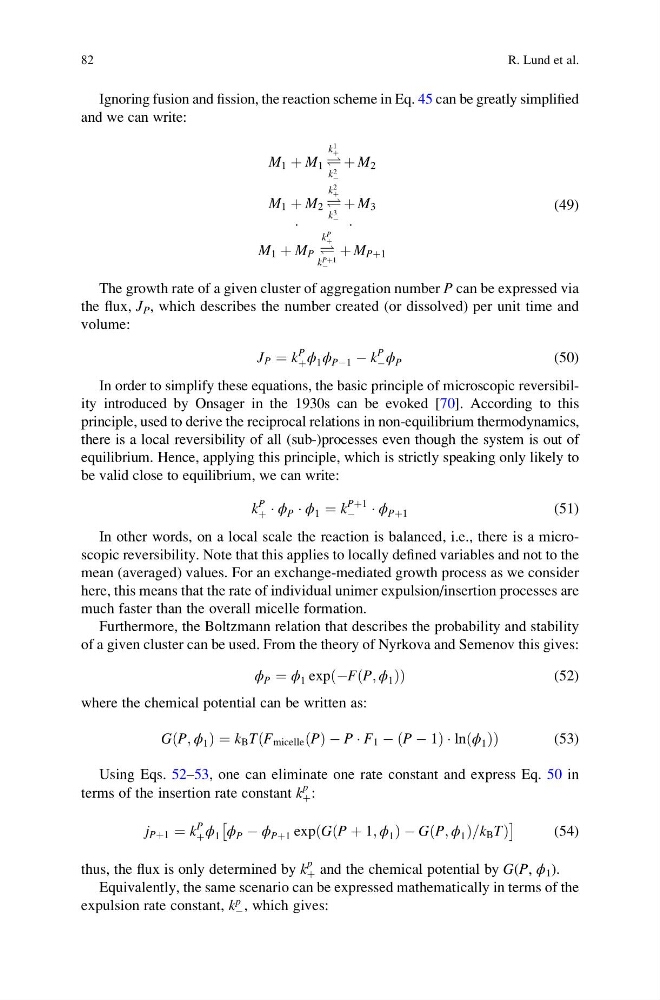
Ignoring fusion and fission, the reaction scheme in Eq. 45 can be greatly simplified
and we can write:
M 1 þ M 1 Ð
k
1
þ
k 2
À
þ M 2
M 1 þ M 2 Ð
k
2
þ
k 3
À
þ M 3
Á
Á
M 1 þ M P Ð
k
P
þ
k Pþ1
À
þ M Pþ1
(49)
The growth rate of a given cluster of aggregation number P can be expressed via
the flux, J P , which describes the number created (or dissolved) per unit time and
volume:
J P ¼ k
P
þ ϕ 1 ϕ PÀ1 À k
P
À ϕ P
(50)
In order to simplify these equations, the basic principle of microscopic reversibility introduced by Onsager in the 1930s can be evoked [70]. According to this
principle, used to derive the reciprocal relations in non-equilibrium thermodynamics,
there is a local reversibility of all (sub-)processes even though the system is out of
equilibrium. Hence, applying this principle, which is strictly speaking only likely to
be valid close to equilibrium, we can write:
k
P
þ Á ϕ P Á ϕ 1 ¼ k
Pþ1
À
Á ϕ Pþ1
(51)
In other words, on a local scale the reaction is balanced, i.e., there is a microscopic reversibility. Note that this applies to locally defined variables and not to the
mean (averaged) values. For an exchange-mediated growth process as we consider
here, this means that the rate of individual unimer expulsion/insertion processes are
much faster than the overall micelle formation.
Furthermore, the Boltzmann relation that describes the probability and stability
of a given cluster can be used. From the theory of Nyrkova and Semenov this gives:
ϕ P ¼ ϕ 1 exp ÀFðP; ϕ 1 Þ
ð
Þ
(52)
where the chemical potential can be written as:
GðP; ϕ 1 Þ ¼ k B T F micelle ðPÞ À P Á F 1 À ðP À 1Þ Á lnðϕ 1 Þ
ð
Þ
(53)
Using Eqs. 52–53, one can eliminate one rate constant and express Eq. 50 in
terms of the insertion rate constant k
p
þ :
j Pþ1 ¼ k
P
þ ϕ 1 ϕ P À ϕ Pþ1 exp GðP þ 1; ϕ 1 Þ À GðP; ϕ 1 Þ=k B T
ð
Þ
Â
Ã
(54)
thus, the flux is only determined by k
p
þ and the chemical potential by G(P, ϕ 1 ).
Equivalently, the same scenario can be expressed mathematically in terms of the
expulsion rate constant, k
p
À , which gives:
82
R. Lund et al.
and we can write:
M 1 þ M 1 Ð
k
1
þ
k 2
À
þ M 2
M 1 þ M 2 Ð
k
2
þ
k 3
À
þ M 3
Á
Á
M 1 þ M P Ð
k
P
þ
k Pþ1
À
þ M Pþ1
(49)
The growth rate of a given cluster of aggregation number P can be expressed via
the flux, J P , which describes the number created (or dissolved) per unit time and
volume:
J P ¼ k
P
þ ϕ 1 ϕ PÀ1 À k
P
À ϕ P
(50)
In order to simplify these equations, the basic principle of microscopic reversibility introduced by Onsager in the 1930s can be evoked [70]. According to this
principle, used to derive the reciprocal relations in non-equilibrium thermodynamics,
there is a local reversibility of all (sub-)processes even though the system is out of
equilibrium. Hence, applying this principle, which is strictly speaking only likely to
be valid close to equilibrium, we can write:
k
P
þ Á ϕ P Á ϕ 1 ¼ k
Pþ1
À
Á ϕ Pþ1
(51)
In other words, on a local scale the reaction is balanced, i.e., there is a microscopic reversibility. Note that this applies to locally defined variables and not to the
mean (averaged) values. For an exchange-mediated growth process as we consider
here, this means that the rate of individual unimer expulsion/insertion processes are
much faster than the overall micelle formation.
Furthermore, the Boltzmann relation that describes the probability and stability
of a given cluster can be used. From the theory of Nyrkova and Semenov this gives:
ϕ P ¼ ϕ 1 exp ÀFðP; ϕ 1 Þ
ð
Þ
(52)
where the chemical potential can be written as:
GðP; ϕ 1 Þ ¼ k B T F micelle ðPÞ À P Á F 1 À ðP À 1Þ Á lnðϕ 1 Þ
ð
Þ
(53)
Using Eqs. 52–53, one can eliminate one rate constant and express Eq. 50 in
terms of the insertion rate constant k
p
þ :
j Pþ1 ¼ k
P
þ ϕ 1 ϕ P À ϕ Pþ1 exp GðP þ 1; ϕ 1 Þ À GðP; ϕ 1 Þ=k B T
ð
Þ
Â
Ã
(54)
thus, the flux is only determined by k
p
þ and the chemical potential by G(P, ϕ 1 ).
Equivalently, the same scenario can be expressed mathematically in terms of the
expulsion rate constant, k
p
À , which gives:
82
R. Lund et al.