

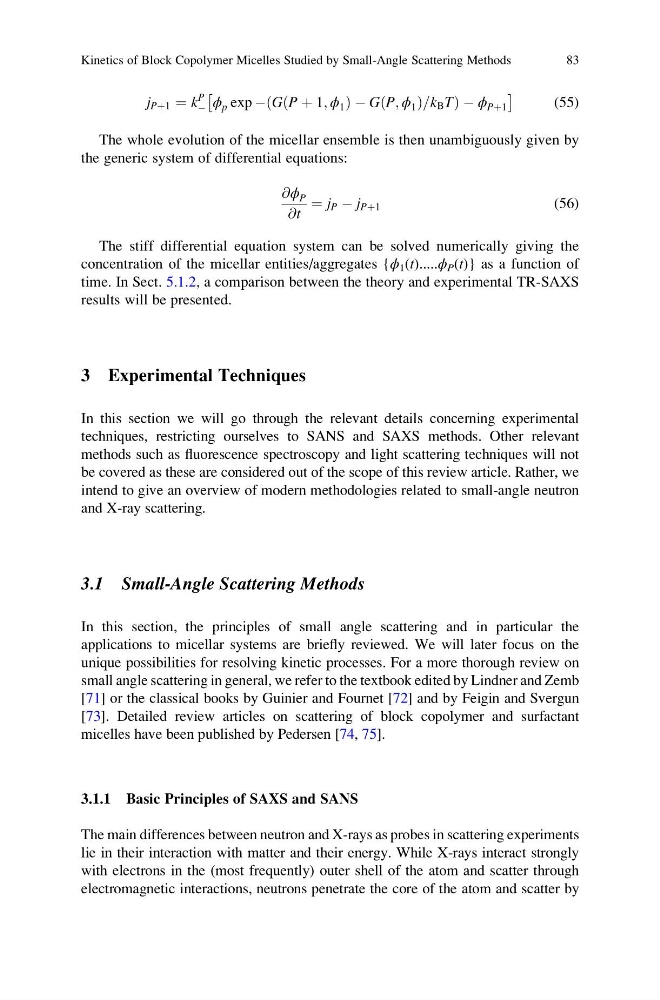
j Pþ1 ¼ k
P
À ϕ p exp À GðP þ 1; ϕ 1 Þ À GðP; ϕ 1 Þ=k B T
ð
Þ À ϕ Pþ1
Â
Ã
(55)
The whole evolution of the micellar ensemble is then unambiguously given by
the generic system of differential equations:
@ϕ P
@t
¼ j P À j Pþ1
(56)
The stiff differential equation system can be solved numerically giving the
concentration of the micellar entities/aggregates {ϕ 1 (t).....ϕ P (t)} as a function of
time. In Sect. 5.1.2, a comparison between the theory and experimental TR-SAXS
results will be presented.
3 Experimental Techniques
In this section we will go through the relevant details concerning experimental
techniques, restricting ourselves to SANS and SAXS methods. Other relevant
methods such as fluorescence spectroscopy and light scattering techniques will not
be covered as these are considered out of the scope of this review article. Rather, we
intend to give an overview of modern methodologies related to small-angle neutron
and X-ray scattering.
3.1 Small-Angle Scattering Methods
In this section, the principles of small angle scattering and in particular the
applications to micellar systems are briefly reviewed. We will later focus on the
unique possibilities for resolving kinetic processes. For a more thorough review on
small angle scattering in general, we refer to the textbook edited by Lindner and Zemb
[71] or the classical books by Guinier and Fournet [72] and by Feigin and Svergun
[73]. Detailed review articles on scattering of block copolymer and surfactant
micelles have been published by Pedersen [74, 75].
3.1.1 Basic Principles of SAXS and SANS
The main differences between neutron and X-rays as probes in scattering experiments
lie in their interaction with matter and their energy. While X-rays interact strongly
with electrons in the (most frequently) outer shell of the atom and scatter through
electromagnetic interactions, neutrons penetrate the core of the atom and scatter by
Kinetics of Block Copolymer Micelles Studied by Small-Angle Scattering Methods
83
P
À ϕ p exp À GðP þ 1; ϕ 1 Þ À GðP; ϕ 1 Þ=k B T
ð
Þ À ϕ Pþ1
Â
Ã
(55)
The whole evolution of the micellar ensemble is then unambiguously given by
the generic system of differential equations:
@ϕ P
@t
¼ j P À j Pþ1
(56)
The stiff differential equation system can be solved numerically giving the
concentration of the micellar entities/aggregates {ϕ 1 (t).....ϕ P (t)} as a function of
time. In Sect. 5.1.2, a comparison between the theory and experimental TR-SAXS
results will be presented.
3 Experimental Techniques
In this section we will go through the relevant details concerning experimental
techniques, restricting ourselves to SANS and SAXS methods. Other relevant
methods such as fluorescence spectroscopy and light scattering techniques will not
be covered as these are considered out of the scope of this review article. Rather, we
intend to give an overview of modern methodologies related to small-angle neutron
and X-ray scattering.
3.1 Small-Angle Scattering Methods
In this section, the principles of small angle scattering and in particular the
applications to micellar systems are briefly reviewed. We will later focus on the
unique possibilities for resolving kinetic processes. For a more thorough review on
small angle scattering in general, we refer to the textbook edited by Lindner and Zemb
[71] or the classical books by Guinier and Fournet [72] and by Feigin and Svergun
[73]. Detailed review articles on scattering of block copolymer and surfactant
micelles have been published by Pedersen [74, 75].
3.1.1 Basic Principles of SAXS and SANS
The main differences between neutron and X-rays as probes in scattering experiments
lie in their interaction with matter and their energy. While X-rays interact strongly
with electrons in the (most frequently) outer shell of the atom and scatter through
electromagnetic interactions, neutrons penetrate the core of the atom and scatter by
Kinetics of Block Copolymer Micelles Studied by Small-Angle Scattering Methods
83