

2.3.3 Nucleation and Growth Approach
Nucleation and growth theories constitute a very attractive methodology in solid
state physics to describe phenomena related to phase transitions. In this view, a new
phase is pictured as growing out from a small finite-sized droplet. Typical examples
are liquid bubbles formed from a gaseous phase (e.g., rain droplets), gas bubbles
forming under close-to-critical liquids (e.g., boiling water), or crystallization in
amorphous liquids (e.g., in silica-based semiconductors or organic polymers) [69].
Although micellization is not strictly speaking a phase transition phenomenon,
nucleation and growth can also be used here. The micelles are then seen as droplets
that can only grow up to limited size and will form a new continuous body
(new phase). The next section reviews an example of such an approach.
Micellization Kinetics as a Nucleation Process
Considering the results of Halperin and Alexander [60] and of Nyrkova and Semenov
[68] presented above, fusion and fission events between polymeric micelles appear to
be rather rare. In any case, unimer exchange will always be an important if not
completely dominating mechanism as a consequence of the low activation barrier of
the process compared to other mechanisms.
0 10 20 30 40 50 60 70 80 90 100 110
10
1
10
3
10
5
10
7
10
9
10
11
10
13
10
15
10
17
τ
mic [s]
φ 1 /cmc
cmc app.
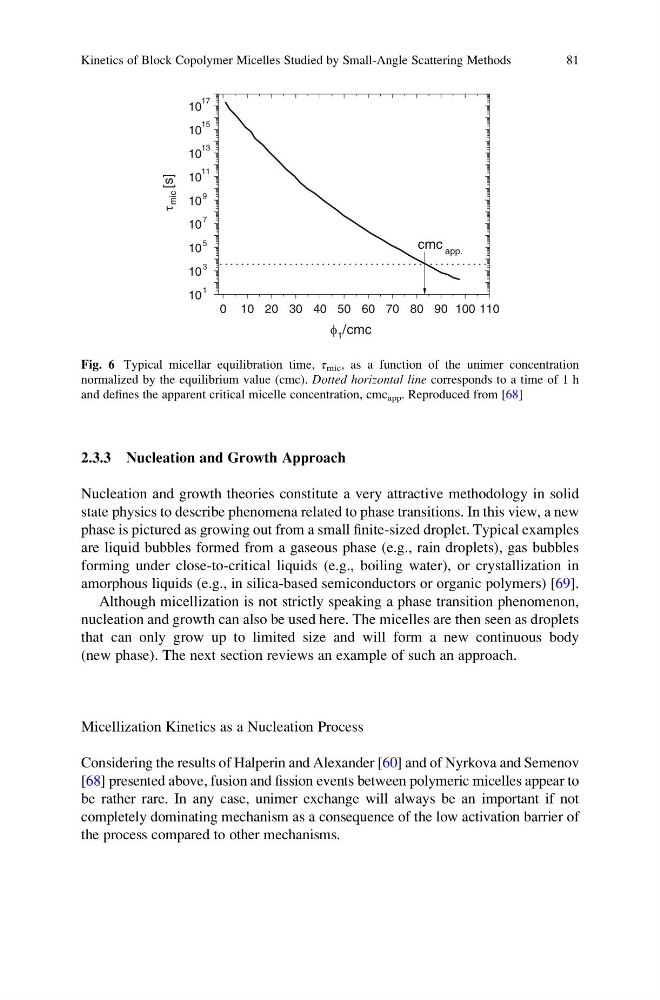
Fig. 6 Typical micellar equilibration time, τ mic , as a function of the unimer concentration
normalized by the equilibrium value (cmc). Dotted horizontal line corresponds to a time of 1 h
and defines the apparent critical micelle concentration, cmc app . Reproduced from [68]
Kinetics of Block Copolymer Micelles Studied by Small-Angle Scattering Methods
81
Nucleation and growth theories constitute a very attractive methodology in solid
state physics to describe phenomena related to phase transitions. In this view, a new
phase is pictured as growing out from a small finite-sized droplet. Typical examples
are liquid bubbles formed from a gaseous phase (e.g., rain droplets), gas bubbles
forming under close-to-critical liquids (e.g., boiling water), or crystallization in
amorphous liquids (e.g., in silica-based semiconductors or organic polymers) [69].
Although micellization is not strictly speaking a phase transition phenomenon,
nucleation and growth can also be used here. The micelles are then seen as droplets
that can only grow up to limited size and will form a new continuous body
(new phase). The next section reviews an example of such an approach.
Micellization Kinetics as a Nucleation Process
Considering the results of Halperin and Alexander [60] and of Nyrkova and Semenov
[68] presented above, fusion and fission events between polymeric micelles appear to
be rather rare. In any case, unimer exchange will always be an important if not
completely dominating mechanism as a consequence of the low activation barrier of
the process compared to other mechanisms.
0 10 20 30 40 50 60 70 80 90 100 110
10
1
10
3
10
5
10
7
10
9
10
11
10
13
10
15
10
17
τ
mic [s]
φ 1 /cmc
cmc app.
Fig. 6 Typical micellar equilibration time, τ mic , as a function of the unimer concentration
normalized by the equilibrium value (cmc). Dotted horizontal line corresponds to a time of 1 h
and defines the apparent critical micelle concentration, cmc app . Reproduced from [68]
Kinetics of Block Copolymer Micelles Studied by Small-Angle Scattering Methods
81