

where τ 0 is a typical factor setting the time scale and α ¼ 1/2 and 2/9 for a star-like
and crew-cut micelles, respectively.
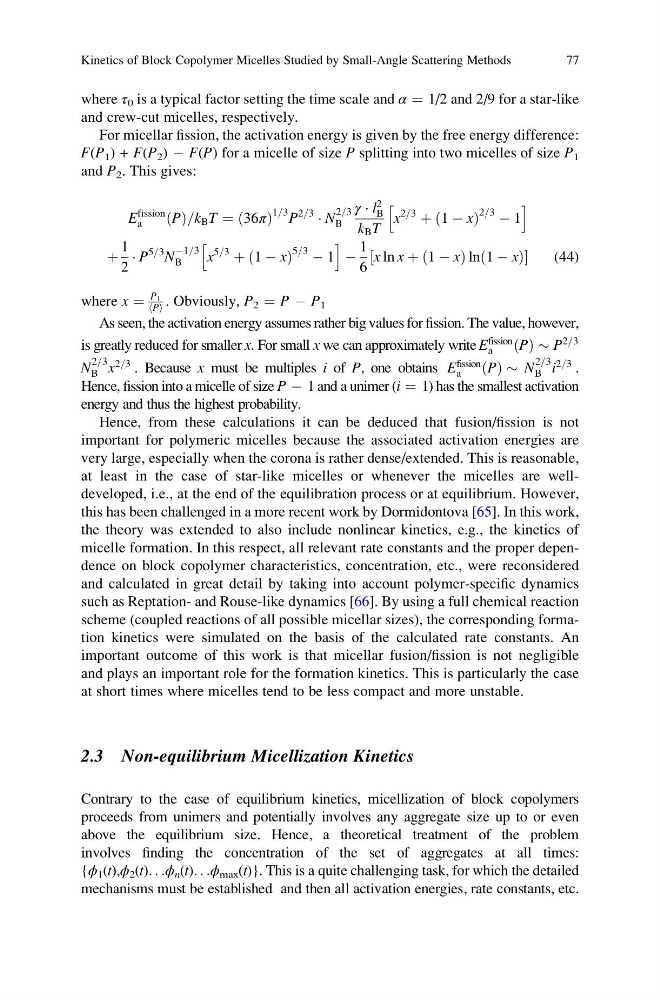
For micellar fission, the activation energy is given by the free energy difference:
F(P 1 ) + F(P 2 ) À F(P) for a micelle of size P splitting into two micelles of size P 1
and P 2 . This gives:
E
fission
a
ðPÞ=k B T ¼ ð36πÞ
1=3 P
2=3
Á N
2=3
B
γ Á l
2
B
k B T
x
2=3
þ ð1 À xÞ
2=3 À 1
h
i
þ
1
2
Á P
5=3 N
À1=3
B
x
5=3
þ ð1 À xÞ
5=3 À 1
h
i
À
1
6
x ln x þ ð1 À xÞ lnð1 À xÞ
½
(44)
where x ¼
P 1
hPi . Obviously, P 2 ¼ P À P 1
As seen, the activation energy assumes rather big values for fission. The value, however,
is greatly reduced for smaller x. For small x we can approximately write E
fission
a
ðPÞ $ P
2=3
N
2=3
B x
2=3 . Because x must be multiples i of P, one obtains E
fission
a
ðPÞ $ N
2=3
B i
2=3 .
Hence, fission into a micelle of size P À 1 and a unimer (i ¼ 1) has the smallest activation
energy and thus the highest probability.
Hence, from these calculations it can be deduced that fusion/fission is not
important for polymeric micelles because the associated activation energies are
very large, especially when the corona is rather dense/extended. This is reasonable,
at least in the case of star-like micelles or whenever the micelles are welldeveloped, i.e., at the end of the equilibration process or at equilibrium. However,
this has been challenged in a more recent work by Dormidontova [65]. In this work,
the theory was extended to also include nonlinear kinetics, e.g., the kinetics of
micelle formation. In this respect, all relevant rate constants and the proper dependence on block copolymer characteristics, concentration, etc., were reconsidered
and calculated in great detail by taking into account polymer-specific dynamics
such as Reptation- and Rouse-like dynamics [66]. By using a full chemical reaction
scheme (coupled reactions of all possible micellar sizes), the corresponding formation kinetics were simulated on the basis of the calculated rate constants. An
important outcome of this work is that micellar fusion/fission is not negligible
and plays an important role for the formation kinetics. This is particularly the case
at short times where micelles tend to be less compact and more unstable.
2.3 Non-equilibrium Micellization Kinetics
Contrary to the case of equilibrium kinetics, micellization of block copolymers
proceeds from unimers and potentially involves any aggregate size up to or even
above the equilibrium size. Hence, a theoretical treatment of the problem
involves finding the concentration of the set of aggregates at all times:
{ϕ 1 (t),ϕ 2 (t). . .ϕ n (t). . .ϕ max (t)}. This is a quite challenging task, for which the detailed
mechanisms must be established and then all activation energies, rate constants, etc.
Kinetics of Block Copolymer Micelles Studied by Small-Angle Scattering Methods
77
and crew-cut micelles, respectively.
For micellar fission, the activation energy is given by the free energy difference:
F(P 1 ) + F(P 2 ) À F(P) for a micelle of size P splitting into two micelles of size P 1
and P 2 . This gives:
E
fission
a
ðPÞ=k B T ¼ ð36πÞ
1=3 P
2=3
Á N
2=3
B
γ Á l
2
B
k B T
x
2=3
þ ð1 À xÞ
2=3 À 1
h
i
þ
1
2
Á P
5=3 N
À1=3
B
x
5=3
þ ð1 À xÞ
5=3 À 1
h
i
À
1
6
x ln x þ ð1 À xÞ lnð1 À xÞ
½
(44)
where x ¼
P 1
hPi . Obviously, P 2 ¼ P À P 1
As seen, the activation energy assumes rather big values for fission. The value, however,
is greatly reduced for smaller x. For small x we can approximately write E
fission
a
ðPÞ $ P
2=3
N
2=3
B x
2=3 . Because x must be multiples i of P, one obtains E
fission
a
ðPÞ $ N
2=3
B i
2=3 .
Hence, fission into a micelle of size P À 1 and a unimer (i ¼ 1) has the smallest activation
energy and thus the highest probability.
Hence, from these calculations it can be deduced that fusion/fission is not
important for polymeric micelles because the associated activation energies are
very large, especially when the corona is rather dense/extended. This is reasonable,
at least in the case of star-like micelles or whenever the micelles are welldeveloped, i.e., at the end of the equilibration process or at equilibrium. However,
this has been challenged in a more recent work by Dormidontova [65]. In this work,
the theory was extended to also include nonlinear kinetics, e.g., the kinetics of
micelle formation. In this respect, all relevant rate constants and the proper dependence on block copolymer characteristics, concentration, etc., were reconsidered
and calculated in great detail by taking into account polymer-specific dynamics
such as Reptation- and Rouse-like dynamics [66]. By using a full chemical reaction
scheme (coupled reactions of all possible micellar sizes), the corresponding formation kinetics were simulated on the basis of the calculated rate constants. An
important outcome of this work is that micellar fusion/fission is not negligible
and plays an important role for the formation kinetics. This is particularly the case
at short times where micelles tend to be less compact and more unstable.
2.3 Non-equilibrium Micellization Kinetics
Contrary to the case of equilibrium kinetics, micellization of block copolymers
proceeds from unimers and potentially involves any aggregate size up to or even
above the equilibrium size. Hence, a theoretical treatment of the problem
involves finding the concentration of the set of aggregates at all times:
{ϕ 1 (t),ϕ 2 (t). . .ϕ n (t). . .ϕ max (t)}. This is a quite challenging task, for which the detailed
mechanisms must be established and then all activation energies, rate constants, etc.
Kinetics of Block Copolymer Micelles Studied by Small-Angle Scattering Methods
77