

must be calculated. There are several approaches to this problem, which we will briefly
go through in the next section.
2.3.1 Chemical Reaction Approach
A brute force method for calculation of the micellization kinetics is to treat the
problem as series of chemical reactions. Such an approach has been developed
extensively within chemical engineering to treat complex coupled reactions.
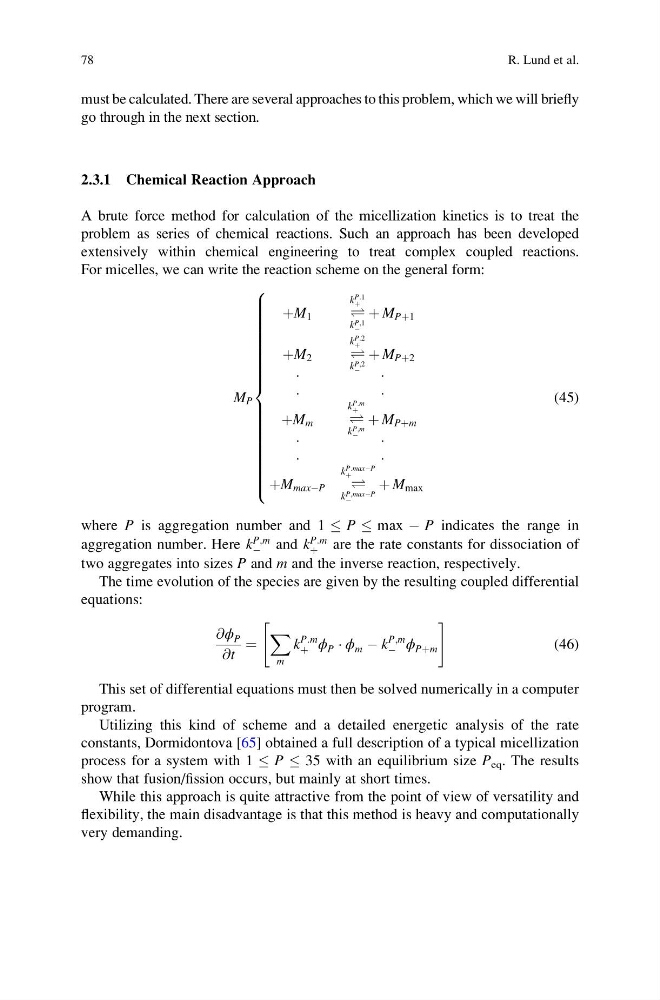
For micelles, we can write the reaction scheme on the general form:
M P
þM 1
Ð
k
P:1
þ
k P;1
À
þ M Pþ1
þM 2
Ð
k
P:2
þ
k P;2
À
þ M Pþ2
Á
Á
Á
Á
þM m
Ð
k
P:m
þ
k P;m
À
þ M Pþm
Á
Á
Á
Á
þM maxÀP
Ð
k
P:maxÀP
þ
k P;maxÀP
À
þ M max
8
> > > > > > > > > > > > > > > > > > <
> > > > > > > > > > > > > > > > > > :
(45)
where P is aggregation number and 1 P max À P indicates the range in
aggregation number. Here k
P;m
À and k
P:m
þ are the rate constants for dissociation of
two aggregates into sizes P and m and the inverse reaction, respectively.
The time evolution of the species are given by the resulting coupled differential
equations:
@ϕ P
@t
¼
X
m
k
P:m
þ ϕ P Á ϕ m À k
P;m
À ϕ Pþm
"
#
(46)
This set of differential equations must then be solved numerically in a computer
program.
Utilizing this kind of scheme and a detailed energetic analysis of the rate
constants, Dormidontova [65] obtained a full description of a typical micellization
process for a system with 1 P 35 with an equilibrium size P eq . The results
show that fusion/fission occurs, but mainly at short times.
While this approach is quite attractive from the point of view of versatility and
flexibility, the main disadvantage is that this method is heavy and computationally
very demanding.
78
R. Lund et al.
go through in the next section.
2.3.1 Chemical Reaction Approach
A brute force method for calculation of the micellization kinetics is to treat the
problem as series of chemical reactions. Such an approach has been developed
extensively within chemical engineering to treat complex coupled reactions.
For micelles, we can write the reaction scheme on the general form:
M P
þM 1
Ð
k
P:1
þ
k P;1
À
þ M Pþ1
þM 2
Ð
k
P:2
þ
k P;2
À
þ M Pþ2
Á
Á
Á
Á
þM m
Ð
k
P:m
þ
k P;m
À
þ M Pþm
Á
Á
Á
Á
þM maxÀP
Ð
k
P:maxÀP
þ
k P;maxÀP
À
þ M max
8
> > > > > > > > > > > > > > > > > > <
> > > > > > > > > > > > > > > > > > :
(45)
where P is aggregation number and 1 P max À P indicates the range in
aggregation number. Here k
P;m
À and k
P:m
þ are the rate constants for dissociation of
two aggregates into sizes P and m and the inverse reaction, respectively.
The time evolution of the species are given by the resulting coupled differential
equations:
@ϕ P
@t
¼
X
m
k
P:m
þ ϕ P Á ϕ m À k
P;m
À ϕ Pþm
"
#
(46)
This set of differential equations must then be solved numerically in a computer
program.
Utilizing this kind of scheme and a detailed energetic analysis of the rate
constants, Dormidontova [65] obtained a full description of a typical micellization
process for a system with 1 P 35 with an equilibrium size P eq . The results
show that fusion/fission occurs, but mainly at short times.
While this approach is quite attractive from the point of view of versatility and
flexibility, the main disadvantage is that this method is heavy and computationally
very demanding.
78
R. Lund et al.