

direct overlap of the corona belonging to two adjacent micelles. Alternatively, a
similar effect can be induced by adding A-type homopolymers [64].
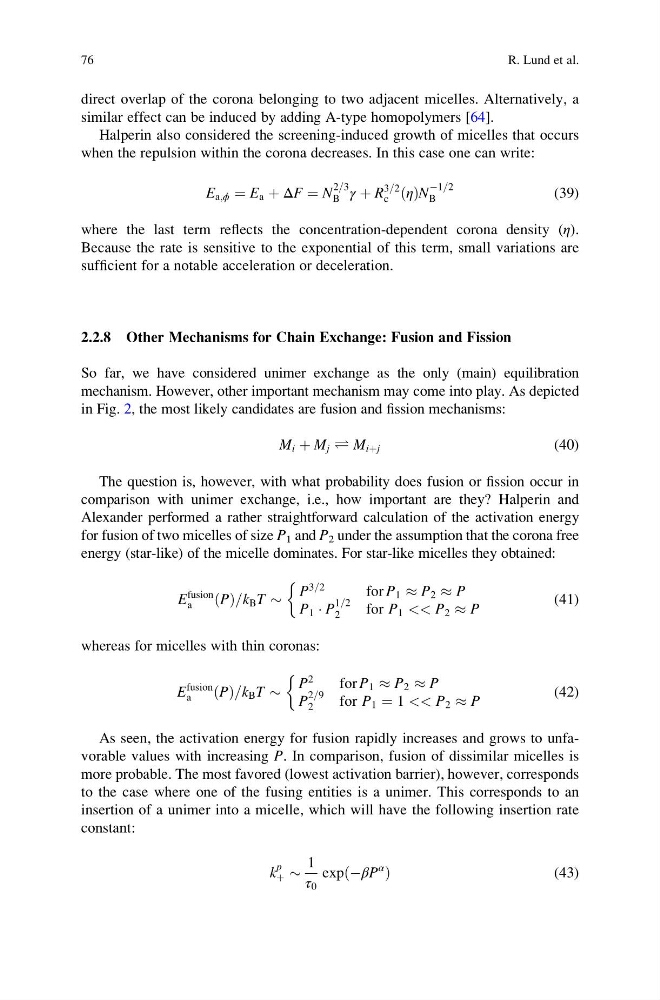
Halperin also considered the screening-induced growth of micelles that occurs
when the repulsion within the corona decreases. In this case one can write:
E a;ϕ ¼ E a þ ΔF ¼ N
2=3
B γ þ R
3=2
c ðηÞN
À1=2
B
(39)
where the last term reflects the concentration-dependent corona density (η).
Because the rate is sensitive to the exponential of this term, small variations are
sufficient for a notable acceleration or deceleration.
2.2.8 Other Mechanisms for Chain Exchange: Fusion and Fission
So far, we have considered unimer exchange as the only (main) equilibration
mechanism. However, other important mechanism may come into play. As depicted
in Fig. 2, the most likely candidates are fusion and fission mechanisms:
M i þ M j Ð M iþj
(40)
The question is, however, with what probability does fusion or fission occur in
comparison with unimer exchange, i.e., how important are they? Halperin and
Alexander performed a rather straightforward calculation of the activation energy
for fusion of two micelles of size P 1 and P 2 under the assumption that the corona free
energy (star-like) of the micelle dominates. For star-like micelles they obtained:
E
fusion
a
ðPÞ=k B T $
P
3=2
for P 1 % P 2 % P
P 1 Á P
1=2
2
for P 1 << P 2 % P
&
(41)
whereas for micelles with thin coronas:
E
fusion
a
ðPÞ=k B T $
P
2
for P 1 % P 2 % P
P
2=9
2
for P 1 ¼ 1 << P 2 % P
&
(42)
As seen, the activation energy for fusion rapidly increases and grows to unfavorable values with increasing P. In comparison, fusion of dissimilar micelles is
more probable. The most favored (lowest activation barrier), however, corresponds
to the case where one of the fusing entities is a unimer. This corresponds to an
insertion of a unimer into a micelle, which will have the following insertion rate
constant:
k
p
þ $
1
τ 0
expðÀβP
α
Þ
(43)
76
R. Lund et al.
similar effect can be induced by adding A-type homopolymers [64].
Halperin also considered the screening-induced growth of micelles that occurs
when the repulsion within the corona decreases. In this case one can write:
E a;ϕ ¼ E a þ ΔF ¼ N
2=3
B γ þ R
3=2
c ðηÞN
À1=2
B
(39)
where the last term reflects the concentration-dependent corona density (η).
Because the rate is sensitive to the exponential of this term, small variations are
sufficient for a notable acceleration or deceleration.
2.2.8 Other Mechanisms for Chain Exchange: Fusion and Fission
So far, we have considered unimer exchange as the only (main) equilibration
mechanism. However, other important mechanism may come into play. As depicted
in Fig. 2, the most likely candidates are fusion and fission mechanisms:
M i þ M j Ð M iþj
(40)
The question is, however, with what probability does fusion or fission occur in
comparison with unimer exchange, i.e., how important are they? Halperin and
Alexander performed a rather straightforward calculation of the activation energy
for fusion of two micelles of size P 1 and P 2 under the assumption that the corona free
energy (star-like) of the micelle dominates. For star-like micelles they obtained:
E
fusion
a
ðPÞ=k B T $
P
3=2
for P 1 % P 2 % P
P 1 Á P
1=2
2
for P 1 << P 2 % P
&
(41)
whereas for micelles with thin coronas:
E
fusion
a
ðPÞ=k B T $
P
2
for P 1 % P 2 % P
P
2=9
2
for P 1 ¼ 1 << P 2 % P
&
(42)
As seen, the activation energy for fusion rapidly increases and grows to unfavorable values with increasing P. In comparison, fusion of dissimilar micelles is
more probable. The most favored (lowest activation barrier), however, corresponds
to the case where one of the fusing entities is a unimer. This corresponds to an
insertion of a unimer into a micelle, which will have the following insertion rate
constant:
k
p
þ $
1
τ 0
expðÀβP
α
Þ
(43)
76
R. Lund et al.