

where V 0 is the monomer volume of the hydrophobic block.
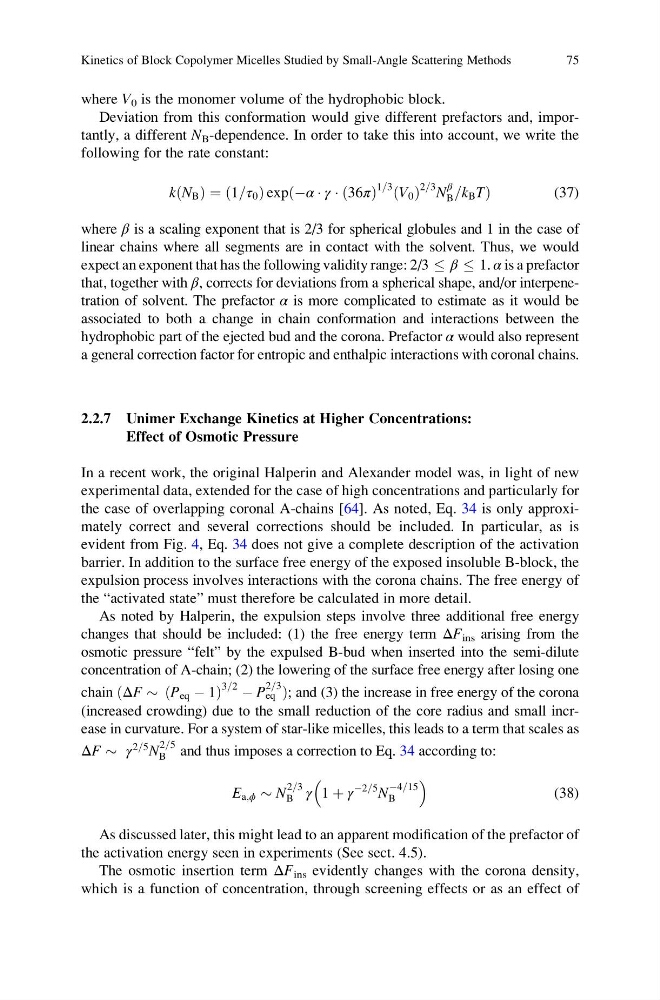
Deviation from this conformation would give different prefactors and, importantly, a different N B -dependence. In order to take this into account, we write the
following for the rate constant:
kðN B Þ ¼ ð1=τ 0 Þ expðÀα Á γ Á ð36πÞ
1=3 ðV 0 Þ
2=3 N
β
B =k B TÞ
(37)
where β is a scaling exponent that is 2/3 for spherical globules and 1 in the case of
linear chains where all segments are in contact with the solvent. Thus, we would
expect an exponent that has the following validity range: 2/3 β 1. α is a prefactor
that, together with β, corrects for deviations from a spherical shape, and/or interpenetration of solvent. The prefactor α is more complicated to estimate as it would be
associated to both a change in chain conformation and interactions between the
hydrophobic part of the ejected bud and the corona. Prefactor α would also represent
a general correction factor for entropic and enthalpic interactions with coronal chains.
2.2.7 Unimer Exchange Kinetics at Higher Concentrations:
Effect of Osmotic Pressure
In a recent work, the original Halperin and Alexander model was, in light of new
experimental data, extended for the case of high concentrations and particularly for
the case of overlapping coronal A-chains [64]. As noted, Eq. 34 is only approximately correct and several corrections should be included. In particular, as is
evident from Fig. 4, Eq. 34 does not give a complete description of the activation
barrier. In addition to the surface free energy of the exposed insoluble B-block, the
expulsion process involves interactions with the corona chains. The free energy of
the “activated state” must therefore be calculated in more detail.
As noted by Halperin, the expulsion steps involve three additional free energy
changes that should be included: (1) the free energy term ΔF ins arising from the
osmotic pressure “felt” by the expulsed B-bud when inserted into the semi-dilute
concentration of A-chain; (2) the lowering of the surface free energy after losing one
chain ðΔF $ ðP eq À 1Þ
3=2 À P
2=3
eq Þ; and (3) the increase in free energy of the corona
(increased crowding) due to the small reduction of the core radius and small increase in curvature. For a system of star-like micelles, this leads to a term that scales as
ΔF $ γ
2=5 N
2=5
B and thus imposes a correction to Eq. 34 according to:
E a;ϕ $ N
2=3
B γ 1 þ γ
À2=5 N
À4=15
B
(38)
As discussed later, this might lead to an apparent modification of the prefactor of
the activation energy seen in experiments (See sect. 4.5).
The osmotic insertion term ΔF ins evidently changes with the corona density,
which is a function of concentration, through screening effects or as an effect of
Kinetics of Block Copolymer Micelles Studied by Small-Angle Scattering Methods
75
Deviation from this conformation would give different prefactors and, importantly, a different N B -dependence. In order to take this into account, we write the
following for the rate constant:
kðN B Þ ¼ ð1=τ 0 Þ expðÀα Á γ Á ð36πÞ
1=3 ðV 0 Þ
2=3 N
β
B =k B TÞ
(37)
where β is a scaling exponent that is 2/3 for spherical globules and 1 in the case of
linear chains where all segments are in contact with the solvent. Thus, we would
expect an exponent that has the following validity range: 2/3 β 1. α is a prefactor
that, together with β, corrects for deviations from a spherical shape, and/or interpenetration of solvent. The prefactor α is more complicated to estimate as it would be
associated to both a change in chain conformation and interactions between the
hydrophobic part of the ejected bud and the corona. Prefactor α would also represent
a general correction factor for entropic and enthalpic interactions with coronal chains.
2.2.7 Unimer Exchange Kinetics at Higher Concentrations:
Effect of Osmotic Pressure
In a recent work, the original Halperin and Alexander model was, in light of new
experimental data, extended for the case of high concentrations and particularly for
the case of overlapping coronal A-chains [64]. As noted, Eq. 34 is only approximately correct and several corrections should be included. In particular, as is
evident from Fig. 4, Eq. 34 does not give a complete description of the activation
barrier. In addition to the surface free energy of the exposed insoluble B-block, the
expulsion process involves interactions with the corona chains. The free energy of
the “activated state” must therefore be calculated in more detail.
As noted by Halperin, the expulsion steps involve three additional free energy
changes that should be included: (1) the free energy term ΔF ins arising from the
osmotic pressure “felt” by the expulsed B-bud when inserted into the semi-dilute
concentration of A-chain; (2) the lowering of the surface free energy after losing one
chain ðΔF $ ðP eq À 1Þ
3=2 À P
2=3
eq Þ; and (3) the increase in free energy of the corona
(increased crowding) due to the small reduction of the core radius and small increase in curvature. For a system of star-like micelles, this leads to a term that scales as
ΔF $ γ
2=5 N
2=5
B and thus imposes a correction to Eq. 34 according to:
E a;ϕ $ N
2=3
B γ 1 þ γ
À2=5 N
À4=15
B
(38)
As discussed later, this might lead to an apparent modification of the prefactor of
the activation energy seen in experiments (See sect. 4.5).
The osmotic insertion term ΔF ins evidently changes with the corona density,
which is a function of concentration, through screening effects or as an effect of
Kinetics of Block Copolymer Micelles Studied by Small-Angle Scattering Methods
75