

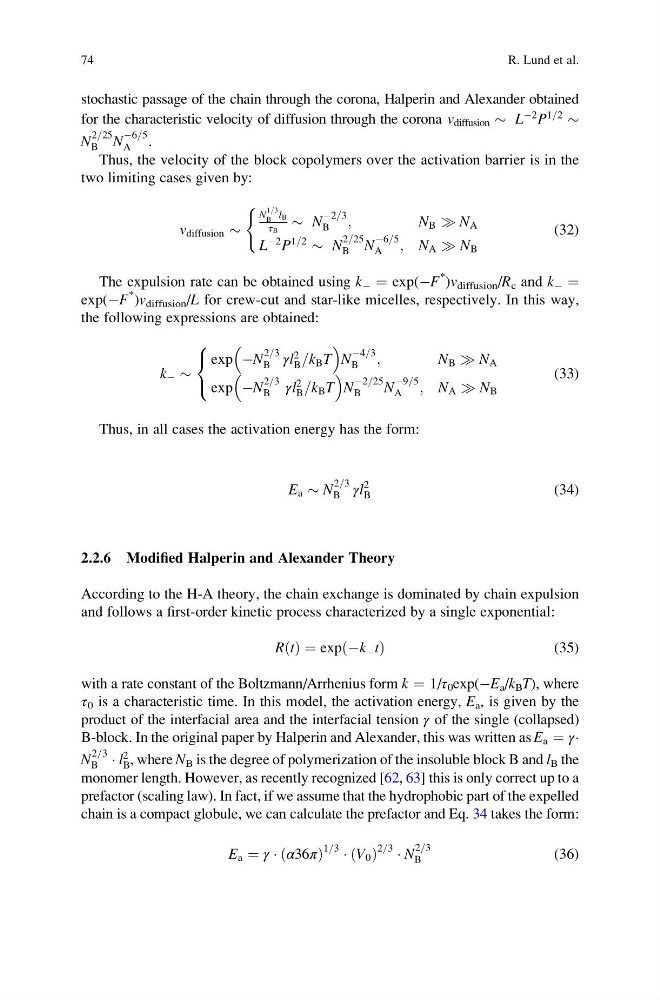
stochastic passage of the chain through the corona, Halperin and Alexander obtained
for the characteristic velocity of diffusion through the corona v diffusion $ L
À2 P
1=2
$
N
2=25
B N
À6=5
A
.
Thus, the velocity of the block copolymers over the activation barrier is in the
two limiting cases given by:
v diffusion $
N
1=3
B l B
τ B
$ N
À2=3
B
;
N B ) N A
L
À2 P
1=2
$ N
2=25
B N
À6=5
A
; N A ) N B
(
(32)
The expulsion rate can be obtained using k À ¼ exp(ÀF
* )v diffusion /R c and k À ¼
exp(ÀF
* )v diffusion /L for crew-cut and star-like micelles, respectively. In this way,
the following expressions are obtained:
k À $
exp ÀN
2=3
B γl
2
B =k B T
N
À4=3
B
;
N B ) N A
exp ÀN
2=3
B γl
2
B =k B T
N
À2=25
B
N
À9=5
A
; N A ) N B
8
<
:
(33)
Thus, in all cases the activation energy has the form:
E a $ N
2=3
B γl
2
B
(34)
2.2.6 Modified Halperin and Alexander Theory
According to the H-A theory, the chain exchange is dominated by chain expulsion
and follows a first-order kinetic process characterized by a single exponential:
RðtÞ ¼ expðÀk À tÞ
(35)
with a rate constant of the Boltzmann/Arrhenius form k ¼ 1/τ 0 exp(ÀE a /k B T), where
τ 0 is a characteristic time. In this model, the activation energy, E a , is given by the
product of the interfacial area and the interfacial tension γ of the single (collapsed)
B-block. In the original paper by Halperin and Alexander, this was written as E a ¼ γÁ
N
2=3
B Á l
2
B , where N B is the degree of polymerization of the insoluble block B and l B the
monomer length. However, as recently recognized [62, 63] this is only correct up to a
prefactor (scaling law). In fact, if we assume that the hydrophobic part of the expelled
chain is a compact globule, we can calculate the prefactor and Eq. 34 takes the form:
E a ¼ γ Á ðα36πÞ
1=3 Á ðV 0 Þ
2=3 Á N
2=3
B
(36)
74
R. Lund et al.
for the characteristic velocity of diffusion through the corona v diffusion $ L
À2 P
1=2
$
N
2=25
B N
À6=5
A
.
Thus, the velocity of the block copolymers over the activation barrier is in the
two limiting cases given by:
v diffusion $
N
1=3
B l B
τ B
$ N
À2=3
B
;
N B ) N A
L
À2 P
1=2
$ N
2=25
B N
À6=5
A
; N A ) N B
(
(32)
The expulsion rate can be obtained using k À ¼ exp(ÀF
* )v diffusion /R c and k À ¼
exp(ÀF
* )v diffusion /L for crew-cut and star-like micelles, respectively. In this way,
the following expressions are obtained:
k À $
exp ÀN
2=3
B γl
2
B =k B T
N
À4=3
B
;
N B ) N A
exp ÀN
2=3
B γl
2
B =k B T
N
À2=25
B
N
À9=5
A
; N A ) N B
8
<
:
(33)
Thus, in all cases the activation energy has the form:
E a $ N
2=3
B γl
2
B
(34)
2.2.6 Modified Halperin and Alexander Theory
According to the H-A theory, the chain exchange is dominated by chain expulsion
and follows a first-order kinetic process characterized by a single exponential:
RðtÞ ¼ expðÀk À tÞ
(35)
with a rate constant of the Boltzmann/Arrhenius form k ¼ 1/τ 0 exp(ÀE a /k B T), where
τ 0 is a characteristic time. In this model, the activation energy, E a , is given by the
product of the interfacial area and the interfacial tension γ of the single (collapsed)
B-block. In the original paper by Halperin and Alexander, this was written as E a ¼ γÁ
N
2=3
B Á l
2
B , where N B is the degree of polymerization of the insoluble block B and l B the
monomer length. However, as recently recognized [62, 63] this is only correct up to a
prefactor (scaling law). In fact, if we assume that the hydrophobic part of the expelled
chain is a compact globule, we can calculate the prefactor and Eq. 34 takes the form:
E a ¼ γ Á ðα36πÞ
1=3 Á ðV 0 Þ
2=3 Á N
2=3
B
(36)
74
R. Lund et al.