

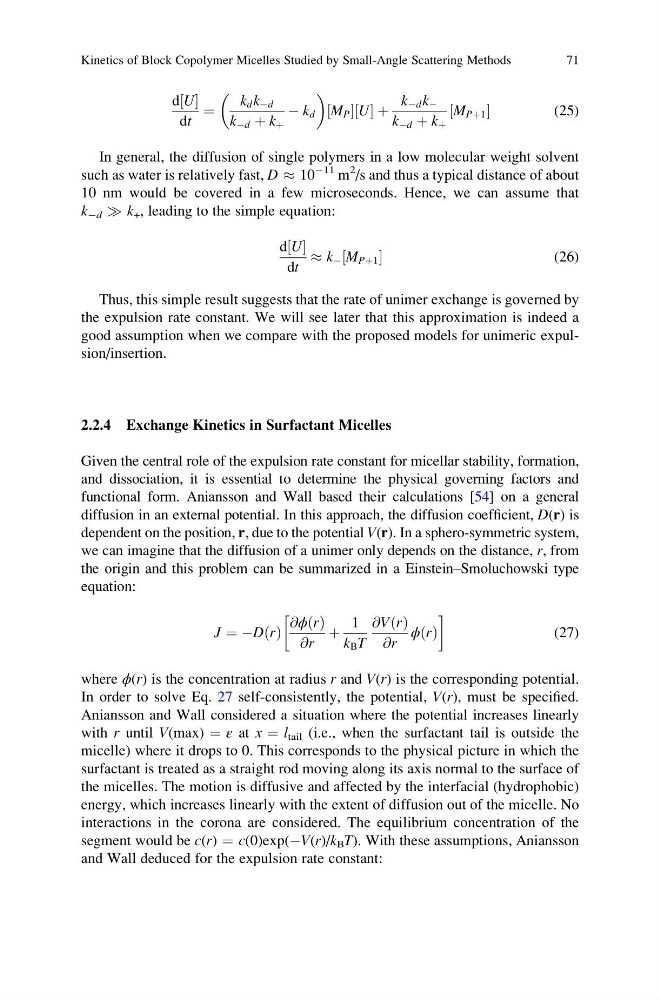
d½U
dt
¼
k d k Àd
k Àd þ k þ
À k d
½M P ½U þ
k Àd k À
k Àd þ k þ
½M Pþ1
(25)
In general, the diffusion of single polymers in a low molecular weight solvent
such as water is relatively fast, D % 10
À11 m
2
/s and thus a typical distance of about
10 nm would be covered in a few microseconds. Hence, we can assume that
k Àd ) k + , leading to the simple equation:
d½U
dt
% k À ½M Pþ1
(26)
Thus, this simple result suggests that the rate of unimer exchange is governed by
the expulsion rate constant. We will see later that this approximation is indeed a
good assumption when we compare with the proposed models for unimeric expulsion/insertion.
2.2.4 Exchange Kinetics in Surfactant Micelles
Given the central role of the expulsion rate constant for micellar stability, formation,
and dissociation, it is essential to determine the physical governing factors and
functional form. Aniansson and Wall based their calculations [54] on a general
diffusion in an external potential. In this approach, the diffusion coefficient, D(r) is
dependent on the position, r, due to the potential V(r). In a sphero-symmetric system,
we can imagine that the diffusion of a unimer only depends on the distance, r, from
the origin and this problem can be summarized in a Einstein–Smoluchowski type
equation:
J ¼ ÀDðrÞ
@ϕðrÞ
@r
þ
1
k B T
@VðrÞ
@r
ϕðrÞ
!
(27)
where ϕ(r) is the concentration at radius r and V(r) is the corresponding potential.
In order to solve Eq. 27 self-consistently, the potential, V(r), must be specified.
Aniansson and Wall considered a situation where the potential increases linearly
with r until V(max) ¼ ε at x ¼ l tail (i.e., when the surfactant tail is outside the
micelle) where it drops to 0. This corresponds to the physical picture in which the
surfactant is treated as a straight rod moving along its axis normal to the surface of
the micelles. The motion is diffusive and affected by the interfacial (hydrophobic)
energy, which increases linearly with the extent of diffusion out of the micelle. No
interactions in the corona are considered. The equilibrium concentration of the
segment would be c(r) ¼ c(0)exp(ÀV(r)/k B T). With these assumptions, Aniansson
and Wall deduced for the expulsion rate constant:
Kinetics of Block Copolymer Micelles Studied by Small-Angle Scattering Methods
71
dt
¼
k d k Àd
k Àd þ k þ
À k d
½M P ½U þ
k Àd k À
k Àd þ k þ
½M Pþ1
(25)
In general, the diffusion of single polymers in a low molecular weight solvent
such as water is relatively fast, D % 10
À11 m
2
/s and thus a typical distance of about
10 nm would be covered in a few microseconds. Hence, we can assume that
k Àd ) k + , leading to the simple equation:
d½U
dt
% k À ½M Pþ1
(26)
Thus, this simple result suggests that the rate of unimer exchange is governed by
the expulsion rate constant. We will see later that this approximation is indeed a
good assumption when we compare with the proposed models for unimeric expulsion/insertion.
2.2.4 Exchange Kinetics in Surfactant Micelles
Given the central role of the expulsion rate constant for micellar stability, formation,
and dissociation, it is essential to determine the physical governing factors and
functional form. Aniansson and Wall based their calculations [54] on a general
diffusion in an external potential. In this approach, the diffusion coefficient, D(r) is
dependent on the position, r, due to the potential V(r). In a sphero-symmetric system,
we can imagine that the diffusion of a unimer only depends on the distance, r, from
the origin and this problem can be summarized in a Einstein–Smoluchowski type
equation:
J ¼ ÀDðrÞ
@ϕðrÞ
@r
þ
1
k B T
@VðrÞ
@r
ϕðrÞ
!
(27)
where ϕ(r) is the concentration at radius r and V(r) is the corresponding potential.
In order to solve Eq. 27 self-consistently, the potential, V(r), must be specified.
Aniansson and Wall considered a situation where the potential increases linearly
with r until V(max) ¼ ε at x ¼ l tail (i.e., when the surfactant tail is outside the
micelle) where it drops to 0. This corresponds to the physical picture in which the
surfactant is treated as a straight rod moving along its axis normal to the surface of
the micelles. The motion is diffusive and affected by the interfacial (hydrophobic)
energy, which increases linearly with the extent of diffusion out of the micelle. No
interactions in the corona are considered. The equilibrium concentration of the
segment would be c(r) ¼ c(0)exp(ÀV(r)/k B T). With these assumptions, Aniansson
and Wall deduced for the expulsion rate constant:
Kinetics of Block Copolymer Micelles Studied by Small-Angle Scattering Methods
71