

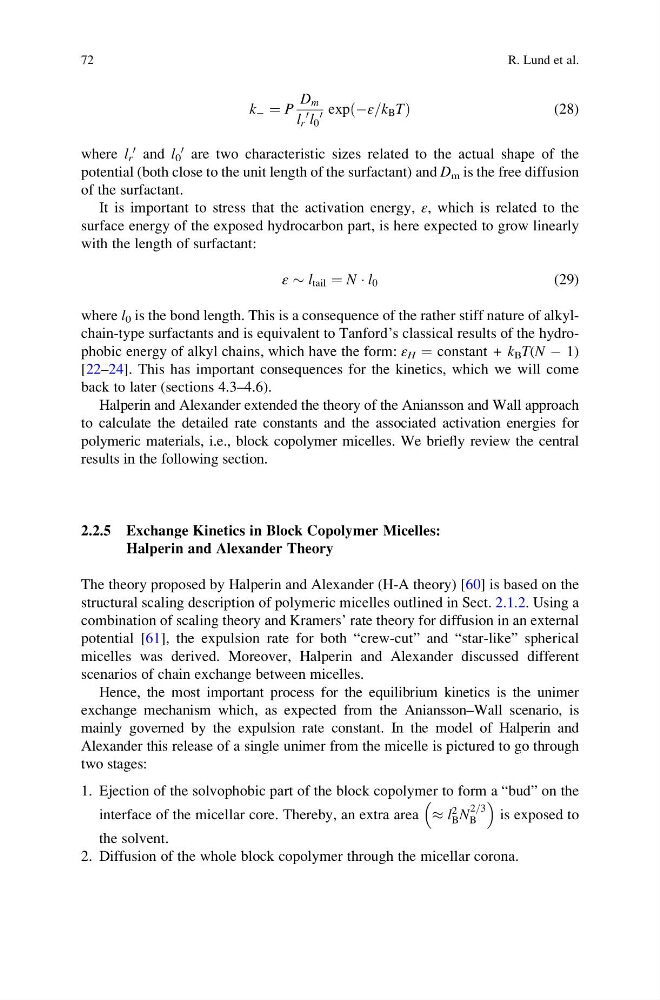
k À ¼ P
D m
l r
0 l 0
0 expðÀε=k B TÞ
(28)
where l r
0 and l 0
0 are two characteristic sizes related to the actual shape of the
potential (both close to the unit length of the surfactant) and D m is the free diffusion
of the surfactant.
It is important to stress that the activation energy, ε, which is related to the
surface energy of the exposed hydrocarbon part, is here expected to grow linearly
with the length of surfactant:
ε $ l tail ¼ N Á l 0
(29)
where l 0 is the bond length. This is a consequence of the rather stiff nature of alkylchain-type surfactants and is equivalent to Tanford’s classical results of the hydrophobic energy of alkyl chains, which have the form: ε H ¼ constant + k B T(N À 1)
[22–24]. This has important consequences for the kinetics, which we will come
back to later (sections 4.3–4.6).
Halperin and Alexander extended the theory of the Aniansson and Wall approach
to calculate the detailed rate constants and the associated activation energies for
polymeric materials, i.e., block copolymer micelles. We briefly review the central
results in the following section.
2.2.5 Exchange Kinetics in Block Copolymer Micelles:
Halperin and Alexander Theory
The theory proposed by Halperin and Alexander (H-A theory) [60] is based on the
structural scaling description of polymeric micelles outlined in Sect. 2.1.2. Using a
combination of scaling theory and Kramers’ rate theory for diffusion in an external
potential [61], the expulsion rate for both “crew-cut” and “star-like” spherical
micelles was derived. Moreover, Halperin and Alexander discussed different
scenarios of chain exchange between micelles.
Hence, the most important process for the equilibrium kinetics is the unimer
exchange mechanism which, as expected from the Aniansson–Wall scenario, is
mainly governed by the expulsion rate constant. In the model of Halperin and
Alexander this release of a single unimer from the micelle is pictured to go through
two stages:
1. Ejection of the solvophobic part of the block copolymer to form a “bud” on the
interface of the micellar core. Thereby, an extra area % l
2
B N
2=3
B
is exposed to
the solvent.
2. Diffusion of the whole block copolymer through the micellar corona.
72
R. Lund et al.
D m
l r
0 l 0
0 expðÀε=k B TÞ
(28)
where l r
0 and l 0
0 are two characteristic sizes related to the actual shape of the
potential (both close to the unit length of the surfactant) and D m is the free diffusion
of the surfactant.
It is important to stress that the activation energy, ε, which is related to the
surface energy of the exposed hydrocarbon part, is here expected to grow linearly
with the length of surfactant:
ε $ l tail ¼ N Á l 0
(29)
where l 0 is the bond length. This is a consequence of the rather stiff nature of alkylchain-type surfactants and is equivalent to Tanford’s classical results of the hydrophobic energy of alkyl chains, which have the form: ε H ¼ constant + k B T(N À 1)
[22–24]. This has important consequences for the kinetics, which we will come
back to later (sections 4.3–4.6).
Halperin and Alexander extended the theory of the Aniansson and Wall approach
to calculate the detailed rate constants and the associated activation energies for
polymeric materials, i.e., block copolymer micelles. We briefly review the central
results in the following section.
2.2.5 Exchange Kinetics in Block Copolymer Micelles:
Halperin and Alexander Theory
The theory proposed by Halperin and Alexander (H-A theory) [60] is based on the
structural scaling description of polymeric micelles outlined in Sect. 2.1.2. Using a
combination of scaling theory and Kramers’ rate theory for diffusion in an external
potential [61], the expulsion rate for both “crew-cut” and “star-like” spherical
micelles was derived. Moreover, Halperin and Alexander discussed different
scenarios of chain exchange between micelles.
Hence, the most important process for the equilibrium kinetics is the unimer
exchange mechanism which, as expected from the Aniansson–Wall scenario, is
mainly governed by the expulsion rate constant. In the model of Halperin and
Alexander this release of a single unimer from the micelle is pictured to go through
two stages:
1. Ejection of the solvophobic part of the block copolymer to form a “bud” on the
interface of the micellar core. Thereby, an extra area % l
2
B N
2=3
B
is exposed to
the solvent.
2. Diffusion of the whole block copolymer through the micellar corona.
72
R. Lund et al.