

to slower τ 2 at higher concentrations (increasing ionic strengths). Some corrections
along these lines, explicitly taking into account issues of charge screening, have
been done by Kahlweit and coworkers [52, 53].
2.2.2 Rate Constants for Unimer Exchange in Equilibrium
Most of the experimental and theoretical work concerning kinetics of micellar
systems in the 1970s and 1980s were concerned with the outcome of so-called
linear relaxation experiments. There was also an attempt to relate the kinetics with
the general diffusion in micellar systems [50]. NMR experiments as well as later
experiments using fluorescence spectroscopy or neutron scattering are able to
follow labeled entities and the signal is not related to changes in sizes and their
distributions. For example, in temperature-jump experiments followed by light
scattering, the changes in concentration and size of all micelles and unimers are
monitored. A labeling experiment is thus “cleaner” and provides a more direct
access to the rate constants. In addition, for neutron scattering, the structure can also
be analyzed simultaneously with nanometer resolution. In the subsequent section,
rate constants associated with micellar kinetics and their dependence on molecular
parameters will be discussed.
2.2.3 Reaction-Limited Versus Diffusion-Limited Exchange Kinetics
The situation for low molecular weight surfactant micelles might be different to that
for polymeric micelles. In the former case, the kinetics is close to being “diffusionlimited” [54], i.e., the diffusion of chains between the micellar droplets is comparable to the time scale of the expulsion/insertion process.
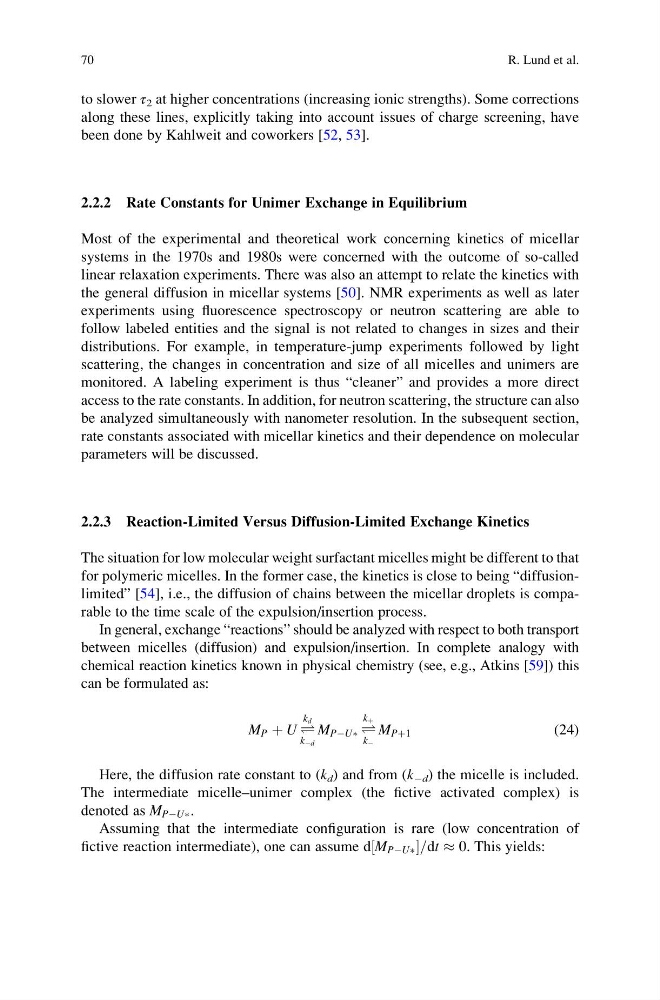
In general, exchange “reactions” should be analyzed with respect to both transport
between micelles (diffusion) and expulsion/insertion. In complete analogy with
chemical reaction kinetics known in physical chemistry (see, e.g., Atkins [59]) this
can be formulated as:
M P þ U Ð
k d
k Àd
M PÀUÃ Ð
k þ
k À
M Pþ1
(24)
Here, the diffusion rate constant to (k d ) and from (k Àd ) the micelle is included.
The intermediate micelle–unimer complex (the fictive activated complex) is
denoted as M PÀUÃ .
Assuming that the intermediate configuration is rare (low concentration of
fictive reaction intermediate), one can assume d M PÀUÃ
½
=dt % 0. This yields:
70
R. Lund et al.
along these lines, explicitly taking into account issues of charge screening, have
been done by Kahlweit and coworkers [52, 53].
2.2.2 Rate Constants for Unimer Exchange in Equilibrium
Most of the experimental and theoretical work concerning kinetics of micellar
systems in the 1970s and 1980s were concerned with the outcome of so-called
linear relaxation experiments. There was also an attempt to relate the kinetics with
the general diffusion in micellar systems [50]. NMR experiments as well as later
experiments using fluorescence spectroscopy or neutron scattering are able to
follow labeled entities and the signal is not related to changes in sizes and their
distributions. For example, in temperature-jump experiments followed by light
scattering, the changes in concentration and size of all micelles and unimers are
monitored. A labeling experiment is thus “cleaner” and provides a more direct
access to the rate constants. In addition, for neutron scattering, the structure can also
be analyzed simultaneously with nanometer resolution. In the subsequent section,
rate constants associated with micellar kinetics and their dependence on molecular
parameters will be discussed.
2.2.3 Reaction-Limited Versus Diffusion-Limited Exchange Kinetics
The situation for low molecular weight surfactant micelles might be different to that
for polymeric micelles. In the former case, the kinetics is close to being “diffusionlimited” [54], i.e., the diffusion of chains between the micellar droplets is comparable to the time scale of the expulsion/insertion process.
In general, exchange “reactions” should be analyzed with respect to both transport
between micelles (diffusion) and expulsion/insertion. In complete analogy with
chemical reaction kinetics known in physical chemistry (see, e.g., Atkins [59]) this
can be formulated as:
M P þ U Ð
k d
k Àd
M PÀUÃ Ð
k þ
k À
M Pþ1
(24)
Here, the diffusion rate constant to (k d ) and from (k Àd ) the micelle is included.
The intermediate micelle–unimer complex (the fictive activated complex) is
denoted as M PÀUÃ .
Assuming that the intermediate configuration is rare (low concentration of
fictive reaction intermediate), one can assume d M PÀUÃ
½
=dt % 0. This yields:
70
R. Lund et al.