

possible to make several simplifications and consider limiting cases or classes of
micelles. We will assume that the pseudo-phase approximation is fulfilled and that
mixing entropy terms are negligible and can be ignored.
In all models (as for mean-field theories), the reduction of interfacial area upon
micellization is considered to be the driving force for micellization. Thus, the
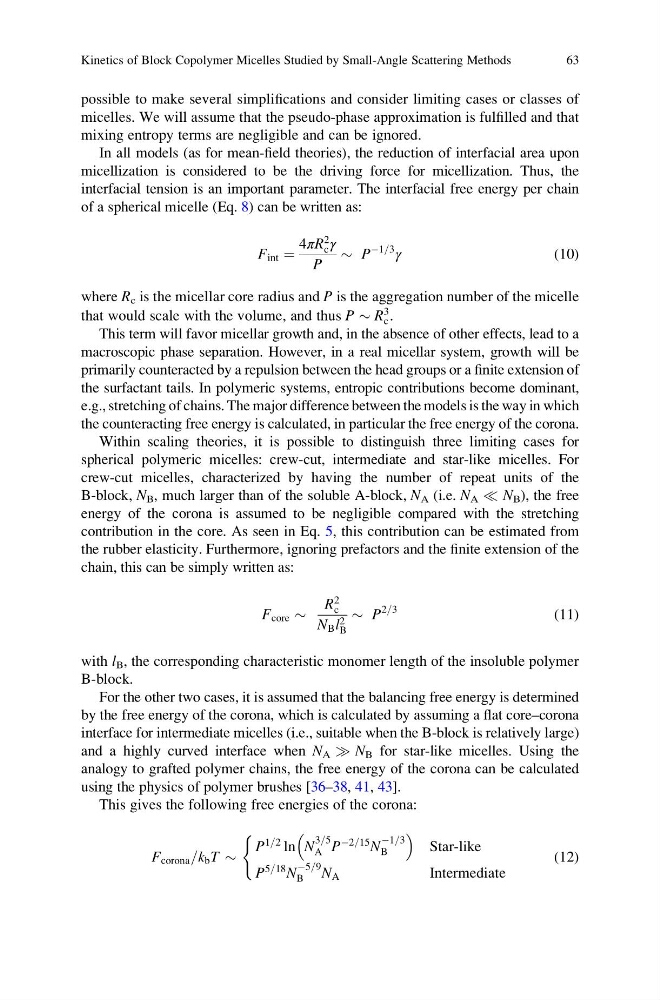
interfacial tension is an important parameter. The interfacial free energy per chain
of a spherical micelle (Eq. 8) can be written as:
F int ¼
4πR
2
c γ
P
$ P
À1=3
γ
(10)
where R c is the micellar core radius and P is the aggregation number of the micelle
that would scale with the volume, and thus P $ R
3
c .
This term will favor micellar growth and, in the absence of other effects, lead to a
macroscopic phase separation. However, in a real micellar system, growth will be
primarily counteracted by a repulsion between the head groups or a finite extension of
the surfactant tails. In polymeric systems, entropic contributions become dominant,
e.g., stretching of chains. The major difference between the models is the way in which
the counteracting free energy is calculated, in particular the free energy of the corona.
Within scaling theories, it is possible to distinguish three limiting cases for
spherical polymeric micelles: crew-cut, intermediate and star-like micelles. For
crew-cut micelles, characterized by having the number of repeat units of the
B-block, N B , much larger than of the soluble A-block, N A (i.e. N A ( N B ), the free
energy of the corona is assumed to be negligible compared with the stretching
contribution in the core. As seen in Eq. 5, this contribution can be estimated from
the rubber elasticity. Furthermore, ignoring prefactors and the finite extension of the
chain, this can be simply written as:
F core $
R
2
c
N B l 2
B
$ P
2=3
(11)
with l B , the corresponding characteristic monomer length of the insoluble polymer
B-block.
For the other two cases, it is assumed that the balancing free energy is determined
by the free energy of the corona, which is calculated by assuming a flat core–corona
interface for intermediate micelles (i.e., suitable when the B-block is relatively large)
and a highly curved interface when N A ) N B for star-like micelles. Using the
analogy to grafted polymer chains, the free energy of the corona can be calculated
using the physics of polymer brushes [36–38, 41, 43].
This gives the following free energies of the corona:
F corona =k b T $
P
1=2 ln N
3=5
A P
À2=15 N
À1=3
B
Star-like
P
5=18 N
À5=9
B
N A
Intermediate
(
(12)
Kinetics of Block Copolymer Micelles Studied by Small-Angle Scattering Methods
63
micelles. We will assume that the pseudo-phase approximation is fulfilled and that
mixing entropy terms are negligible and can be ignored.
In all models (as for mean-field theories), the reduction of interfacial area upon
micellization is considered to be the driving force for micellization. Thus, the
interfacial tension is an important parameter. The interfacial free energy per chain
of a spherical micelle (Eq. 8) can be written as:
F int ¼
4πR
2
c γ
P
$ P
À1=3
γ
(10)
where R c is the micellar core radius and P is the aggregation number of the micelle
that would scale with the volume, and thus P $ R
3
c .
This term will favor micellar growth and, in the absence of other effects, lead to a
macroscopic phase separation. However, in a real micellar system, growth will be
primarily counteracted by a repulsion between the head groups or a finite extension of
the surfactant tails. In polymeric systems, entropic contributions become dominant,
e.g., stretching of chains. The major difference between the models is the way in which
the counteracting free energy is calculated, in particular the free energy of the corona.
Within scaling theories, it is possible to distinguish three limiting cases for
spherical polymeric micelles: crew-cut, intermediate and star-like micelles. For
crew-cut micelles, characterized by having the number of repeat units of the
B-block, N B , much larger than of the soluble A-block, N A (i.e. N A ( N B ), the free
energy of the corona is assumed to be negligible compared with the stretching
contribution in the core. As seen in Eq. 5, this contribution can be estimated from
the rubber elasticity. Furthermore, ignoring prefactors and the finite extension of the
chain, this can be simply written as:
F core $
R
2
c
N B l 2
B
$ P
2=3
(11)
with l B , the corresponding characteristic monomer length of the insoluble polymer
B-block.
For the other two cases, it is assumed that the balancing free energy is determined
by the free energy of the corona, which is calculated by assuming a flat core–corona
interface for intermediate micelles (i.e., suitable when the B-block is relatively large)
and a highly curved interface when N A ) N B for star-like micelles. Using the
analogy to grafted polymer chains, the free energy of the corona can be calculated
using the physics of polymer brushes [36–38, 41, 43].
This gives the following free energies of the corona:
F corona =k b T $
P
1=2 ln N
3=5
A P
À2=15 N
À1=3
B
Star-like
P
5=18 N
À5=9
B
N A
Intermediate
(
(12)
Kinetics of Block Copolymer Micelles Studied by Small-Angle Scattering Methods
63