

From this formalism, the dependence of the various micellar parameters on, for
example, molecular weight, composition, interfacial tension, etc. can be estimated.
The results seem to compare rather well with experimental data, see, e.g., [44, 45].
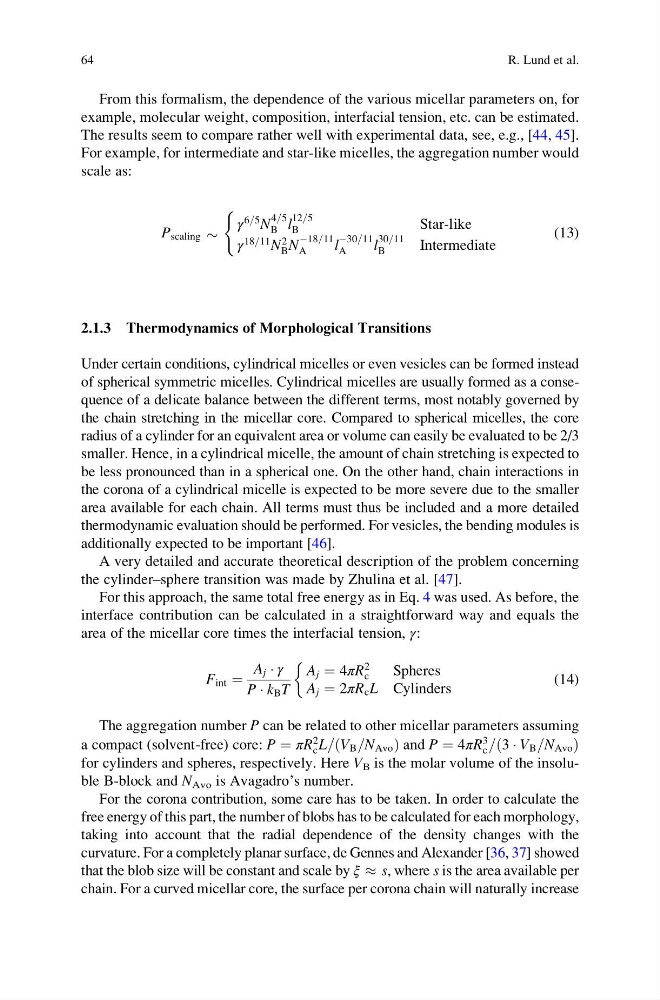
For example, for intermediate and star-like micelles, the aggregation number would
scale as:
P scaling $
γ
6=5 N
4=5
B l
12=5
B
Star-like
γ
18=11 N
2
B N
À18=11
A
l
À30=11
A
l
30=11
B
Intermediate
(
(13)
2.1.3 Thermodynamics of Morphological Transitions
Under certain conditions, cylindrical micelles or even vesicles can be formed instead
of spherical symmetric micelles. Cylindrical micelles are usually formed as a consequence of a delicate balance between the different terms, most notably governed by
the chain stretching in the micellar core. Compared to spherical micelles, the core
radius of a cylinder for an equivalent area or volume can easily be evaluated to be 2/3
smaller. Hence, in a cylindrical micelle, the amount of chain stretching is expected to
be less pronounced than in a spherical one. On the other hand, chain interactions in
the corona of a cylindrical micelle is expected to be more severe due to the smaller
area available for each chain. All terms must thus be included and a more detailed
thermodynamic evaluation should be performed. For vesicles, the bending modules is
additionally expected to be important [46].
A very detailed and accurate theoretical description of the problem concerning
the cylinder–sphere transition was made by Zhulina et al. [47].
For this approach, the same total free energy as in Eq. 4 was used. As before, the
interface contribution can be calculated in a straightforward way and equals the
area of the micellar core times the interfacial tension, γ:
F int ¼
A j Á γ
P Á k B T
A j ¼ 4πR
2
c
Spheres
A j ¼ 2πR c L Cylinders
&
(14)
The aggregation number P can be related to other micellar parameters assuming
a compact (solvent-free) core: P ¼ πR
2
c L=ðV B =N Avo Þ and P ¼ 4πR
3
c =ð3 Á V B =N Avo Þ
for cylinders and spheres, respectively. Here V B is the molar volume of the insoluble B-block and N Avo is Avagadro’s number.
For the corona contribution, some care has to be taken. In order to calculate the
free energy of this part, the number of blobs has to be calculated for each morphology,
taking into account that the radial dependence of the density changes with the
curvature. For a completely planar surface, de Gennes and Alexander [36, 37] showed
that the blob size will be constant and scale by ξ % s, where s is the area available per
chain. For a curved micellar core, the surface per corona chain will naturally increase
64
R. Lund et al.
example, molecular weight, composition, interfacial tension, etc. can be estimated.
The results seem to compare rather well with experimental data, see, e.g., [44, 45].
For example, for intermediate and star-like micelles, the aggregation number would
scale as:
P scaling $
γ
6=5 N
4=5
B l
12=5
B
Star-like
γ
18=11 N
2
B N
À18=11
A
l
À30=11
A
l
30=11
B
Intermediate
(
(13)
2.1.3 Thermodynamics of Morphological Transitions
Under certain conditions, cylindrical micelles or even vesicles can be formed instead
of spherical symmetric micelles. Cylindrical micelles are usually formed as a consequence of a delicate balance between the different terms, most notably governed by
the chain stretching in the micellar core. Compared to spherical micelles, the core
radius of a cylinder for an equivalent area or volume can easily be evaluated to be 2/3
smaller. Hence, in a cylindrical micelle, the amount of chain stretching is expected to
be less pronounced than in a spherical one. On the other hand, chain interactions in
the corona of a cylindrical micelle is expected to be more severe due to the smaller
area available for each chain. All terms must thus be included and a more detailed
thermodynamic evaluation should be performed. For vesicles, the bending modules is
additionally expected to be important [46].
A very detailed and accurate theoretical description of the problem concerning
the cylinder–sphere transition was made by Zhulina et al. [47].
For this approach, the same total free energy as in Eq. 4 was used. As before, the
interface contribution can be calculated in a straightforward way and equals the
area of the micellar core times the interfacial tension, γ:
F int ¼
A j Á γ
P Á k B T
A j ¼ 4πR
2
c
Spheres
A j ¼ 2πR c L Cylinders
&
(14)
The aggregation number P can be related to other micellar parameters assuming
a compact (solvent-free) core: P ¼ πR
2
c L=ðV B =N Avo Þ and P ¼ 4πR
3
c =ð3 Á V B =N Avo Þ
for cylinders and spheres, respectively. Here V B is the molar volume of the insoluble B-block and N Avo is Avagadro’s number.
For the corona contribution, some care has to be taken. In order to calculate the
free energy of this part, the number of blobs has to be calculated for each morphology,
taking into account that the radial dependence of the density changes with the
curvature. For a completely planar surface, de Gennes and Alexander [36, 37] showed
that the blob size will be constant and scale by ξ % s, where s is the area available per
chain. For a curved micellar core, the surface per corona chain will naturally increase
64
R. Lund et al.