

2.1.2 Scaling Theories
For systems exhibiting strong excluded volume interactions, a mean-field approach
is no longer realistic and spatial correlations must be taken into account. Although
this is a notorious deep problem in theoretical statistical physics in general and
polymers in particular, a relatively simple way of calculating free energies for
micellar systems is represented by so-called “scaling theories”, which have an
origin in Kadanoff’s approach and renormalization group theories developed to
treat interactions in magnetic systems and critical phenomena [32, 33].
Scaling theory is a quite simple approach, which in the realm of polymer science
was pioneered mainly by de Gennes [34]. Scaling theories apply a “coarse-grained”
approach whereby the molecular details of the system is only indirectly considered
using simplified geometrical descriptions. Complicated structural and thermodynamic features of polymeric systems are estimated using simple geometrical and
physical arguments. Thereby, problems associated with mathematical complexities
imposed by long-range excluded volume effects are partially circumvented. The
central idea utilizes the fractal properties of polymeric chains and the scale invariance of such systems.
1 Introducing a characteristic length scale, ξ (the blob size),
defined as regions of non-overlapping polymer segments, the polymer chains can be
pictured as a “necklace” of connected “blobs”. Inside the blobs, the potential of
neighboring chains are not felt and the chains effectively behave as single isolated
chains. The blob size scales as: [34]:
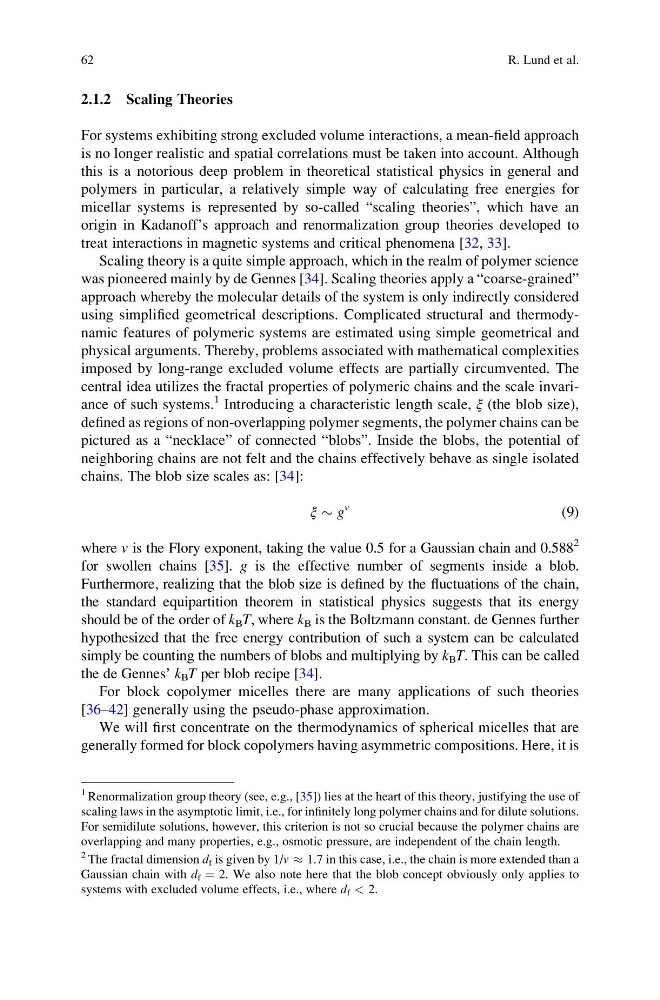
ξ $ g
v
(9)
where v is the Flory exponent, taking the value 0.5 for a Gaussian chain and 0.588
2
for swollen chains [35]. g is the effective number of segments inside a blob.
Furthermore, realizing that the blob size is defined by the fluctuations of the chain,
the standard equipartition theorem in statistical physics suggests that its energy
should be of the order of k B T, where k B is the Boltzmann constant. de Gennes further
hypothesized that the free energy contribution of such a system can be calculated
simply be counting the numbers of blobs and multiplying by k B T. This can be called
the de Gennes’ k B T per blob recipe [34].
For block copolymer micelles there are many applications of such theories
[36–42] generally using the pseudo-phase approximation.
We will first concentrate on the thermodynamics of spherical micelles that are
generally formed for block copolymers having asymmetric compositions. Here, it is
1 Renormalization group theory (see, e.g., [35]) lies at the heart of this theory, justifying the use of
scaling laws in the asymptotic limit, i.e., for infinitely long polymer chains and for dilute solutions.
For semidilute solutions, however, this criterion is not so crucial because the polymer chains are
overlapping and many properties, e.g., osmotic pressure, are independent of the chain length.
2 The fractal dimension d f is given by 1/v % 1.7 in this case, i.e., the chain is more extended than a
Gaussian chain with d f ¼ 2. We also note here that the blob concept obviously only applies to
systems with excluded volume effects, i.e., where d f < 2.
62
R. Lund et al.
For systems exhibiting strong excluded volume interactions, a mean-field approach
is no longer realistic and spatial correlations must be taken into account. Although
this is a notorious deep problem in theoretical statistical physics in general and
polymers in particular, a relatively simple way of calculating free energies for
micellar systems is represented by so-called “scaling theories”, which have an
origin in Kadanoff’s approach and renormalization group theories developed to
treat interactions in magnetic systems and critical phenomena [32, 33].
Scaling theory is a quite simple approach, which in the realm of polymer science
was pioneered mainly by de Gennes [34]. Scaling theories apply a “coarse-grained”
approach whereby the molecular details of the system is only indirectly considered
using simplified geometrical descriptions. Complicated structural and thermodynamic features of polymeric systems are estimated using simple geometrical and
physical arguments. Thereby, problems associated with mathematical complexities
imposed by long-range excluded volume effects are partially circumvented. The
central idea utilizes the fractal properties of polymeric chains and the scale invariance of such systems.
1 Introducing a characteristic length scale, ξ (the blob size),
defined as regions of non-overlapping polymer segments, the polymer chains can be
pictured as a “necklace” of connected “blobs”. Inside the blobs, the potential of
neighboring chains are not felt and the chains effectively behave as single isolated
chains. The blob size scales as: [34]:
ξ $ g
v
(9)
where v is the Flory exponent, taking the value 0.5 for a Gaussian chain and 0.588
2
for swollen chains [35]. g is the effective number of segments inside a blob.
Furthermore, realizing that the blob size is defined by the fluctuations of the chain,
the standard equipartition theorem in statistical physics suggests that its energy
should be of the order of k B T, where k B is the Boltzmann constant. de Gennes further
hypothesized that the free energy contribution of such a system can be calculated
simply be counting the numbers of blobs and multiplying by k B T. This can be called
the de Gennes’ k B T per blob recipe [34].
For block copolymer micelles there are many applications of such theories
[36–42] generally using the pseudo-phase approximation.
We will first concentrate on the thermodynamics of spherical micelles that are
generally formed for block copolymers having asymmetric compositions. Here, it is
1 Renormalization group theory (see, e.g., [35]) lies at the heart of this theory, justifying the use of
scaling laws in the asymptotic limit, i.e., for infinitely long polymer chains and for dilute solutions.
For semidilute solutions, however, this criterion is not so crucial because the polymer chains are
overlapping and many properties, e.g., osmotic pressure, are independent of the chain length.
2 The fractal dimension d f is given by 1/v % 1.7 in this case, i.e., the chain is more extended than a
Gaussian chain with d f ¼ 2. We also note here that the blob concept obviously only applies to
systems with excluded volume effects, i.e., where d f < 2.
62
R. Lund et al.