

where N 0 is the number of lattice sites occupied by a solvent molecule and Φ 0 is the
fraction of solvent molecules in the core (homogeneously distributed).
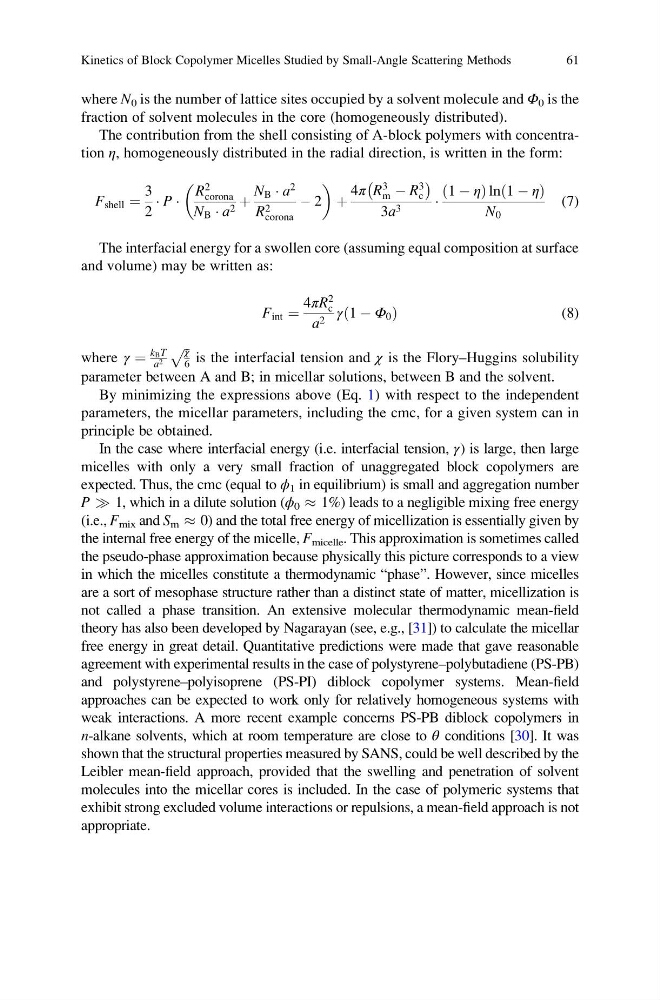
The contribution from the shell consisting of A-block polymers with concentration η, homogeneously distributed in the radial direction, is written in the form:
F shell ¼
3
2
Á P Á
R
2
corona
N B Á a 2 þ
N B Á a
2
R 2
corona
À 2
þ
4π R
3
m À R
3
c
À
Á
3a 3
Á
ð1 À ηÞ lnð1 À ηÞ
N 0
(7)
The interfacial energy for a swollen core (assuming equal composition at surface
and volume) may be written as:
F int ¼
4πR
2
c
a 2 γð1 À Φ 0 Þ
(8)
where γ ¼
k B T
a 2
ffiffi χ
6
p
is the interfacial tension and χ is the Flory–Huggins solubility
parameter between A and B; in micellar solutions, between B and the solvent.
By minimizing the expressions above (Eq. 1) with respect to the independent
parameters, the micellar parameters, including the cmc, for a given system can in
principle be obtained.
In the case where interfacial energy (i.e. interfacial tension, γ) is large, then large
micelles with only a very small fraction of unaggregated block copolymers are
expected. Thus, the cmc (equal to ϕ 1 in equilibrium) is small and aggregation number
P ) 1, which in a dilute solution (ϕ 0 % 1%) leads to a negligible mixing free energy
(i.e., F mix and S m % 0) and the total free energy of micellization is essentially given by
the internal free energy of the micelle, F micelle . This approximation is sometimes called
the pseudo-phase approximation because physically this picture corresponds to a view
in which the micelles constitute a thermodynamic “phase”. However, since micelles
are a sort of mesophase structure rather than a distinct state of matter, micellization is
not called a phase transition. An extensive molecular thermodynamic mean-field
theory has also been developed by Nagarayan (see, e.g., [31]) to calculate the micellar
free energy in great detail. Quantitative predictions were made that gave reasonable
agreement with experimental results in the case of polystyrene–polybutadiene (PS-PB)
and polystyrene–polyisoprene (PS-PI) diblock copolymer systems. Mean-field
approaches can be expected to work only for relatively homogeneous systems with
weak interactions. A more recent example concerns PS-PB diblock copolymers in
n-alkane solvents, which at room temperature are close to θ conditions [30]. It was
shown that the structural properties measured by SANS, could be well described by the
Leibler mean-field approach, provided that the swelling and penetration of solvent
molecules into the micellar cores is included. In the case of polymeric systems that
exhibit strong excluded volume interactions or repulsions, a mean-field approach is not
appropriate.
Kinetics of Block Copolymer Micelles Studied by Small-Angle Scattering Methods
61
fraction of solvent molecules in the core (homogeneously distributed).
The contribution from the shell consisting of A-block polymers with concentration η, homogeneously distributed in the radial direction, is written in the form:
F shell ¼
3
2
Á P Á
R
2
corona
N B Á a 2 þ
N B Á a
2
R 2
corona
À 2
þ
4π R
3
m À R
3
c
À
Á
3a 3
Á
ð1 À ηÞ lnð1 À ηÞ
N 0
(7)
The interfacial energy for a swollen core (assuming equal composition at surface
and volume) may be written as:
F int ¼
4πR
2
c
a 2 γð1 À Φ 0 Þ
(8)
where γ ¼
k B T
a 2
ffiffi χ
6
p
is the interfacial tension and χ is the Flory–Huggins solubility
parameter between A and B; in micellar solutions, between B and the solvent.
By minimizing the expressions above (Eq. 1) with respect to the independent
parameters, the micellar parameters, including the cmc, for a given system can in
principle be obtained.
In the case where interfacial energy (i.e. interfacial tension, γ) is large, then large
micelles with only a very small fraction of unaggregated block copolymers are
expected. Thus, the cmc (equal to ϕ 1 in equilibrium) is small and aggregation number
P ) 1, which in a dilute solution (ϕ 0 % 1%) leads to a negligible mixing free energy
(i.e., F mix and S m % 0) and the total free energy of micellization is essentially given by
the internal free energy of the micelle, F micelle . This approximation is sometimes called
the pseudo-phase approximation because physically this picture corresponds to a view
in which the micelles constitute a thermodynamic “phase”. However, since micelles
are a sort of mesophase structure rather than a distinct state of matter, micellization is
not called a phase transition. An extensive molecular thermodynamic mean-field
theory has also been developed by Nagarayan (see, e.g., [31]) to calculate the micellar
free energy in great detail. Quantitative predictions were made that gave reasonable
agreement with experimental results in the case of polystyrene–polybutadiene (PS-PB)
and polystyrene–polyisoprene (PS-PI) diblock copolymer systems. Mean-field
approaches can be expected to work only for relatively homogeneous systems with
weak interactions. A more recent example concerns PS-PB diblock copolymers in
n-alkane solvents, which at room temperature are close to θ conditions [30]. It was
shown that the structural properties measured by SANS, could be well described by the
Leibler mean-field approach, provided that the swelling and penetration of solvent
molecules into the micellar cores is included. In the case of polymeric systems that
exhibit strong excluded volume interactions or repulsions, a mean-field approach is not
appropriate.
Kinetics of Block Copolymer Micelles Studied by Small-Angle Scattering Methods
61