

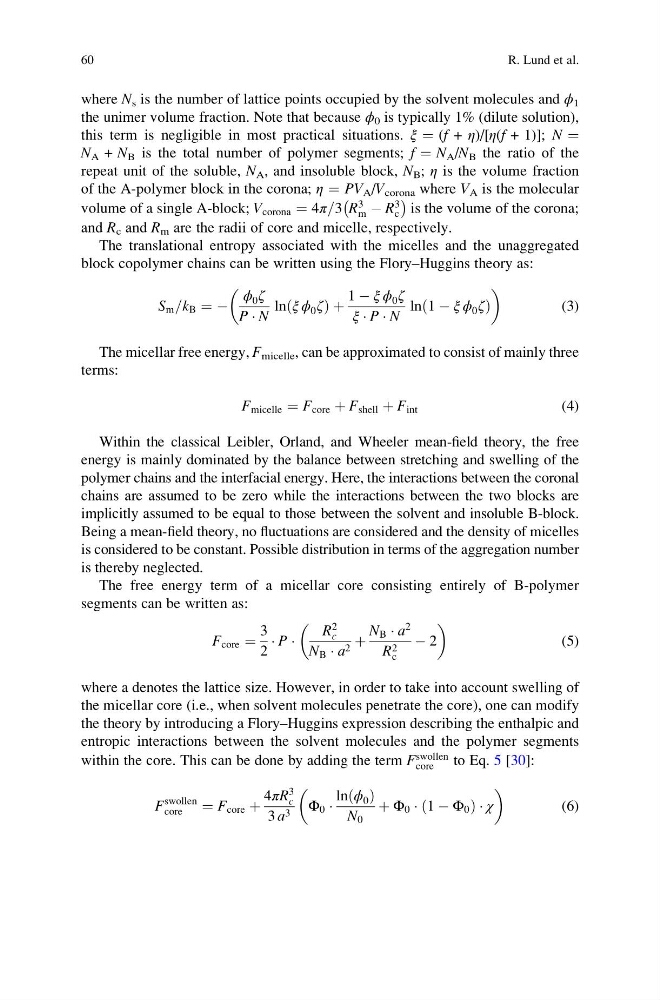
where N s is the number of lattice points occupied by the solvent molecules and ϕ 1
the unimer volume fraction. Note that because ϕ 0 is typically 1% (dilute solution),
this term is negligible in most practical situations. ξ ¼ (f + η)/[η(f + 1)]; N ¼
N A + N B is the total number of polymer segments; f ¼ N A /N B the ratio of the
repeat unit of the soluble, N A , and insoluble block, N B ; η is the volume fraction
of the A-polymer block in the corona; η ¼ PV A /V corona where V A is the molecular
volume of a single A-block; V corona ¼ 4π=3 R
3
m À R
3
c
À
Á
is the volume of the corona;
and R c and R m are the radii of core and micelle, respectively.
The translational entropy associated with the micelles and the unaggregated
block copolymer chains can be written using the Flory–Huggins theory as:
S m =k B ¼ À
ϕ 0 ζ
P Á N
lnðξ ϕ 0 ζÞ þ
1 À ξ ϕ 0 ζ
ξ Á P Á N
lnð1 À ξ ϕ 0 ζÞ
(3)
The micellar free energy, F micelle , can be approximated to consist of mainly three
terms:
F micelle ¼ F core þ F shell þ F int
(4)
Within the classical Leibler, Orland, and Wheeler mean-field theory, the free
energy is mainly dominated by the balance between stretching and swelling of the
polymer chains and the interfacial energy. Here, the interactions between the coronal
chains are assumed to be zero while the interactions between the two blocks are
implicitly assumed to be equal to those between the solvent and insoluble B-block.
Being a mean-field theory, no fluctuations are considered and the density of micelles
is considered to be constant. Possible distribution in terms of the aggregation number
is thereby neglected.
The free energy term of a micellar core consisting entirely of B-polymer
segments can be written as:
F core ¼
3
2
Á P Á
R
2
c
N B Á a 2 þ
N B Á a
2
R 2
c
À 2
(5)
where a denotes the lattice size. However, in order to take into account swelling of
the micellar core (i.e., when solvent molecules penetrate the core), one can modify
the theory by introducing a Flory–Huggins expression describing the enthalpic and
entropic interactions between the solvent molecules and the polymer segments
within the core. This can be done by adding the term F
swollen
core
to Eq. 5 [30]:
F
swollen
core
¼ F core þ
4πR
3
c
3 a 3 Φ 0 Á
lnðϕ 0 Þ
N 0
þ Φ 0 Á ð1 À Φ 0 Þ Á χ
(6)
60
R. Lund et al.
the unimer volume fraction. Note that because ϕ 0 is typically 1% (dilute solution),
this term is negligible in most practical situations. ξ ¼ (f + η)/[η(f + 1)]; N ¼
N A + N B is the total number of polymer segments; f ¼ N A /N B the ratio of the
repeat unit of the soluble, N A , and insoluble block, N B ; η is the volume fraction
of the A-polymer block in the corona; η ¼ PV A /V corona where V A is the molecular
volume of a single A-block; V corona ¼ 4π=3 R
3
m À R
3
c
À
Á
is the volume of the corona;
and R c and R m are the radii of core and micelle, respectively.
The translational entropy associated with the micelles and the unaggregated
block copolymer chains can be written using the Flory–Huggins theory as:
S m =k B ¼ À
ϕ 0 ζ
P Á N
lnðξ ϕ 0 ζÞ þ
1 À ξ ϕ 0 ζ
ξ Á P Á N
lnð1 À ξ ϕ 0 ζÞ
(3)
The micellar free energy, F micelle , can be approximated to consist of mainly three
terms:
F micelle ¼ F core þ F shell þ F int
(4)
Within the classical Leibler, Orland, and Wheeler mean-field theory, the free
energy is mainly dominated by the balance between stretching and swelling of the
polymer chains and the interfacial energy. Here, the interactions between the coronal
chains are assumed to be zero while the interactions between the two blocks are
implicitly assumed to be equal to those between the solvent and insoluble B-block.
Being a mean-field theory, no fluctuations are considered and the density of micelles
is considered to be constant. Possible distribution in terms of the aggregation number
is thereby neglected.
The free energy term of a micellar core consisting entirely of B-polymer
segments can be written as:
F core ¼
3
2
Á P Á
R
2
c
N B Á a 2 þ
N B Á a
2
R 2
c
À 2
(5)
where a denotes the lattice size. However, in order to take into account swelling of
the micellar core (i.e., when solvent molecules penetrate the core), one can modify
the theory by introducing a Flory–Huggins expression describing the enthalpic and
entropic interactions between the solvent molecules and the polymer segments
within the core. This can be done by adding the term F
swollen
core
to Eq. 5 [30]:
F
swollen
core
¼ F core þ
4πR
3
c
3 a 3 Φ 0 Á
lnðϕ 0 Þ
N 0
þ Φ 0 Á ð1 À Φ 0 Þ Á χ
(6)
60
R. Lund et al.