

2.1.1 Mean-Field Theories
Mean-field theories are common in statistical physics and have been used to
describe a wide range of phenomena ranging from magnetism to micelles. The
common basis is the assumption that the local potential felt by all the neighboring
particles is replaced by an effective field. The field is constant in time, isotropical
and its strength depends on the number, coordination, and nature of its neighbors.
This means that a multibody problem is reduced into effective interactions. In
polymer physics, a familiar version is the Flory–Huggins solution theory whereby
polymer segments are distributed together with the solvent molecules on a lattice.
The thermodynamic properties can thereby be derived by calculating the distribution and resulting enthalpic interactions on such a lattice [25]. These ideas have
been used by several authors to calculate the structural properties in micellar
solutions [26–28].
A very complete and detailed model was presented by Leibler, Wheeler and
Orland in the early 1980s [26]. The model uses a Flory–Huggins framework to
calculate the mixing free energy and the free energy of the reference disordered
state. The theory was originally developed for symmetric A-B type block copolymers
(where A is the soluble block and B the insoluble block) in an A-homopolymer
“solvent” and is thus restricted to a situation with no excluded volume effects in
the corona (χ ¼ 0.5) (true mean field). Although the theory was originally formulated
for symmetric block copolymers, Balsara and coworkers extended the theory for
asymmetric B-A-B type systems and also considered “loops” in the corona [29].
Lund et al. later extended the model further to allow for a partial mixing between
the B-type chain and a solvent for micelles in solutions [30]. As the model also
applies relatively well for some block copolymer/solvent systems and provides a very
useful starting point for discussing micellization theoretically, we will describe the
theory in some detail.
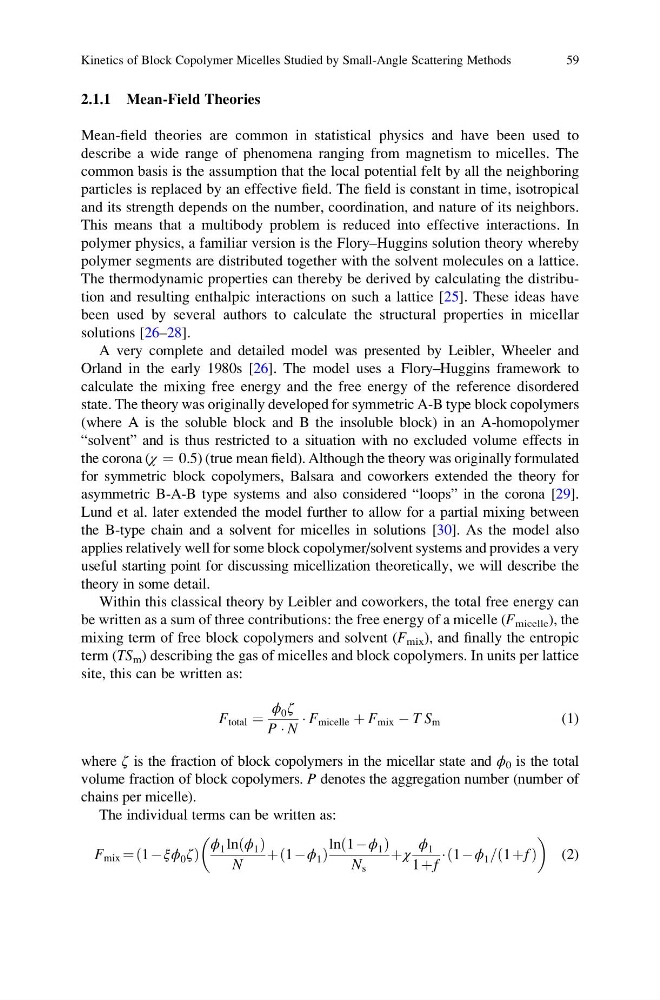
Within this classical theory by Leibler and coworkers, the total free energy can
be written as a sum of three contributions: the free energy of a micelle (F micelle ), the
mixing term of free block copolymers and solvent (F mix ), and finally the entropic
term (TS m ) describing the gas of micelles and block copolymers. In units per lattice
site, this can be written as:
F total ¼
ϕ 0 ζ
P Á N
Á F micelle þ F mix À T S m
(1)
where ζ is the fraction of block copolymers in the micellar state and ϕ 0 is the total
volume fraction of block copolymers. P denotes the aggregation number (number of
chains per micelle).
The individual terms can be written as:
F mix ¼ ð1Àξϕ 0 ζÞ
ϕ 1 lnðϕ 1 Þ
N
þð1Àϕ 1 Þ
lnð1Àϕ 1 Þ
N s
þχ
ϕ 1
1þf
Áð1Àϕ 1 =ð1þf Þ
(2)
Kinetics of Block Copolymer Micelles Studied by Small-Angle Scattering Methods
59
Mean-field theories are common in statistical physics and have been used to
describe a wide range of phenomena ranging from magnetism to micelles. The
common basis is the assumption that the local potential felt by all the neighboring
particles is replaced by an effective field. The field is constant in time, isotropical
and its strength depends on the number, coordination, and nature of its neighbors.
This means that a multibody problem is reduced into effective interactions. In
polymer physics, a familiar version is the Flory–Huggins solution theory whereby
polymer segments are distributed together with the solvent molecules on a lattice.
The thermodynamic properties can thereby be derived by calculating the distribution and resulting enthalpic interactions on such a lattice [25]. These ideas have
been used by several authors to calculate the structural properties in micellar
solutions [26–28].
A very complete and detailed model was presented by Leibler, Wheeler and
Orland in the early 1980s [26]. The model uses a Flory–Huggins framework to
calculate the mixing free energy and the free energy of the reference disordered
state. The theory was originally developed for symmetric A-B type block copolymers
(where A is the soluble block and B the insoluble block) in an A-homopolymer
“solvent” and is thus restricted to a situation with no excluded volume effects in
the corona (χ ¼ 0.5) (true mean field). Although the theory was originally formulated
for symmetric block copolymers, Balsara and coworkers extended the theory for
asymmetric B-A-B type systems and also considered “loops” in the corona [29].
Lund et al. later extended the model further to allow for a partial mixing between
the B-type chain and a solvent for micelles in solutions [30]. As the model also
applies relatively well for some block copolymer/solvent systems and provides a very
useful starting point for discussing micellization theoretically, we will describe the
theory in some detail.
Within this classical theory by Leibler and coworkers, the total free energy can
be written as a sum of three contributions: the free energy of a micelle (F micelle ), the
mixing term of free block copolymers and solvent (F mix ), and finally the entropic
term (TS m ) describing the gas of micelles and block copolymers. In units per lattice
site, this can be written as:
F total ¼
ϕ 0 ζ
P Á N
Á F micelle þ F mix À T S m
(1)
where ζ is the fraction of block copolymers in the micellar state and ϕ 0 is the total
volume fraction of block copolymers. P denotes the aggregation number (number of
chains per micelle).
The individual terms can be written as:
F mix ¼ ð1Àξϕ 0 ζÞ
ϕ 1 lnðϕ 1 Þ
N
þð1Àϕ 1 Þ
lnð1Àϕ 1 Þ
N s
þχ
ϕ 1
1þf
Áð1Àϕ 1 =ð1þf Þ
(2)
Kinetics of Block Copolymer Micelles Studied by Small-Angle Scattering Methods
59