

1.8.2 Fabrication of Polymer Membranes Inside Microchannels
Characteristic features of controlled laminar flow in microfluidics devices have
been utilized in many applications such as diffusion-based separation and detection,
solvent extraction, mixing, and hydrodynamic focusing [255, 256].
A method of microfabrication based on multicomponent laminar flow inside
microchannels was developed by Whitesides, Kenis and colleagues [257, 258].
Laminar streams of solutions enable a reaction at the interface between streams to
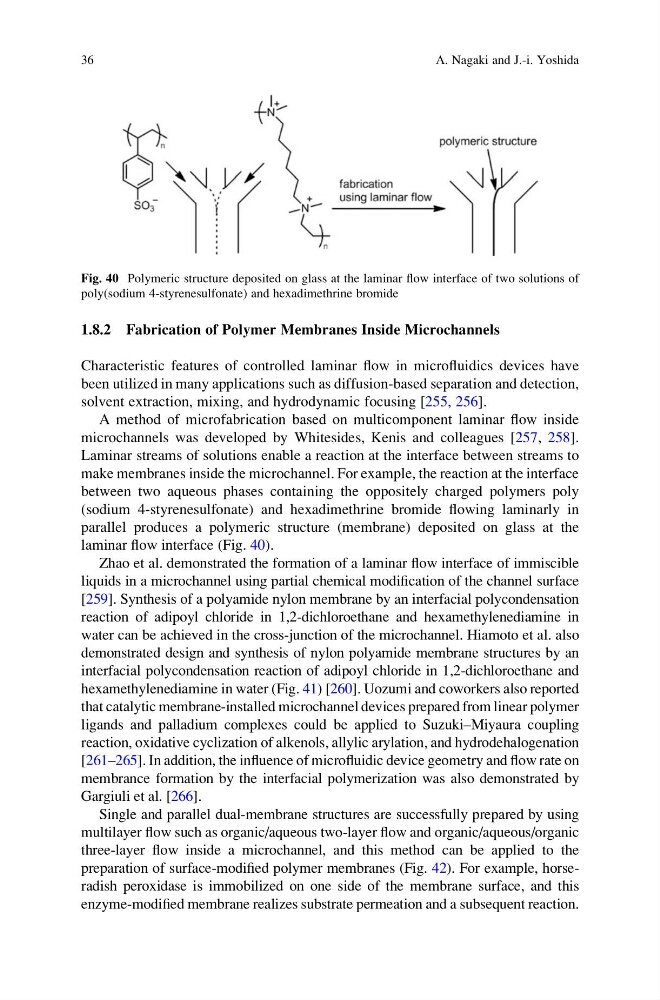
make membranes inside the microchannel. For example, the reaction at the interface
between two aqueous phases containing the oppositely charged polymers poly
(sodium 4-styrenesulfonate) and hexadimethrine bromide flowing laminarly in
parallel produces a polymeric structure (membrane) deposited on glass at the
laminar flow interface (Fig. 40).
Zhao et al. demonstrated the formation of a laminar flow interface of immiscible
liquids in a microchannel using partial chemical modification of the channel surface
[259]. Synthesis of a polyamide nylon membrane by an interfacial polycondensation
reaction of adipoyl chloride in 1,2-dichloroethane and hexamethylenediamine in
water can be achieved in the cross-junction of the microchannel. Hiamoto et al. also
demonstrated design and synthesis of nylon polyamide membrane structures by an
interfacial polycondensation reaction of adipoyl chloride in 1,2-dichloroethane and
hexamethylenediamine in water (Fig. 41) [260]. Uozumi and coworkers also reported
that catalytic membrane-installed microchannel devices prepared from linear polymer
ligands and palladium complexes could be applied to Suzuki–Miyaura coupling
reaction, oxidative cyclization of alkenols, allylic arylation, and hydrodehalogenation
[261–265]. In addition, the influence of microfluidic device geometry and flow rate on
membrance formation by the interfacial polymerization was also demonstrated by
Gargiuli et al. [266].
Single and parallel dual-membrane structures are successfully prepared by using
multilayer flow such as organic/aqueous two-layer flow and organic/aqueous/organic
three-layer flow inside a microchannel, and this method can be applied to the
preparation of surface-modified polymer membranes (Fig. 42). For example, horseradish peroxidase is immobilized on one side of the membrane surface, and this
enzyme-modified membrane realizes substrate permeation and a subsequent reaction.
Fig. 40 Polymeric structure deposited on glass at the laminar flow interface of two solutions of
poly(sodium 4-styrenesulfonate) and hexadimethrine bromide
36
A. Nagaki and J.-i. Yoshida
Characteristic features of controlled laminar flow in microfluidics devices have
been utilized in many applications such as diffusion-based separation and detection,
solvent extraction, mixing, and hydrodynamic focusing [255, 256].
A method of microfabrication based on multicomponent laminar flow inside
microchannels was developed by Whitesides, Kenis and colleagues [257, 258].
Laminar streams of solutions enable a reaction at the interface between streams to
make membranes inside the microchannel. For example, the reaction at the interface
between two aqueous phases containing the oppositely charged polymers poly
(sodium 4-styrenesulfonate) and hexadimethrine bromide flowing laminarly in
parallel produces a polymeric structure (membrane) deposited on glass at the
laminar flow interface (Fig. 40).
Zhao et al. demonstrated the formation of a laminar flow interface of immiscible
liquids in a microchannel using partial chemical modification of the channel surface
[259]. Synthesis of a polyamide nylon membrane by an interfacial polycondensation
reaction of adipoyl chloride in 1,2-dichloroethane and hexamethylenediamine in
water can be achieved in the cross-junction of the microchannel. Hiamoto et al. also
demonstrated design and synthesis of nylon polyamide membrane structures by an
interfacial polycondensation reaction of adipoyl chloride in 1,2-dichloroethane and
hexamethylenediamine in water (Fig. 41) [260]. Uozumi and coworkers also reported
that catalytic membrane-installed microchannel devices prepared from linear polymer
ligands and palladium complexes could be applied to Suzuki–Miyaura coupling
reaction, oxidative cyclization of alkenols, allylic arylation, and hydrodehalogenation
[261–265]. In addition, the influence of microfluidic device geometry and flow rate on
membrance formation by the interfacial polymerization was also demonstrated by
Gargiuli et al. [266].
Single and parallel dual-membrane structures are successfully prepared by using
multilayer flow such as organic/aqueous two-layer flow and organic/aqueous/organic
three-layer flow inside a microchannel, and this method can be applied to the
preparation of surface-modified polymer membranes (Fig. 42). For example, horseradish peroxidase is immobilized on one side of the membrane surface, and this
enzyme-modified membrane realizes substrate permeation and a subsequent reaction.
Fig. 40 Polymeric structure deposited on glass at the laminar flow interface of two solutions of
poly(sodium 4-styrenesulfonate) and hexadimethrine bromide
36
A. Nagaki and J.-i. Yoshida