

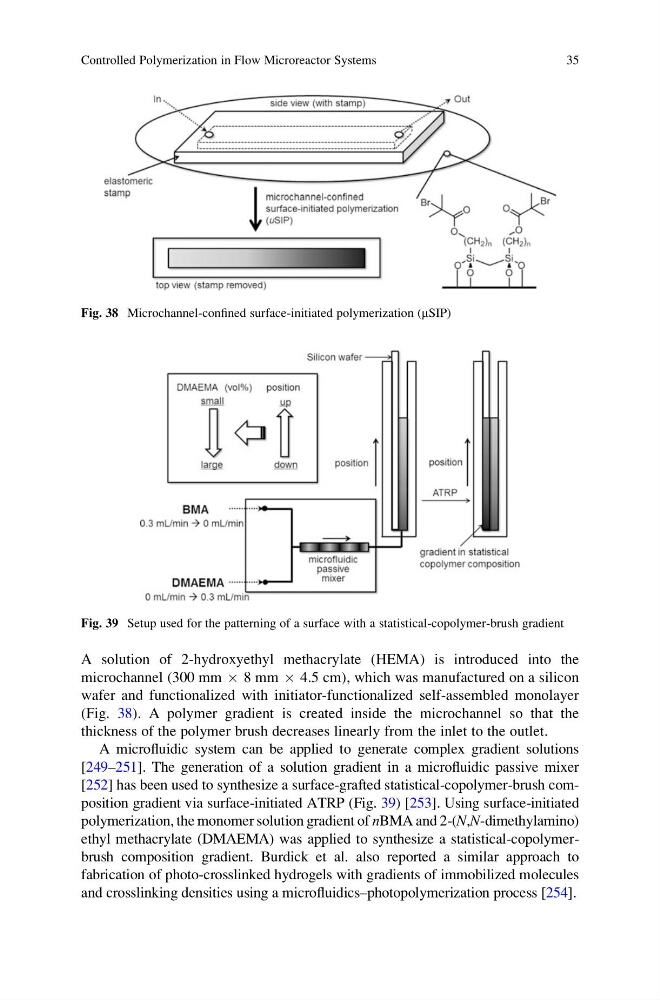
A solution of 2-hydroxyethyl methacrylate (HEMA) is introduced into the
microchannel (300 mm  8 mm  4.5 cm), which was manufactured on a silicon
wafer and functionalized with initiator-functionalized self-assembled monolayer
(Fig. 38). A polymer gradient is created inside the microchannel so that the
thickness of the polymer brush decreases linearly from the inlet to the outlet.
A microfluidic system can be applied to generate complex gradient solutions
[249–251]. The generation of a solution gradient in a microfluidic passive mixer
[252] has been used to synthesize a surface-grafted statistical-copolymer-brush composition gradient via surface-initiated ATRP (Fig. 39) [253]. Using surface-initiated
polymerization, the monomer solution gradient of nBMA and 2-(N,N-dimethylamino)
ethyl methacrylate (DMAEMA) was applied to synthesize a statistical-copolymerbrush composition gradient. Burdick et al. also reported a similar approach to
fabrication of photo-crosslinked hydrogels with gradients of immobilized molecules
and crosslinking densities using a microfluidics–photopolymerization process [254].
Fig. 38 Microchannel-confined surface-initiated polymerization (mSIP)
Fig. 39 Setup used for the patterning of a surface with a statistical-copolymer-brush gradient
Controlled Polymerization in Flow Microreactor Systems
35
microchannel (300 mm  8 mm  4.5 cm), which was manufactured on a silicon
wafer and functionalized with initiator-functionalized self-assembled monolayer
(Fig. 38). A polymer gradient is created inside the microchannel so that the
thickness of the polymer brush decreases linearly from the inlet to the outlet.
A microfluidic system can be applied to generate complex gradient solutions
[249–251]. The generation of a solution gradient in a microfluidic passive mixer
[252] has been used to synthesize a surface-grafted statistical-copolymer-brush composition gradient via surface-initiated ATRP (Fig. 39) [253]. Using surface-initiated
polymerization, the monomer solution gradient of nBMA and 2-(N,N-dimethylamino)
ethyl methacrylate (DMAEMA) was applied to synthesize a statistical-copolymerbrush composition gradient. Burdick et al. also reported a similar approach to
fabrication of photo-crosslinked hydrogels with gradients of immobilized molecules
and crosslinking densities using a microfluidics–photopolymerization process [254].
Fig. 38 Microchannel-confined surface-initiated polymerization (mSIP)
Fig. 39 Setup used for the patterning of a surface with a statistical-copolymer-brush gradient
Controlled Polymerization in Flow Microreactor Systems
35