

weight distribution of the polymer obtained in the flow is slightly narrower than that
obtained in batch. Precise control of reaction temperature in the microreactor seems
to be responsible.
Dendrimers, which have a highly branched 3D structure, provide a high degree of
surface functionality and versatility. Polycondensation reactions are widely used for
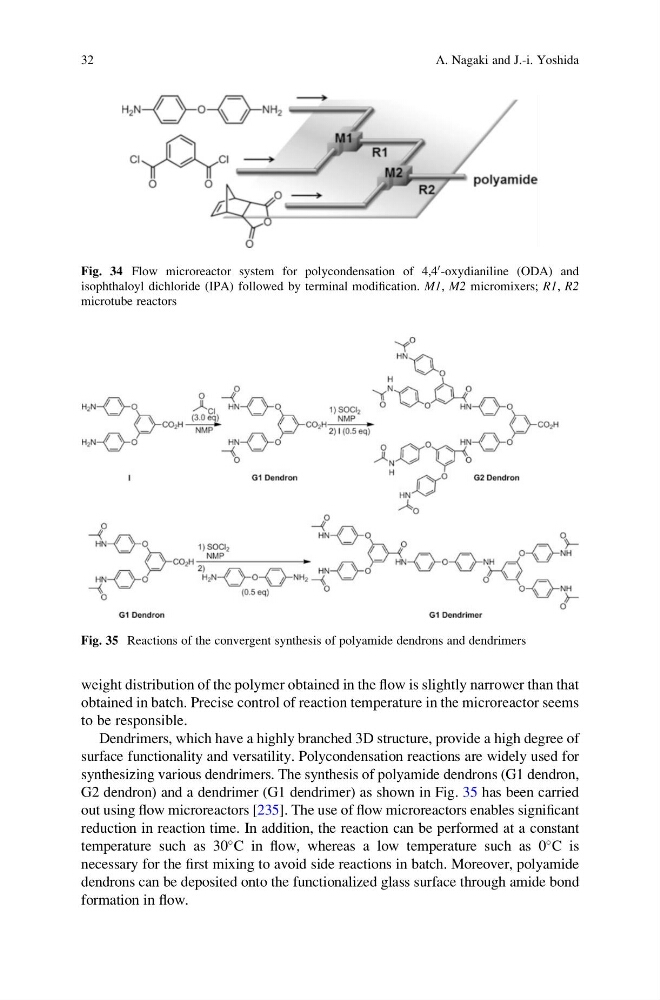
synthesizing various dendrimers. The synthesis of polyamide dendrons (G1 dendron,
G2 dendron) and a dendrimer (G1 dendrimer) as shown in Fig. 35 has been carried
out using flow microreactors [235]. The use of flow microreactors enables significant
reduction in reaction time. In addition, the reaction can be performed at a constant
temperature such as 30
C in flow, whereas a low temperature such as 0
C is
necessary for the first mixing to avoid side reactions in batch. Moreover, polyamide
dendrons can be deposited onto the functionalized glass surface through amide bond
formation in flow.
Fig. 34 Flow microreactor system for polycondensation of 4,4
0 -oxydianiline (ODA) and
isophthaloyl dichloride (IPA) followed by terminal modification. M1, M2 micromixers; R1, R2
microtube reactors
Fig. 35 Reactions of the convergent synthesis of polyamide dendrons and dendrimers
32
A. Nagaki and J.-i. Yoshida
obtained in batch. Precise control of reaction temperature in the microreactor seems
to be responsible.
Dendrimers, which have a highly branched 3D structure, provide a high degree of
surface functionality and versatility. Polycondensation reactions are widely used for
synthesizing various dendrimers. The synthesis of polyamide dendrons (G1 dendron,
G2 dendron) and a dendrimer (G1 dendrimer) as shown in Fig. 35 has been carried
out using flow microreactors [235]. The use of flow microreactors enables significant
reduction in reaction time. In addition, the reaction can be performed at a constant
temperature such as 30
C in flow, whereas a low temperature such as 0
C is
necessary for the first mixing to avoid side reactions in batch. Moreover, polyamide
dendrons can be deposited onto the functionalized glass surface through amide bond
formation in flow.
Fig. 34 Flow microreactor system for polycondensation of 4,4
0 -oxydianiline (ODA) and
isophthaloyl dichloride (IPA) followed by terminal modification. M1, M2 micromixers; R1, R2
microtube reactors
Fig. 35 Reactions of the convergent synthesis of polyamide dendrons and dendrimers
32
A. Nagaki and J.-i. Yoshida