

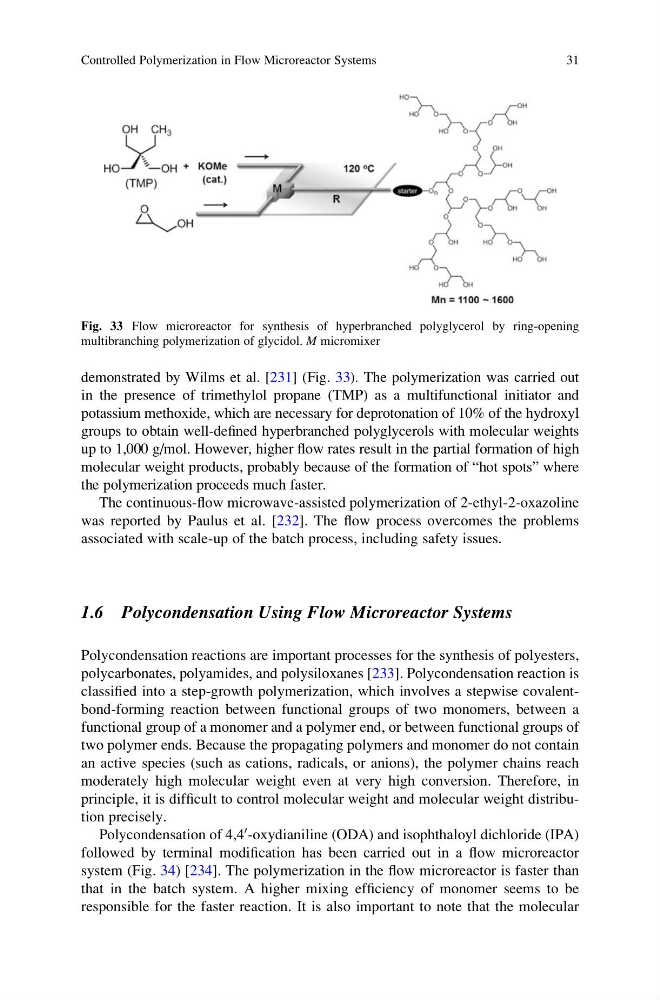
demonstrated by Wilms et al. [231] (Fig. 33). The polymerization was carried out
in the presence of trimethylol propane (TMP) as a multifunctional initiator and
potassium methoxide, which are necessary for deprotonation of 10% of the hydroxyl
groups to obtain well-defined hyperbranched polyglycerols with molecular weights
up to 1,000 g/mol. However, higher flow rates result in the partial formation of high
molecular weight products, probably because of the formation of “hot spots” where
the polymerization proceeds much faster.
The continuous-flow microwave-assisted polymerization of 2-ethyl-2-oxazoline
was reported by Paulus et al. [232]. The flow process overcomes the problems
associated with scale-up of the batch process, including safety issues.
1.6 Polycondensation Using Flow Microreactor Systems
Polycondensation reactions are important processes for the synthesis of polyesters,
polycarbonates, polyamides, and polysiloxanes [233]. Polycondensation reaction is
classified into a step-growth polymerization, which involves a stepwise covalentbond-forming reaction between functional groups of two monomers, between a
functional group of a monomer and a polymer end, or between functional groups of
two polymer ends. Because the propagating polymers and monomer do not contain
an active species (such as cations, radicals, or anions), the polymer chains reach
moderately high molecular weight even at very high conversion. Therefore, in
principle, it is difficult to control molecular weight and molecular weight distribution precisely.
Polycondensation of 4,4
0 -oxydianiline (ODA) and isophthaloyl dichloride (IPA)
followed by terminal modification has been carried out in a flow microreactor
system (Fig. 34) [234]. The polymerization in the flow microreactor is faster than
that in the batch system. A higher mixing efficiency of monomer seems to be
responsible for the faster reaction. It is also important to note that the molecular
Fig. 33 Flow microreactor for synthesis of hyperbranched polyglycerol by ring-opening
multibranching polymerization of glycidol. M micromixer
Controlled Polymerization in Flow Microreactor Systems
31
in the presence of trimethylol propane (TMP) as a multifunctional initiator and
potassium methoxide, which are necessary for deprotonation of 10% of the hydroxyl
groups to obtain well-defined hyperbranched polyglycerols with molecular weights
up to 1,000 g/mol. However, higher flow rates result in the partial formation of high
molecular weight products, probably because of the formation of “hot spots” where
the polymerization proceeds much faster.
The continuous-flow microwave-assisted polymerization of 2-ethyl-2-oxazoline
was reported by Paulus et al. [232]. The flow process overcomes the problems
associated with scale-up of the batch process, including safety issues.
1.6 Polycondensation Using Flow Microreactor Systems
Polycondensation reactions are important processes for the synthesis of polyesters,
polycarbonates, polyamides, and polysiloxanes [233]. Polycondensation reaction is
classified into a step-growth polymerization, which involves a stepwise covalentbond-forming reaction between functional groups of two monomers, between a
functional group of a monomer and a polymer end, or between functional groups of
two polymer ends. Because the propagating polymers and monomer do not contain
an active species (such as cations, radicals, or anions), the polymer chains reach
moderately high molecular weight even at very high conversion. Therefore, in
principle, it is difficult to control molecular weight and molecular weight distribution precisely.
Polycondensation of 4,4
0 -oxydianiline (ODA) and isophthaloyl dichloride (IPA)
followed by terminal modification has been carried out in a flow microreactor
system (Fig. 34) [234]. The polymerization in the flow microreactor is faster than
that in the batch system. A higher mixing efficiency of monomer seems to be
responsible for the faster reaction. It is also important to note that the molecular
Fig. 33 Flow microreactor for synthesis of hyperbranched polyglycerol by ring-opening
multibranching polymerization of glycidol. M micromixer
Controlled Polymerization in Flow Microreactor Systems
31