

By polycondensation of trifunctional silanols, it is possible to prepare poly
(silsesquioxane)s, which emerge as materials for various applications ranging
from low dielectric constant materials [236] to flame-retardant material [237].
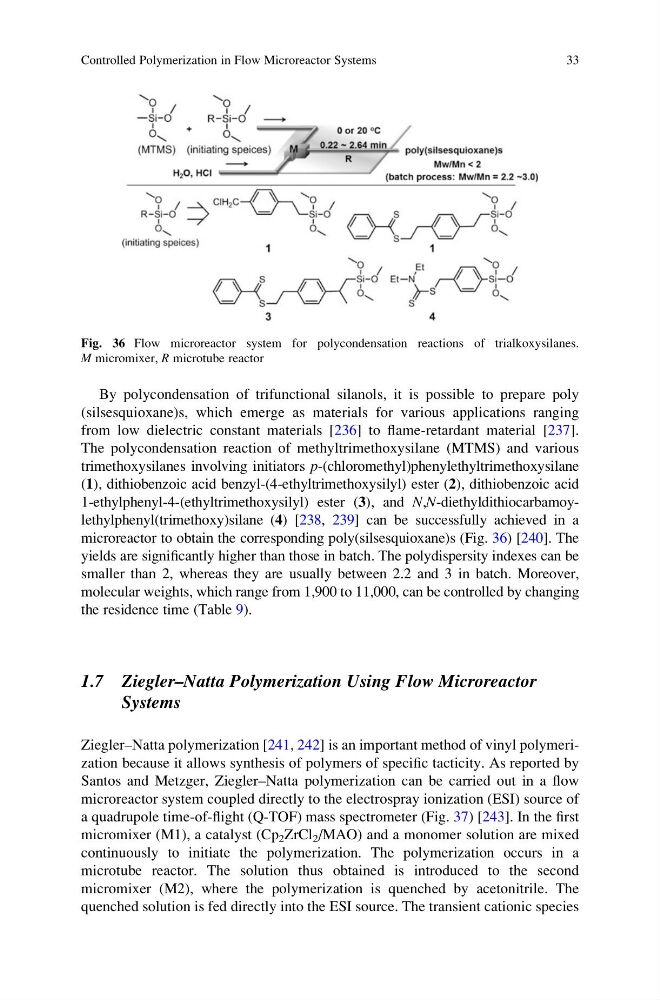
The polycondensation reaction of methyltrimethoxysilane (MTMS) and various
trimethoxysilanes involving initiators p-(chloromethyl)phenylethyltrimethoxysilane
(1), dithiobenzoic acid benzyl-(4-ethyltrimethoxysilyl) ester (2), dithiobenzoic acid
1-ethylphenyl-4-(ethyltrimethoxysilyl) ester (3), and N,N-diethyldithiocarbamoylethylphenyl(trimethoxy)silane (4) [238, 239] can be successfully achieved in a
microreactor to obtain the corresponding poly(silsesquioxane)s (Fig. 36) [240]. The
yields are significantly higher than those in batch. The polydispersity indexes can be
smaller than 2, whereas they are usually between 2.2 and 3 in batch. Moreover,
molecular weights, which range from 1,900 to 11,000, can be controlled by changing
the residence time (Table 9).
1.7 Ziegler–Natta Polymerization Using Flow Microreactor
Systems
Ziegler–Natta polymerization [241, 242] is an important method of vinyl polymerization because it allows synthesis of polymers of specific tacticity. As reported by
Santos and Metzger, Ziegler–Natta polymerization can be carried out in a flow
microreactor system coupled directly to the electrospray ionization (ESI) source of
a quadrupole time-of-flight (Q-TOF) mass spectrometer (Fig. 37) [243]. In the first
micromixer (M1), a catalyst (Cp 2 ZrCl 2 /MAO) and a monomer solution are mixed
continuously to initiate the polymerization. The polymerization occurs in a
microtube reactor. The solution thus obtained is introduced to the second
micromixer (M2), where the polymerization is quenched by acetonitrile. The
quenched solution is fed directly into the ESI source. The transient cationic species
Fig. 36 Flow microreactor system for polycondensation reactions of trialkoxysilanes.
M micromixer, R microtube reactor
Controlled Polymerization in Flow Microreactor Systems
33
(silsesquioxane)s, which emerge as materials for various applications ranging
from low dielectric constant materials [236] to flame-retardant material [237].
The polycondensation reaction of methyltrimethoxysilane (MTMS) and various
trimethoxysilanes involving initiators p-(chloromethyl)phenylethyltrimethoxysilane
(1), dithiobenzoic acid benzyl-(4-ethyltrimethoxysilyl) ester (2), dithiobenzoic acid
1-ethylphenyl-4-(ethyltrimethoxysilyl) ester (3), and N,N-diethyldithiocarbamoylethylphenyl(trimethoxy)silane (4) [238, 239] can be successfully achieved in a
microreactor to obtain the corresponding poly(silsesquioxane)s (Fig. 36) [240]. The
yields are significantly higher than those in batch. The polydispersity indexes can be
smaller than 2, whereas they are usually between 2.2 and 3 in batch. Moreover,
molecular weights, which range from 1,900 to 11,000, can be controlled by changing
the residence time (Table 9).
1.7 Ziegler–Natta Polymerization Using Flow Microreactor
Systems
Ziegler–Natta polymerization [241, 242] is an important method of vinyl polymerization because it allows synthesis of polymers of specific tacticity. As reported by
Santos and Metzger, Ziegler–Natta polymerization can be carried out in a flow
microreactor system coupled directly to the electrospray ionization (ESI) source of
a quadrupole time-of-flight (Q-TOF) mass spectrometer (Fig. 37) [243]. In the first
micromixer (M1), a catalyst (Cp 2 ZrCl 2 /MAO) and a monomer solution are mixed
continuously to initiate the polymerization. The polymerization occurs in a
microtube reactor. The solution thus obtained is introduced to the second
micromixer (M2), where the polymerization is quenched by acetonitrile. The
quenched solution is fed directly into the ESI source. The transient cationic species
Fig. 36 Flow microreactor system for polycondensation reactions of trialkoxysilanes.
M micromixer, R microtube reactor
Controlled Polymerization in Flow Microreactor Systems
33