

weight distribution or molecular weight and F is linear, enabling prediction of
copolymer features.
Recently, Ryu, Studer and colleagues also reported the use of highly sterically
hindered amines [217, 218] for the NMP of styrene and butyl acrylate in a flow
microreactor [219]. The polymerization in the flow microreactor is faster than that
in the batch system, although polymers with slightly smaller molecular are obtained
in flow.
In general, gel permeation chromatography (GPC) is used to characterized
polymers. However, sample preparation and analysis requires a long time. The
integration of a flow microreactor with analytical devices to monitor the progress of
polymerization in real time allows fast screening and optimization. For example,
the continuous online rapid size-exclusion chromatography monitoring of
polymerizations (CORSEMP) system has been developed by Serra, Hadziioannou
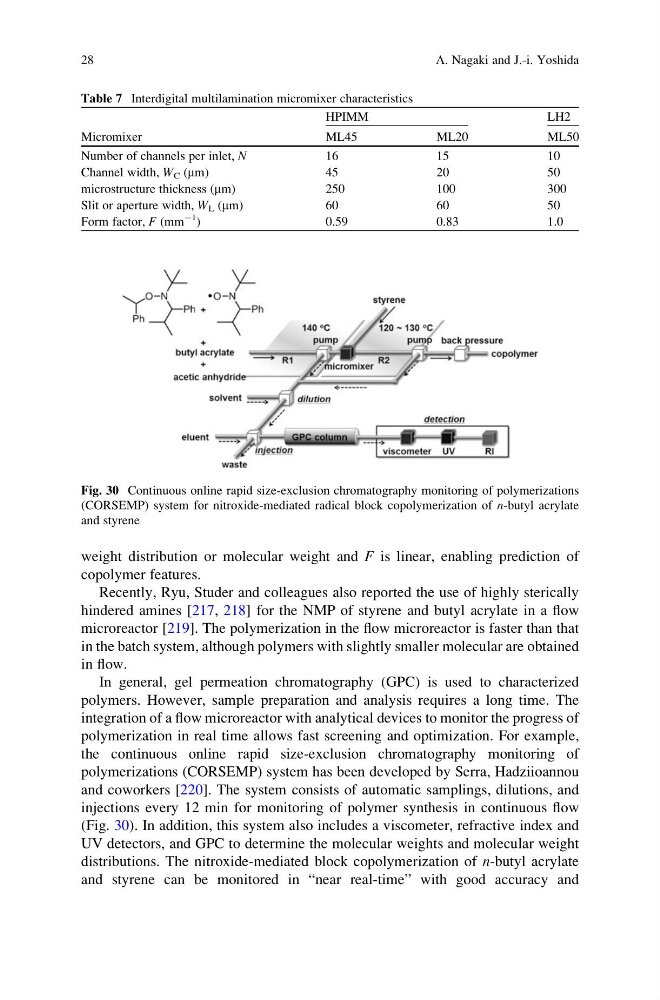
and coworkers [220]. The system consists of automatic samplings, dilutions, and
injections every 12 min for monitoring of polymer synthesis in continuous flow
(Fig. 30). In addition, this system also includes a viscometer, refractive index and
UV detectors, and GPC to determine the molecular weights and molecular weight
distributions. The nitroxide-mediated block copolymerization of n-butyl acrylate
and styrene can be monitored in “near real-time” with good accuracy and
Table 7 Interdigital multilamination micromixer characteristics
Micromixer
HPIMM
LH2
ML45
ML20
ML50
Number of channels per inlet, N
16
15
10
Channel width, W C (mm)
45
20
50
microstructure thickness (mm)
250
100
300
Slit or aperture width, W L (mm)
60
60
50
Form factor, F (mm
À1
)
0.59
0.83
1.0
Fig. 30 Continuous online rapid size-exclusion chromatography monitoring of polymerizations
(CORSEMP) system for nitroxide-mediated radical block copolymerization of n-butyl acrylate
and styrene
28
A. Nagaki and J.-i. Yoshida
copolymer features.
Recently, Ryu, Studer and colleagues also reported the use of highly sterically
hindered amines [217, 218] for the NMP of styrene and butyl acrylate in a flow
microreactor [219]. The polymerization in the flow microreactor is faster than that
in the batch system, although polymers with slightly smaller molecular are obtained
in flow.
In general, gel permeation chromatography (GPC) is used to characterized
polymers. However, sample preparation and analysis requires a long time. The
integration of a flow microreactor with analytical devices to monitor the progress of
polymerization in real time allows fast screening and optimization. For example,
the continuous online rapid size-exclusion chromatography monitoring of
polymerizations (CORSEMP) system has been developed by Serra, Hadziioannou
and coworkers [220]. The system consists of automatic samplings, dilutions, and
injections every 12 min for monitoring of polymer synthesis in continuous flow
(Fig. 30). In addition, this system also includes a viscometer, refractive index and
UV detectors, and GPC to determine the molecular weights and molecular weight
distributions. The nitroxide-mediated block copolymerization of n-butyl acrylate
and styrene can be monitored in “near real-time” with good accuracy and
Table 7 Interdigital multilamination micromixer characteristics
Micromixer
HPIMM
LH2
ML45
ML20
ML50
Number of channels per inlet, N
16
15
10
Channel width, W C (mm)
45
20
50
microstructure thickness (mm)
250
100
300
Slit or aperture width, W L (mm)
60
60
50
Form factor, F (mm
À1
)
0.59
0.83
1.0
Fig. 30 Continuous online rapid size-exclusion chromatography monitoring of polymerizations
(CORSEMP) system for nitroxide-mediated radical block copolymerization of n-butyl acrylate
and styrene
28
A. Nagaki and J.-i. Yoshida