

repeatability. Very recently, bifurcation analysis and grade transition dynamic
optimization for NMP of styrene in a tubular reactor have been demonstrated by
Flores-Tlacuahuac and coworkers [221, 222].
1.5 Ring-Opening Polymerization Using Flow Microreactor
Systems
Ring-opening polymerization is categorized as chain-growth polymerization in
which the terminal end of a polymer acts as a reactive center [223]. The reaction
of cyclic compounds with a polymer end causes cleavage of the ring and repetition
of this process leads to the formation of high molecular weight polymers. The
synthesis of polyamides from lactams, polyesters from lactones, and polyethers
from cyclic ethers have been widely used.
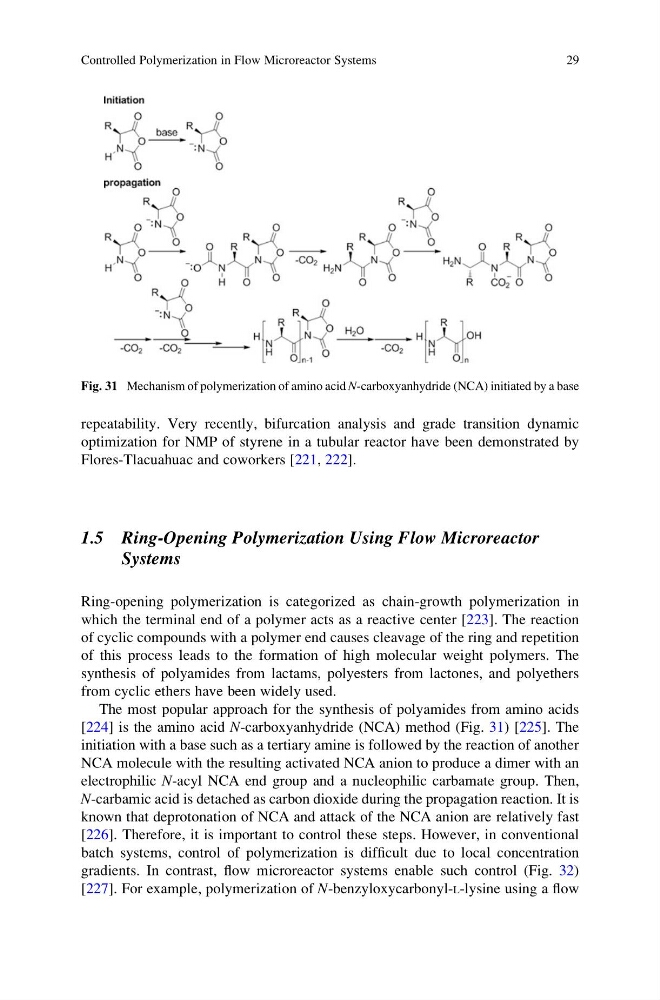
The most popular approach for the synthesis of polyamides from amino acids
[224] is the amino acid N-carboxyanhydride (NCA) method (Fig. 31) [225]. The
initiation with a base such as a tertiary amine is followed by the reaction of another
NCA molecule with the resulting activated NCA anion to produce a dimer with an
electrophilic N-acyl NCA end group and a nucleophilic carbamate group. Then,
N-carbamic acid is detached as carbon dioxide during the propagation reaction. It is
known that deprotonation of NCA and attack of the NCA anion are relatively fast
[226]. Therefore, it is important to control these steps. However, in conventional
batch systems, control of polymerization is difficult due to local concentration
gradients. In contrast, flow microreactor systems enable such control (Fig. 32)
[227]. For example, polymerization of N-benzyloxycarbonyl-L-lysine using a flow
Fig. 31 Mechanism of polymerization of amino acid N-carboxyanhydride (NCA) initiated by a base
Controlled Polymerization in Flow Microreactor Systems
29
optimization for NMP of styrene in a tubular reactor have been demonstrated by
Flores-Tlacuahuac and coworkers [221, 222].
1.5 Ring-Opening Polymerization Using Flow Microreactor
Systems
Ring-opening polymerization is categorized as chain-growth polymerization in
which the terminal end of a polymer acts as a reactive center [223]. The reaction
of cyclic compounds with a polymer end causes cleavage of the ring and repetition
of this process leads to the formation of high molecular weight polymers. The
synthesis of polyamides from lactams, polyesters from lactones, and polyethers
from cyclic ethers have been widely used.
The most popular approach for the synthesis of polyamides from amino acids
[224] is the amino acid N-carboxyanhydride (NCA) method (Fig. 31) [225]. The
initiation with a base such as a tertiary amine is followed by the reaction of another
NCA molecule with the resulting activated NCA anion to produce a dimer with an
electrophilic N-acyl NCA end group and a nucleophilic carbamate group. Then,
N-carbamic acid is detached as carbon dioxide during the propagation reaction. It is
known that deprotonation of NCA and attack of the NCA anion are relatively fast
[226]. Therefore, it is important to control these steps. However, in conventional
batch systems, control of polymerization is difficult due to local concentration
gradients. In contrast, flow microreactor systems enable such control (Fig. 32)
[227]. For example, polymerization of N-benzyloxycarbonyl-L-lysine using a flow
Fig. 31 Mechanism of polymerization of amino acid N-carboxyanhydride (NCA) initiated by a base
Controlled Polymerization in Flow Microreactor Systems
29