

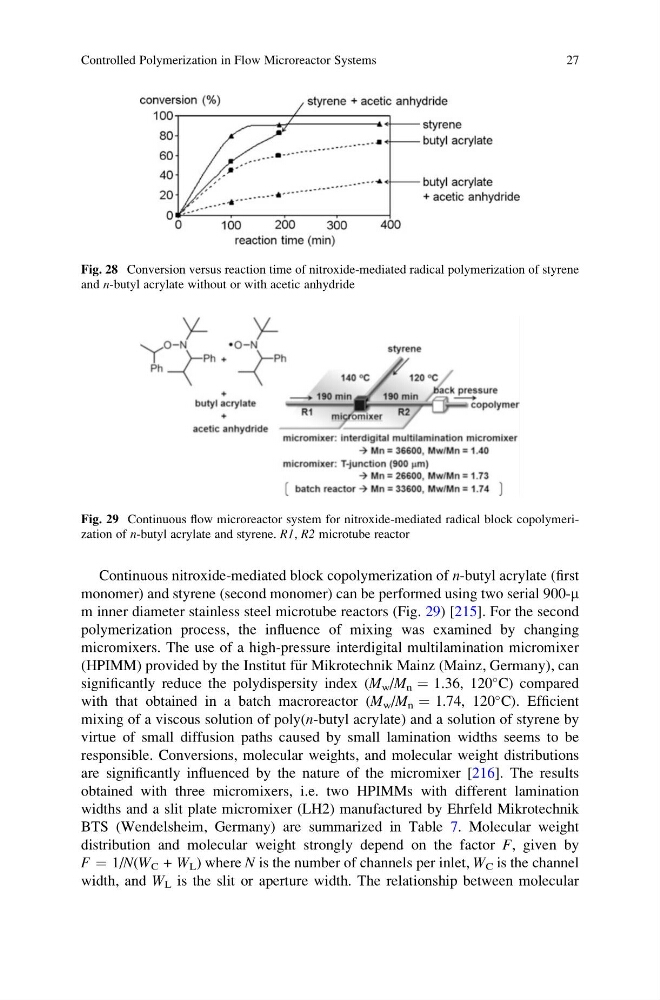
Continuous nitroxide-mediated block copolymerization of n-butyl acrylate (first
monomer) and styrene (second monomer) can be performed using two serial 900-m
m inner diameter stainless steel microtube reactors (Fig. 29) [215]. For the second
polymerization process, the influence of mixing was examined by changing
micromixers. The use of a high-pressure interdigital multilamination micromixer
(HPIMM) provided by the Institut f€ ur Mikrotechnik Mainz (Mainz, Germany), can
significantly reduce the polydispersity index (M w /M n ¼ 1.36, 120
C) compared
with that obtained in a batch macroreactor (M w /M n ¼ 1.74, 120
C). Efficient
mixing of a viscous solution of poly(n-butyl acrylate) and a solution of styrene by
virtue of small diffusion paths caused by small lamination widths seems to be
responsible. Conversions, molecular weights, and molecular weight distributions
are significantly influenced by the nature of the micromixer [216]. The results
obtained with three micromixers, i.e. two HPIMMs with different lamination
widths and a slit plate micromixer (LH2) manufactured by Ehrfeld Mikrotechnik
BTS (Wendelsheim, Germany) are summarized in Table 7. Molecular weight
distribution and molecular weight strongly depend on the factor F, given by
F ¼ 1/N(W C + W L ) where N is the number of channels per inlet, W C is the channel
width, and W L is the slit or aperture width. The relationship between molecular
Fig. 29 Continuous flow microreactor system for nitroxide-mediated radical block copolymerization of n-butyl acrylate and styrene. R1, R2 microtube reactor
Fig. 28 Conversion versus reaction time of nitroxide-mediated radical polymerization of styrene
and n-butyl acrylate without or with acetic anhydride
Controlled Polymerization in Flow Microreactor Systems
27
monomer) and styrene (second monomer) can be performed using two serial 900-m
m inner diameter stainless steel microtube reactors (Fig. 29) [215]. For the second
polymerization process, the influence of mixing was examined by changing
micromixers. The use of a high-pressure interdigital multilamination micromixer
(HPIMM) provided by the Institut f€ ur Mikrotechnik Mainz (Mainz, Germany), can
significantly reduce the polydispersity index (M w /M n ¼ 1.36, 120
C) compared
with that obtained in a batch macroreactor (M w /M n ¼ 1.74, 120
C). Efficient
mixing of a viscous solution of poly(n-butyl acrylate) and a solution of styrene by
virtue of small diffusion paths caused by small lamination widths seems to be
responsible. Conversions, molecular weights, and molecular weight distributions
are significantly influenced by the nature of the micromixer [216]. The results
obtained with three micromixers, i.e. two HPIMMs with different lamination
widths and a slit plate micromixer (LH2) manufactured by Ehrfeld Mikrotechnik
BTS (Wendelsheim, Germany) are summarized in Table 7. Molecular weight
distribution and molecular weight strongly depend on the factor F, given by
F ¼ 1/N(W C + W L ) where N is the number of channels per inlet, W C is the channel
width, and W L is the slit or aperture width. The relationship between molecular
Fig. 29 Continuous flow microreactor system for nitroxide-mediated radical block copolymerization of n-butyl acrylate and styrene. R1, R2 microtube reactor
Fig. 28 Conversion versus reaction time of nitroxide-mediated radical polymerization of styrene
and n-butyl acrylate without or with acetic anhydride
Controlled Polymerization in Flow Microreactor Systems
27