

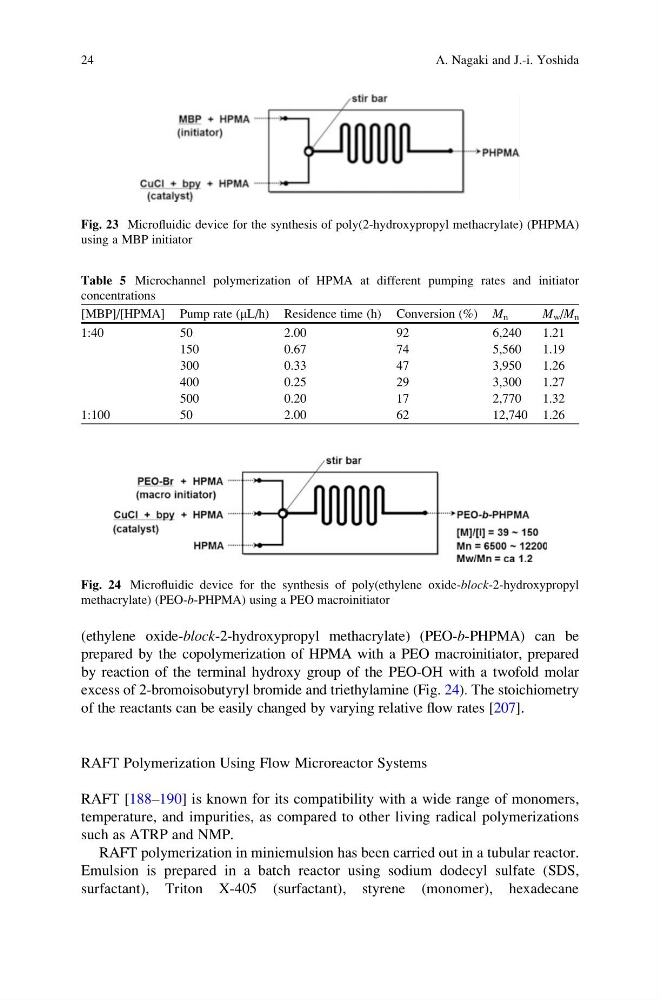
(ethylene oxide-block-2-hydroxypropyl methacrylate) (PEO-b-PHPMA) can be
prepared by the copolymerization of HPMA with a PEO macroinitiator, prepared
by reaction of the terminal hydroxy group of the PEO-OH with a twofold molar
excess of 2-bromoisobutyryl bromide and triethylamine (Fig. 24). The stoichiometry
of the reactants can be easily changed by varying relative flow rates [207].
RAFT Polymerization Using Flow Microreactor Systems
RAFT [188–190] is known for its compatibility with a wide range of monomers,
temperature, and impurities, as compared to other living radical polymerizations
such as ATRP and NMP.
RAFT polymerization in miniemulsion has been carried out in a tubular reactor.
Emulsion is prepared in a batch reactor using sodium dodecyl sulfate (SDS,
surfactant), Triton X-405 (surfactant), styrene (monomer), hexadecane
Table 5 Microchannel polymerization of HPMA at different pumping rates and initiator
concentrations
[MBP]/[HPMA] Pump rate (mL/h) Residence time (h) Conversion (%) M n
M w /M n
1:40
50
2.00
92
6,240
1.21
150
0.67
74
5,560
1.19
300
0.33
47
3,950
1.26
400
0.25
29
3,300
1.27
500
0.20
17
2,770
1.32
1:100
50
2.00
62
12,740 1.26
Fig. 24 Microfluidic device for the synthesis of poly(ethylene oxide-block-2-hydroxypropyl
methacrylate) (PEO-b-PHPMA) using a PEO macroinitiator
Fig. 23 Microfluidic device for the synthesis of poly(2-hydroxypropyl methacrylate) (PHPMA)
using a MBP initiator
24
A. Nagaki and J.-i. Yoshida
prepared by the copolymerization of HPMA with a PEO macroinitiator, prepared
by reaction of the terminal hydroxy group of the PEO-OH with a twofold molar
excess of 2-bromoisobutyryl bromide and triethylamine (Fig. 24). The stoichiometry
of the reactants can be easily changed by varying relative flow rates [207].
RAFT Polymerization Using Flow Microreactor Systems
RAFT [188–190] is known for its compatibility with a wide range of monomers,
temperature, and impurities, as compared to other living radical polymerizations
such as ATRP and NMP.
RAFT polymerization in miniemulsion has been carried out in a tubular reactor.
Emulsion is prepared in a batch reactor using sodium dodecyl sulfate (SDS,
surfactant), Triton X-405 (surfactant), styrene (monomer), hexadecane
Table 5 Microchannel polymerization of HPMA at different pumping rates and initiator
concentrations
[MBP]/[HPMA] Pump rate (mL/h) Residence time (h) Conversion (%) M n
M w /M n
1:40
50
2.00
92
6,240
1.21
150
0.67
74
5,560
1.19
300
0.33
47
3,950
1.26
400
0.25
29
3,300
1.27
500
0.20
17
2,770
1.32
1:100
50
2.00
62
12,740 1.26
Fig. 24 Microfluidic device for the synthesis of poly(ethylene oxide-block-2-hydroxypropyl
methacrylate) (PEO-b-PHPMA) using a PEO macroinitiator
Fig. 23 Microfluidic device for the synthesis of poly(2-hydroxypropyl methacrylate) (PHPMA)
using a MBP initiator
24
A. Nagaki and J.-i. Yoshida