

ATRP Using Flow Microreactor Systems
ATRP [182–187] is one of the most extensively studied living radical polymerizations
because of its simplicity and broad applicability, and serves as a method for
synthesizing previously inaccessible well-defined nanostructured polymeric materials
[202]. One of the main drawbacks of this process is low catalytic efficiency and deep
color of the final product. In general, the use of 0.1–1% catalyst results in the formation
of the colored polymer containing the residual catalyst. Therefore, after polymerization, additional purification by passing the solution through silica gel or alumina gel is
needed to remove the catalyst from product. A possible solution to this problem is the
use of supported catalysts.
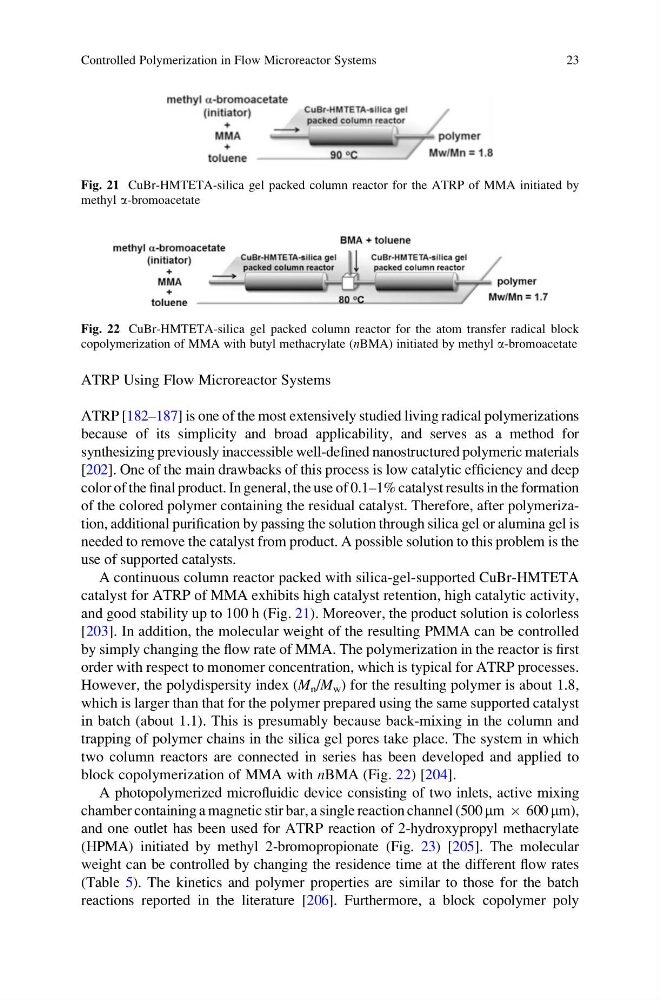
A continuous column reactor packed with silica-gel-supported CuBr-HMTETA
catalyst for ATRP of MMA exhibits high catalyst retention, high catalytic activity,
and good stability up to 100 h (Fig. 21). Moreover, the product solution is colorless
[203]. In addition, the molecular weight of the resulting PMMA can be controlled
by simply changing the flow rate of MMA. The polymerization in the reactor is first
order with respect to monomer concentration, which is typical for ATRP processes.
However, the polydispersity index (M n /M w ) for the resulting polymer is about 1.8,
which is larger than that for the polymer prepared using the same supported catalyst
in batch (about 1.1). This is presumably because back-mixing in the column and
trapping of polymer chains in the silica gel pores take place. The system in which
two column reactors are connected in series has been developed and applied to
block copolymerization of MMA with nBMA (Fig. 22) [204].
A photopolymerized microfluidic device consisting of two inlets, active mixing
chamber containing a magnetic stir bar, a single reaction channel (500 mm  600 mm),
and one outlet has been used for ATRP reaction of 2-hydroxypropyl methacrylate
(HPMA) initiated by methyl 2-bromopropionate (Fig. 23) [205]. The molecular
weight can be controlled by changing the residence time at the different flow rates
(Table 5). The kinetics and polymer properties are similar to those for the batch
reactions reported in the literature [206]. Furthermore, a block copolymer poly
Fig. 21 CuBr-HMTETA-silica gel packed column reactor for the ATRP of MMA initiated by
methyl a-bromoacetate
Fig. 22 CuBr-HMTETA-silica gel packed column reactor for the atom transfer radical block
copolymerization of MMA with butyl methacrylate (nBMA) initiated by methyl a-bromoacetate
Controlled Polymerization in Flow Microreactor Systems
23
ATRP [182–187] is one of the most extensively studied living radical polymerizations
because of its simplicity and broad applicability, and serves as a method for
synthesizing previously inaccessible well-defined nanostructured polymeric materials
[202]. One of the main drawbacks of this process is low catalytic efficiency and deep
color of the final product. In general, the use of 0.1–1% catalyst results in the formation
of the colored polymer containing the residual catalyst. Therefore, after polymerization, additional purification by passing the solution through silica gel or alumina gel is
needed to remove the catalyst from product. A possible solution to this problem is the
use of supported catalysts.
A continuous column reactor packed with silica-gel-supported CuBr-HMTETA
catalyst for ATRP of MMA exhibits high catalyst retention, high catalytic activity,
and good stability up to 100 h (Fig. 21). Moreover, the product solution is colorless
[203]. In addition, the molecular weight of the resulting PMMA can be controlled
by simply changing the flow rate of MMA. The polymerization in the reactor is first
order with respect to monomer concentration, which is typical for ATRP processes.
However, the polydispersity index (M n /M w ) for the resulting polymer is about 1.8,
which is larger than that for the polymer prepared using the same supported catalyst
in batch (about 1.1). This is presumably because back-mixing in the column and
trapping of polymer chains in the silica gel pores take place. The system in which
two column reactors are connected in series has been developed and applied to
block copolymerization of MMA with nBMA (Fig. 22) [204].
A photopolymerized microfluidic device consisting of two inlets, active mixing
chamber containing a magnetic stir bar, a single reaction channel (500 mm  600 mm),
and one outlet has been used for ATRP reaction of 2-hydroxypropyl methacrylate
(HPMA) initiated by methyl 2-bromopropionate (Fig. 23) [205]. The molecular
weight can be controlled by changing the residence time at the different flow rates
(Table 5). The kinetics and polymer properties are similar to those for the batch
reactions reported in the literature [206]. Furthermore, a block copolymer poly
Fig. 21 CuBr-HMTETA-silica gel packed column reactor for the ATRP of MMA initiated by
methyl a-bromoacetate
Fig. 22 CuBr-HMTETA-silica gel packed column reactor for the atom transfer radical block
copolymerization of MMA with butyl methacrylate (nBMA) initiated by methyl a-bromoacetate
Controlled Polymerization in Flow Microreactor Systems
23