

(costabilizer), and 1-phenylethyl phenyldithioacetate (PEPDTA, RAFT agent), and
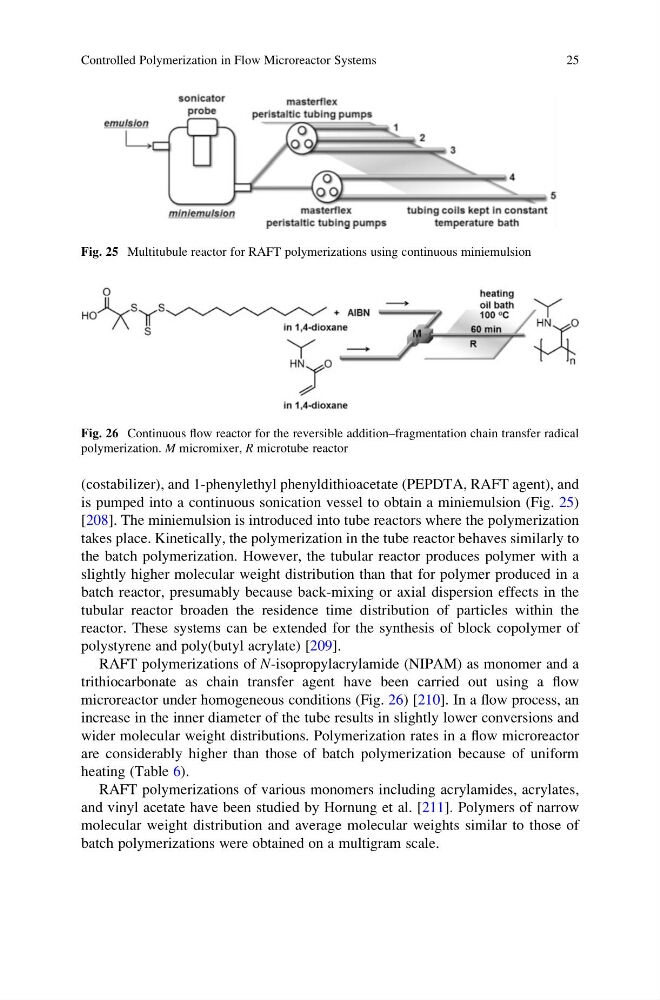
is pumped into a continuous sonication vessel to obtain a miniemulsion (Fig. 25)
[208]. The miniemulsion is introduced into tube reactors where the polymerization
takes place. Kinetically, the polymerization in the tube reactor behaves similarly to
the batch polymerization. However, the tubular reactor produces polymer with a
slightly higher molecular weight distribution than that for polymer produced in a
batch reactor, presumably because back-mixing or axial dispersion effects in the
tubular reactor broaden the residence time distribution of particles within the
reactor. These systems can be extended for the synthesis of block copolymer of
polystyrene and poly(butyl acrylate) [209].
RAFT polymerizations of N-isopropylacrylamide (NIPAM) as monomer and a
trithiocarbonate as chain transfer agent have been carried out using a flow
microreactor under homogeneous conditions (Fig. 26) [210]. In a flow process, an
increase in the inner diameter of the tube results in slightly lower conversions and
wider molecular weight distributions. Polymerization rates in a flow microreactor
are considerably higher than those of batch polymerization because of uniform
heating (Table 6).
RAFT polymerizations of various monomers including acrylamides, acrylates,
and vinyl acetate have been studied by Hornung et al. [211]. Polymers of narrow
molecular weight distribution and average molecular weights similar to those of
batch polymerizations were obtained on a multigram scale.
Fig. 25 Multitubule reactor for RAFT polymerizations using continuous miniemulsion
Fig. 26 Continuous flow reactor for the reversible addition–fragmentation chain transfer radical
polymerization. M micromixer, R microtube reactor
Controlled Polymerization in Flow Microreactor Systems
25
is pumped into a continuous sonication vessel to obtain a miniemulsion (Fig. 25)
[208]. The miniemulsion is introduced into tube reactors where the polymerization
takes place. Kinetically, the polymerization in the tube reactor behaves similarly to
the batch polymerization. However, the tubular reactor produces polymer with a
slightly higher molecular weight distribution than that for polymer produced in a
batch reactor, presumably because back-mixing or axial dispersion effects in the
tubular reactor broaden the residence time distribution of particles within the
reactor. These systems can be extended for the synthesis of block copolymer of
polystyrene and poly(butyl acrylate) [209].
RAFT polymerizations of N-isopropylacrylamide (NIPAM) as monomer and a
trithiocarbonate as chain transfer agent have been carried out using a flow
microreactor under homogeneous conditions (Fig. 26) [210]. In a flow process, an
increase in the inner diameter of the tube results in slightly lower conversions and
wider molecular weight distributions. Polymerization rates in a flow microreactor
are considerably higher than those of batch polymerization because of uniform
heating (Table 6).
RAFT polymerizations of various monomers including acrylamides, acrylates,
and vinyl acetate have been studied by Hornung et al. [211]. Polymers of narrow
molecular weight distribution and average molecular weights similar to those of
batch polymerizations were obtained on a multigram scale.
Fig. 25 Multitubule reactor for RAFT polymerizations using continuous miniemulsion
Fig. 26 Continuous flow reactor for the reversible addition–fragmentation chain transfer radical
polymerization. M micromixer, R microtube reactor
Controlled Polymerization in Flow Microreactor Systems
25