

The use of living anionic polymerization of alkyl methacrylates is very popular for
this purpose. Living anionic polymerization of alkyl methacrylates does not need a
capping agent and therefore is very fast compared to living radical polymerization.
However, synthesis of poly(alkyl methacrylate)s via anionic polymerization using a
conventional batch macroreactor should be carried out at low temperatures such as
À78
C to obtain polymers of narrow molecular-weight distribution [159, 160]. The
requirement of such low temperatures causes several limitations in the use of this
highly useful polymerization in industry. However, if the problem is solved, living
anionic polymerization of alkyl methacrylate could serve as a powerful method for
synthesis of poly(alkyl methacrylate)s.
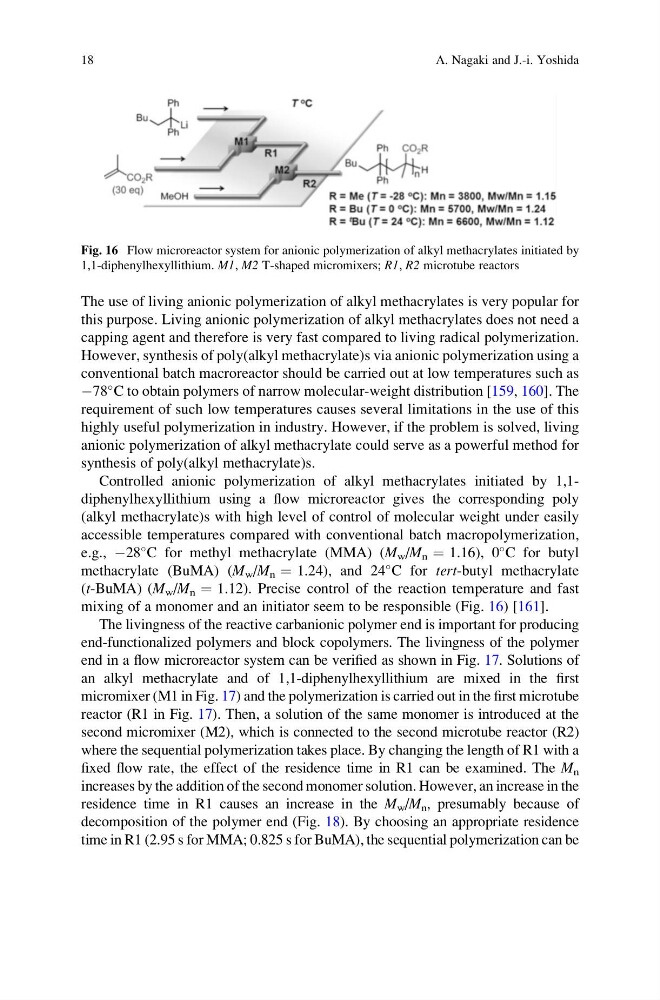
Controlled anionic polymerization of alkyl methacrylates initiated by 1,1diphenylhexyllithium using a flow microreactor gives the corresponding poly
(alkyl methacrylate)s with high level of control of molecular weight under easily
accessible temperatures compared with conventional batch macropolymerization,
e.g., À28
C for methyl methacrylate (MMA) (M w /M n ¼ 1.16), 0
C for butyl
methacrylate (BuMA) (M w /M n ¼ 1.24), and 24
C for tert-butyl methacrylate
(t-BuMA) (M w /M n ¼ 1.12). Precise control of the reaction temperature and fast
mixing of a monomer and an initiator seem to be responsible (Fig. 16) [161].
The livingness of the reactive carbanionic polymer end is important for producing
end-functionalized polymers and block copolymers. The livingness of the polymer
end in a flow microreactor system can be verified as shown in Fig. 17. Solutions of
an alkyl methacrylate and of 1,1-diphenylhexyllithium are mixed in the first
micromixer (M1 in Fig. 17) and the polymerization is carried out in the first microtube
reactor (R1 in Fig. 17). Then, a solution of the same monomer is introduced at the
second micromixer (M2), which is connected to the second microtube reactor (R2)
where the sequential polymerization takes place. By changing the length of R1 with a
fixed flow rate, the effect of the residence time in R1 can be examined. The M n
increases by the addition of the second monomer solution. However, an increase in the
residence time in R1 causes an increase in the M w /M n , presumably because of
decomposition of the polymer end (Fig. 18). By choosing an appropriate residence
time in R1 (2.95 s for MMA; 0.825 s for BuMA), the sequential polymerization can be
Fig. 16 Flow microreactor system for anionic polymerization of alkyl methacrylates initiated by
1,1-diphenylhexyllithium. M1, M2 T-shaped micromixers; R1, R2 microtube reactors
18
A. Nagaki and J.-i. Yoshida
this purpose. Living anionic polymerization of alkyl methacrylates does not need a
capping agent and therefore is very fast compared to living radical polymerization.
However, synthesis of poly(alkyl methacrylate)s via anionic polymerization using a
conventional batch macroreactor should be carried out at low temperatures such as
À78
C to obtain polymers of narrow molecular-weight distribution [159, 160]. The
requirement of such low temperatures causes several limitations in the use of this
highly useful polymerization in industry. However, if the problem is solved, living
anionic polymerization of alkyl methacrylate could serve as a powerful method for
synthesis of poly(alkyl methacrylate)s.
Controlled anionic polymerization of alkyl methacrylates initiated by 1,1diphenylhexyllithium using a flow microreactor gives the corresponding poly
(alkyl methacrylate)s with high level of control of molecular weight under easily
accessible temperatures compared with conventional batch macropolymerization,
e.g., À28
C for methyl methacrylate (MMA) (M w /M n ¼ 1.16), 0
C for butyl
methacrylate (BuMA) (M w /M n ¼ 1.24), and 24
C for tert-butyl methacrylate
(t-BuMA) (M w /M n ¼ 1.12). Precise control of the reaction temperature and fast
mixing of a monomer and an initiator seem to be responsible (Fig. 16) [161].
The livingness of the reactive carbanionic polymer end is important for producing
end-functionalized polymers and block copolymers. The livingness of the polymer
end in a flow microreactor system can be verified as shown in Fig. 17. Solutions of
an alkyl methacrylate and of 1,1-diphenylhexyllithium are mixed in the first
micromixer (M1 in Fig. 17) and the polymerization is carried out in the first microtube
reactor (R1 in Fig. 17). Then, a solution of the same monomer is introduced at the
second micromixer (M2), which is connected to the second microtube reactor (R2)
where the sequential polymerization takes place. By changing the length of R1 with a
fixed flow rate, the effect of the residence time in R1 can be examined. The M n
increases by the addition of the second monomer solution. However, an increase in the
residence time in R1 causes an increase in the M w /M n , presumably because of
decomposition of the polymer end (Fig. 18). By choosing an appropriate residence
time in R1 (2.95 s for MMA; 0.825 s for BuMA), the sequential polymerization can be
Fig. 16 Flow microreactor system for anionic polymerization of alkyl methacrylates initiated by
1,1-diphenylhexyllithium. M1, M2 T-shaped micromixers; R1, R2 microtube reactors
18
A. Nagaki and J.-i. Yoshida