

Controlled/Living Anionic Polymerization of Styrenes in Nonpolar Solvent Using
Flow Microreactor Systems
Anionic polymerization of styrenes can be conducted in nonpolar solvents at room
temperature in a batch macroreactor. However, much longer reaction time is needed
for completion. It is also important to carry out the polymerization with <20% by
volume of styrene because the reactions with >20% by volume of styrene may
result in a rapid increase in reaction temperature, potentially causing danger. The
use of a flow microreactor is effective for solving the problem. In fact, controlled
anionic polymerization of styrene initiated by s-BuLi in cyclohexane as a nonpolar
solvent can be conducted at 80
C by using a flow microreactor system to obtain
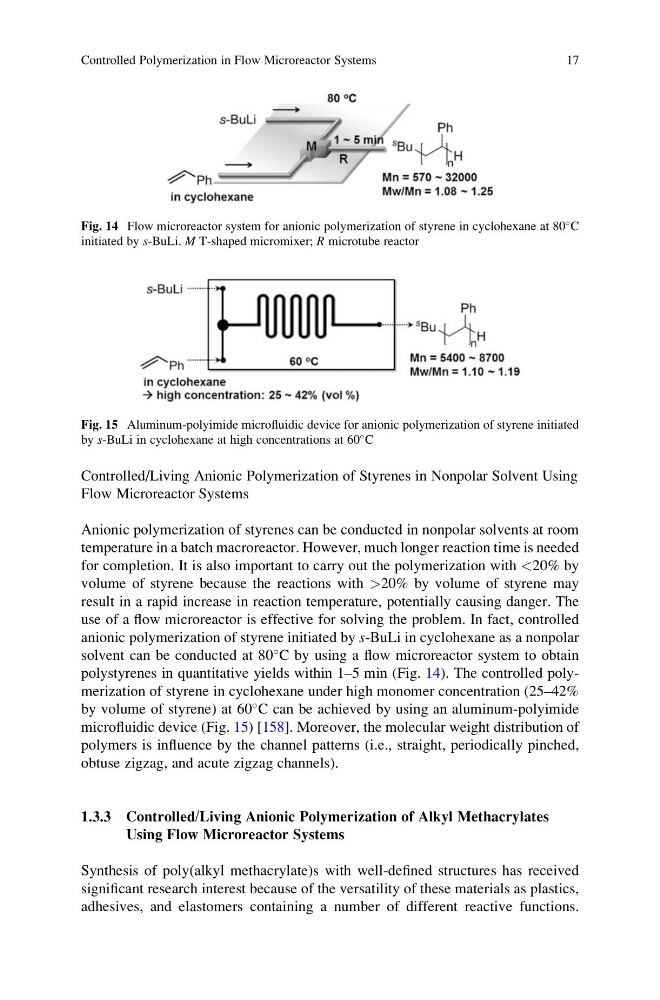
polystyrenes in quantitative yields within 1–5 min (Fig. 14). The controlled polymerization of styrene in cyclohexane under high monomer concentration (25–42%
by volume of styrene) at 60
C can be achieved by using an aluminum-polyimide
microfluidic device (Fig. 15) [158]. Moreover, the molecular weight distribution of
polymers is influence by the channel patterns (i.e., straight, periodically pinched,
obtuse zigzag, and acute zigzag channels).
1.3.3 Controlled/Living Anionic Polymerization of Alkyl Methacrylates
Using Flow Microreactor Systems
Synthesis of poly(alkyl methacrylate)s with well-defined structures has received
significant research interest because of the versatility of these materials as plastics,
adhesives, and elastomers containing a number of different reactive functions.
Fig. 14 Flow microreactor system for anionic polymerization of styrene in cyclohexane at 80
C
initiated by s-BuLi. M T-shaped micromixer; R microtube reactor
Fig. 15 Aluminum-polyimide microfluidic device for anionic polymerization of styrene initiated
by s-BuLi in cyclohexane at high concentrations at 60
C
Controlled Polymerization in Flow Microreactor Systems
17
Flow Microreactor Systems
Anionic polymerization of styrenes can be conducted in nonpolar solvents at room
temperature in a batch macroreactor. However, much longer reaction time is needed
for completion. It is also important to carry out the polymerization with <20% by
volume of styrene because the reactions with >20% by volume of styrene may
result in a rapid increase in reaction temperature, potentially causing danger. The
use of a flow microreactor is effective for solving the problem. In fact, controlled
anionic polymerization of styrene initiated by s-BuLi in cyclohexane as a nonpolar
solvent can be conducted at 80
C by using a flow microreactor system to obtain
polystyrenes in quantitative yields within 1–5 min (Fig. 14). The controlled polymerization of styrene in cyclohexane under high monomer concentration (25–42%
by volume of styrene) at 60
C can be achieved by using an aluminum-polyimide
microfluidic device (Fig. 15) [158]. Moreover, the molecular weight distribution of
polymers is influence by the channel patterns (i.e., straight, periodically pinched,
obtuse zigzag, and acute zigzag channels).
1.3.3 Controlled/Living Anionic Polymerization of Alkyl Methacrylates
Using Flow Microreactor Systems
Synthesis of poly(alkyl methacrylate)s with well-defined structures has received
significant research interest because of the versatility of these materials as plastics,
adhesives, and elastomers containing a number of different reactive functions.
Fig. 14 Flow microreactor system for anionic polymerization of styrene in cyclohexane at 80
C
initiated by s-BuLi. M T-shaped micromixer; R microtube reactor
Fig. 15 Aluminum-polyimide microfluidic device for anionic polymerization of styrene initiated
by s-BuLi in cyclohexane at high concentrations at 60
C
Controlled Polymerization in Flow Microreactor Systems
17