

The syntheses of various branched polymers with complex architectures such
as star polymers and dendrimer-like star-branched polymers using living anionic
polymerization have been studied extensively. These branched polymers have
attracted much attention from theoretical, synthetic, and practical viewpoints
because of their unique and interesting properties in solution, melt, and solid
states. Block copolymers having different polymer chains on a core are especially
interesting. To synthesize such a structure, selective 1:1 reaction of a living
polymer chain and a poly-functional core molecule is essential in the first step.
In a conventional batch macroreactor, an excess amount of polyfunctional core
should be used to obtain the monosubstituted compound selectively [155–157].
This requirement is problematic because an excess amount of functional core
should remain unchanged in the first step and, therefore, it should be removed
before proceeding to the second step. The use of a flow microreactor system
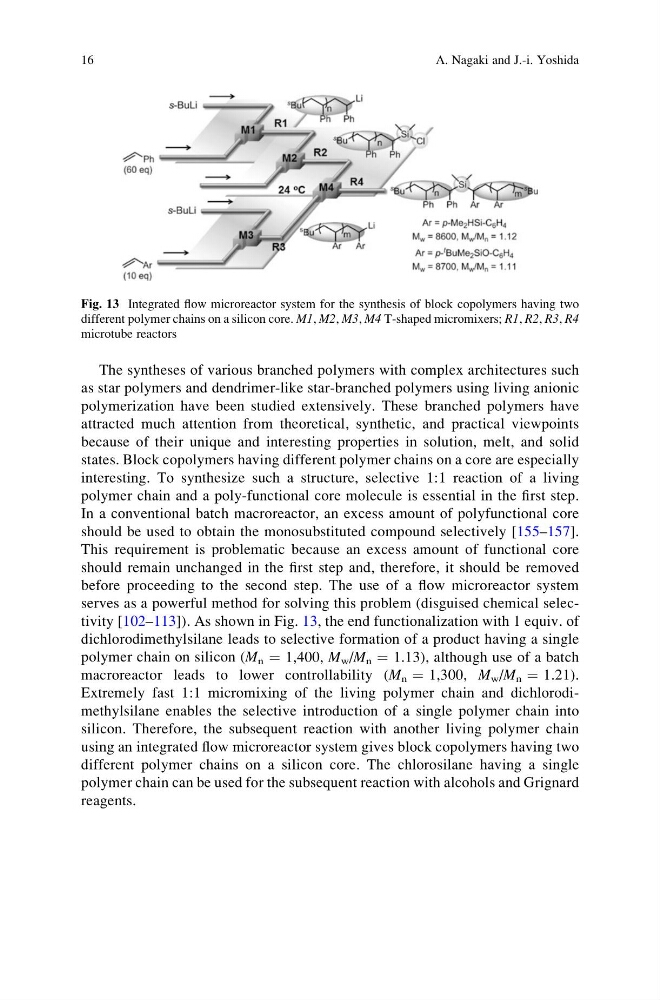
serves as a powerful method for solving this problem (disguised chemical selectivity [102–113]). As shown in Fig. 13, the end functionalization with 1 equiv. of
dichlorodimethylsilane leads to selective formation of a product having a single
polymer chain on silicon (M n ¼ 1,400, M w /M n ¼ 1.13), although use of a batch
macroreactor leads to lower controllability (M n ¼ 1,300, M w /M n ¼ 1.21).
Extremely fast 1:1 micromixing of the living polymer chain and dichlorodimethylsilane enables the selective introduction of a single polymer chain into
silicon. Therefore, the subsequent reaction with another living polymer chain
using an integrated flow microreactor system gives block copolymers having two
different polymer chains on a silicon core. The chlorosilane having a single
polymer chain can be used for the subsequent reaction with alcohols and Grignard
reagents.
Fig. 13 Integrated flow microreactor system for the synthesis of block copolymers having two
different polymer chains on a silicon core. M1, M2, M3, M4 T-shaped micromixers; R1, R2, R3, R4
microtube reactors
16
A. Nagaki and J.-i. Yoshida
as star polymers and dendrimer-like star-branched polymers using living anionic
polymerization have been studied extensively. These branched polymers have
attracted much attention from theoretical, synthetic, and practical viewpoints
because of their unique and interesting properties in solution, melt, and solid
states. Block copolymers having different polymer chains on a core are especially
interesting. To synthesize such a structure, selective 1:1 reaction of a living
polymer chain and a poly-functional core molecule is essential in the first step.
In a conventional batch macroreactor, an excess amount of polyfunctional core
should be used to obtain the monosubstituted compound selectively [155–157].
This requirement is problematic because an excess amount of functional core
should remain unchanged in the first step and, therefore, it should be removed
before proceeding to the second step. The use of a flow microreactor system
serves as a powerful method for solving this problem (disguised chemical selectivity [102–113]). As shown in Fig. 13, the end functionalization with 1 equiv. of
dichlorodimethylsilane leads to selective formation of a product having a single
polymer chain on silicon (M n ¼ 1,400, M w /M n ¼ 1.13), although use of a batch
macroreactor leads to lower controllability (M n ¼ 1,300, M w /M n ¼ 1.21).
Extremely fast 1:1 micromixing of the living polymer chain and dichlorodimethylsilane enables the selective introduction of a single polymer chain into
silicon. Therefore, the subsequent reaction with another living polymer chain
using an integrated flow microreactor system gives block copolymers having two
different polymer chains on a silicon core. The chlorosilane having a single
polymer chain can be used for the subsequent reaction with alcohols and Grignard
reagents.
Fig. 13 Integrated flow microreactor system for the synthesis of block copolymers having two
different polymer chains on a silicon core. M1, M2, M3, M4 T-shaped micromixers; R1, R2, R3, R4
microtube reactors
16
A. Nagaki and J.-i. Yoshida