

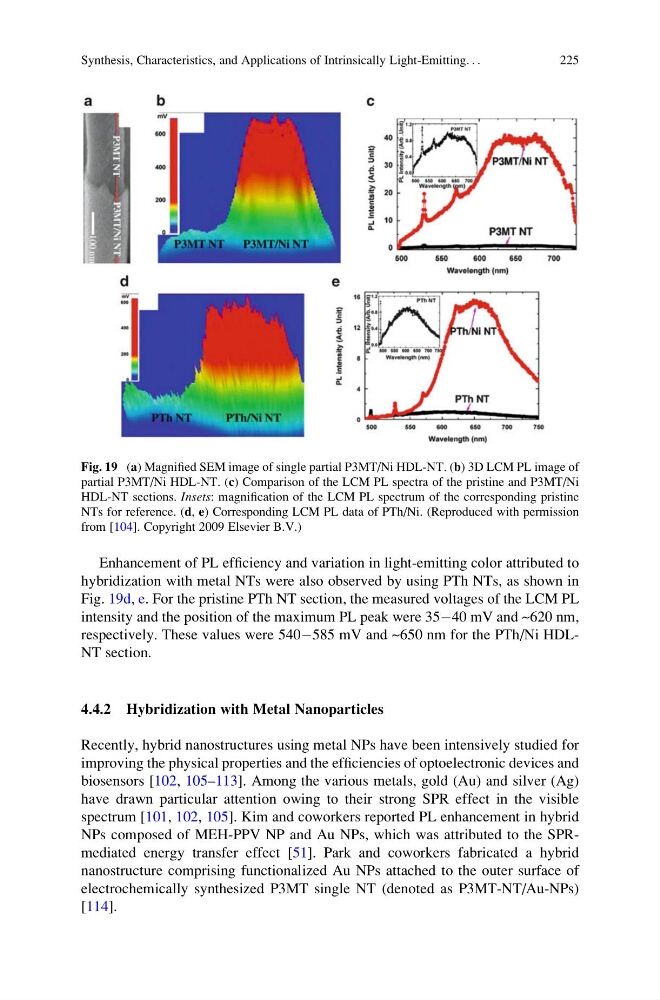
Enhancement of PL efficiency and variation in light-emitting color attributed to
hybridization with metal NTs were also observed by using PTh NTs, as shown in
Fig. 19d, e. For the pristine PTh NT section, the measured voltages of the LCM PL
intensity and the position of the maximum PL peak were 35À40 mV and ~620 nm,
respectively. These values were 540À585 mV and ~650 nm for the PTh/Ni HDLNT section.
4.4.2 Hybridization with Metal Nanoparticles
Recently, hybrid nanostructures using metal NPs have been intensively studied for
improving the physical properties and the efficiencies of optoelectronic devices and
biosensors [102, 105–113]. Among the various metals, gold (Au) and silver (Ag)
have drawn particular attention owing to their strong SPR effect in the visible
spectrum [101, 102, 105]. Kim and coworkers reported PL enhancement in hybrid
NPs composed of MEH-PPV NP and Au NPs, which was attributed to the SPRmediated energy transfer effect [51]. Park and coworkers fabricated a hybrid
nanostructure comprising functionalized Au NPs attached to the outer surface of
electrochemically synthesized P3MT single NT (denoted as P3MT-NT/Au-NPs)
[114].
Fig. 19 (a) Magnified SEM image of single partial P3MT/Ni HDL-NT. (b) 3D LCM PL image of
partial P3MT/Ni HDL-NT. (c) Comparison of the LCM PL spectra of the pristine and P3MT/Ni
HDL-NT sections. Insets: magnification of the LCM PL spectrum of the corresponding pristine
NTs for reference. (d, e) Corresponding LCM PL data of PTh/Ni. (Reproduced with permission
from [104]. Copyright 2009 Elsevier B.V.)
Synthesis, Characteristics, and Applications of Intrinsically Light-Emitting. . .
225
hybridization with metal NTs were also observed by using PTh NTs, as shown in
Fig. 19d, e. For the pristine PTh NT section, the measured voltages of the LCM PL
intensity and the position of the maximum PL peak were 35À40 mV and ~620 nm,
respectively. These values were 540À585 mV and ~650 nm for the PTh/Ni HDLNT section.
4.4.2 Hybridization with Metal Nanoparticles
Recently, hybrid nanostructures using metal NPs have been intensively studied for
improving the physical properties and the efficiencies of optoelectronic devices and
biosensors [102, 105–113]. Among the various metals, gold (Au) and silver (Ag)
have drawn particular attention owing to their strong SPR effect in the visible
spectrum [101, 102, 105]. Kim and coworkers reported PL enhancement in hybrid
NPs composed of MEH-PPV NP and Au NPs, which was attributed to the SPRmediated energy transfer effect [51]. Park and coworkers fabricated a hybrid
nanostructure comprising functionalized Au NPs attached to the outer surface of
electrochemically synthesized P3MT single NT (denoted as P3MT-NT/Au-NPs)
[114].
Fig. 19 (a) Magnified SEM image of single partial P3MT/Ni HDL-NT. (b) 3D LCM PL image of
partial P3MT/Ni HDL-NT. (c) Comparison of the LCM PL spectra of the pristine and P3MT/Ni
HDL-NT sections. Insets: magnification of the LCM PL spectrum of the corresponding pristine
NTs for reference. (d, e) Corresponding LCM PL data of PTh/Ni. (Reproduced with permission
from [104]. Copyright 2009 Elsevier B.V.)
Synthesis, Characteristics, and Applications of Intrinsically Light-Emitting. . .
225