

temperature as well as the template-dissolving organic solvents. It was reported that
lower temperatures in electrochemical synthesis of conducting polymers lead to
enhanced electrical properties owing to the better chain alignment and extended
conjugation length [66].
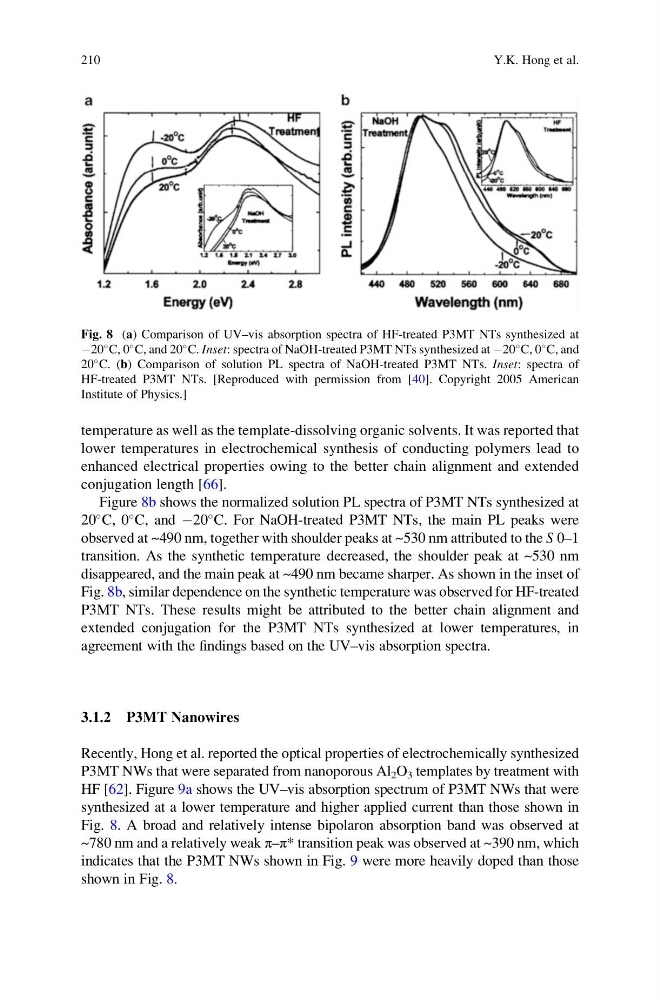
Figure 8b shows the normalized solution PL spectra of P3MT NTs synthesized at
20
C, 0
C, and À20
C. For NaOH-treated P3MT NTs, the main PL peaks were
observed at ~490 nm, together with shoulder peaks at ~530 nm attributed to the S 0–1
transition. As the synthetic temperature decreased, the shoulder peak at ~530 nm
disappeared, and the main peak at ~490 nm became sharper. As shown in the inset of
Fig. 8b, similar dependence on the synthetic temperature was observed for HF-treated
P3MT NTs. These results might be attributed to the better chain alignment and
extended conjugation for the P3MT NTs synthesized at lower temperatures, in
agreement with the findings based on the UV–vis absorption spectra.
3.1.2 P3MT Nanowires
Recently, Hong et al. reported the optical properties of electrochemically synthesized
P3MT NWs that were separated from nanoporous Al 2 O 3 templates by treatment with
HF [62]. Figure 9a shows the UV–vis absorption spectrum of P3MT NWs that were
synthesized at a lower temperature and higher applied current than those shown in
Fig. 8. A broad and relatively intense bipolaron absorption band was observed at
~780 nm and a relatively weak π–π* transition peak was observed at ~390 nm, which
indicates that the P3MT NWs shown in Fig. 9 were more heavily doped than those
shown in Fig. 8.
Fig. 8 (a) Comparison of UV–vis absorption spectra of HF-treated P3MT NTs synthesized at
À20
C, 0
C, and 20
C. Inset: spectra of NaOH-treated P3MT NTs synthesized at À20
C, 0
C, and
20
C. (b) Comparison of solution PL spectra of NaOH-treated P3MT NTs. Inset: spectra of
HF-treated P3MT NTs. [Reproduced with permission from [40]. Copyright 2005 American
Institute of Physics.]
210
Y.K. Hong et al.
lower temperatures in electrochemical synthesis of conducting polymers lead to
enhanced electrical properties owing to the better chain alignment and extended
conjugation length [66].
Figure 8b shows the normalized solution PL spectra of P3MT NTs synthesized at
20
C, 0
C, and À20
C. For NaOH-treated P3MT NTs, the main PL peaks were
observed at ~490 nm, together with shoulder peaks at ~530 nm attributed to the S 0–1
transition. As the synthetic temperature decreased, the shoulder peak at ~530 nm
disappeared, and the main peak at ~490 nm became sharper. As shown in the inset of
Fig. 8b, similar dependence on the synthetic temperature was observed for HF-treated
P3MT NTs. These results might be attributed to the better chain alignment and
extended conjugation for the P3MT NTs synthesized at lower temperatures, in
agreement with the findings based on the UV–vis absorption spectra.
3.1.2 P3MT Nanowires
Recently, Hong et al. reported the optical properties of electrochemically synthesized
P3MT NWs that were separated from nanoporous Al 2 O 3 templates by treatment with
HF [62]. Figure 9a shows the UV–vis absorption spectrum of P3MT NWs that were
synthesized at a lower temperature and higher applied current than those shown in
Fig. 8. A broad and relatively intense bipolaron absorption band was observed at
~780 nm and a relatively weak π–π* transition peak was observed at ~390 nm, which
indicates that the P3MT NWs shown in Fig. 9 were more heavily doped than those
shown in Fig. 8.
Fig. 8 (a) Comparison of UV–vis absorption spectra of HF-treated P3MT NTs synthesized at
À20
C, 0
C, and 20
C. Inset: spectra of NaOH-treated P3MT NTs synthesized at À20
C, 0
C, and
20
C. (b) Comparison of solution PL spectra of NaOH-treated P3MT NTs. Inset: spectra of
HF-treated P3MT NTs. [Reproduced with permission from [40]. Copyright 2005 American
Institute of Physics.]
210
Y.K. Hong et al.